

Search Problem Solvers
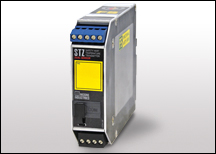 The STZ is the latest in the line of Moore Industries' Associated Intrinsically-Safe (AIS) family of products. The SIL 2/3 capable STZ Functional Safety Dual Input Smart HART® DIN-style Temperature Transmitter with Associated IS sensor connections are certified by exida to IEC61508 for systematic integrity up to SIL 3 and for single use in Safety Instrumented Systems (SIS) up to SIL 2.
The intrinsically-safe -AIS option for the STZ-DIN allows direct connection of sensors located in hazardous locations by including an embedded intrinsically-safe barrier in the front end of the STZ-DIN. The STZ-DIN -AIS is an associated apparatus suitable for mounting in Non-Hazardous or Class I, Division 2/Zone 2 hazardous locations with sensor input terminals connected to sensors or equipment in Class I, II, III, Division 1/Zone 0/1 hazardous locations.
The STZ-DIN configures quickly and easily to accept a single or dual input from a wide array of sensors and analog devices including RTDs, thermocouples, resistance and potentiometer devices, and direct millivolt inputs. The STZ-DIN’s 2-wire (loop-powered) Associated IS transmitter provides an isolated and linear 4-20mA output proportional to the input. This signal is ready for direct interface with a HART or non-HART based Safety System, DCS, PLC, and other SCADA systems.
The STZ is HART and DTM Programmable with user-oriented basic configuration for fast and accurate setup. The STZ-DIN provides HART exception-based reporting and dynamic variable mapping as well as HART Access Control, which allows users to set HART communication to Read Only or Off mode, to prevent unauthorized or accidental reconfiguration while it is performing its safety function.
Check out Moore Industries other Associated Intrinsically Safe products including the newly released THZ3 -AIS Dual Input Smart HART® Temperature Transmitter with the -AIS option for the DIN Rail Mount housing and the reliable universal SPA2IS Programmable Limit Alarm Trip. All these feature the rugged reliability customers have come to rely on from Moore Industries. With these Associated Intrinsically-Safe products there is no need for the additional cost of the IS barrier, cabinet space, high integrity clean ground connection, separate power supply, or custom vendor backplanes. This drastically reduces the cost of purchasing, installation, and maintenance versus more traditional approaches requiring a separate Zener or isolating barrier.
Learn more about the STZ with -AIS, THZ3 with -AIS, and the SPA2IS from our website.
Do you want more information? Download the data sheet. Or visit the catalog.
Need to get price or availability or have a technical question?
Send us a message using E-Help.
Hydrocarbon Processing, October 2007
For about 30 years, it has been a given within the oil and gas industry that intrinsic safety (IS) is the natural technique for explosion-proof protection of electronic instruments. Fieldbus users now want complex processing and digital communications to and from many devices in intrinsically safe applications. The key is delivering enough power to a large number of field devices.
View Article (PDF, 1.9M )
Control Supplement, September 2009
The HART protocol is simple, easy to understand and use, yet powerful and reliable. The HART protocol has become an industry-leading communications technology. Now that HART device use is commonplace and continues to grow, achieving interoperability is the goal of the HART device registration process. Moore Industries looks to lead the way in developing HART 7 technology. Scott Saunders, Vice President at Moore Industries, comments on the new features that will be implemented as part of the HART 7 standard.
View Article (PDF, 1.9M )
Control Engineering, December 2009
Technological advancements such as systems on a chip, multi-core processing and higher levels of integration have led to devices that are smaller, lighter, faster and smarter. These smart devices are bringing industrial applications into a realm of unprecedented product and system performance and efficiency. Building intelligence into devices has also driven diagnostics to the component level. Thus, information from such smart devices must be easily accessible and understood.
Moore Industries Director of Technology Charles Larson discusses the improvements in the software of smart devices that lends to component reliability; even allowing smart instruments to be used in safety applications. Intelligence at the Device features Moore Industries microprocessor-based THZ2 Temperature Transmitter as an example of a smart device with advanced sensing and diagnostic capabilities.
View Article (PDF, 1.2M )
Process Industry Informer, January/February/March/April 2008
Don't get hung up on which fieldbus to choose. Fieldbus is a generic term for a variety of communications protocols using various media, but all are simply a means to an end. What you want at the end of the project is a satisfactory and functional control system. Although Fieldbus is a wonderful technology with many benefits, its installation requires considerations over and above typical 4-20 mA projects. In parts 1 and 2 of this article, MooreHawke fieldbus expert Mike O'Neill discusses how to specify fieldbus power supplies; make segment calculations; implement fieldbus segment termination; select fieldbus cable and wiring and more.
View Article (PDF, 3.0M )
IPP&T Magazine, October 2006
Process plants often have certain locations where explosive or flammable gases and vapors may exist through accidental or unavoidable release. One of our fieldbus experts, Harry Wilson, addresses the various techniques-including Entity vs. FISCO-used in hazardous area installation of fieldbus devices.
View Article (PDF, 1.5M)
Industrial Networking Magazine, April 2005
Mesh networks restore broken links, enhance reliability and show potential for success in control applications. In this comprehensive article, industry experts, including Moore Industries' Scott Saunders, discuss how this emerging network strategy can be implemented.
View Article (PDF, 2.0M)
Control Supplement, September 2011
Moore Industries Director of Engineering Tina Lockhart was quoted in the Control Global 2011 HART Supplement. In the article, she discusses the advantages of utilizing information stored within HART field devices, including the ability to quickly get diagnostic information and the reduction in maintenance costs and disruptions.
View Article (PDF, 900K)
HART LINE Newsletter, September 2000
Estimates indicate that as much as 40 to 50 percent of loop operational problems can be blamed on final control elements. In this technical article, our Director of Professional Development Bud Adler tells how HART communicating valve positioners used in conjunction with HART loop monitors provide an efficient and cost-effective way to test online emergency shutdown valves and increase system integrity.
View Article (PDF, 136K)
HART Communication News, July 2005
The HART Protocol's bi-directional, digital communication capability has given the technology a vital role in testing of safety instrumented systems that protect people, the plants they work in and the environment. Read this article to learn more.
View Article (PDF, 240K)
HART Communication Foundation, October 2004
The HART Communication Foundation (HCF) announced at ISA Expo 2004 that the BP Cooper River Plant in Wando, South Carolina has been selected as one of two recipients of its 2004 HART Plant of the Year Award. The award is given annually to recognize success in the innovative use of HART communications in real-time process applications. A major component of BP Cooper River Plant's winning application includes the use of the Smart HART Loop Interface and Monitor (Model HIM) from Moore Industries.
Applied Automation, May 2008
A simple and cost-effective solution for gathering HART information is to use a HART interface device. Fortunately, HART interface devices make acquiring HART data a fairly simple proposition. Moore Industries Greg Feliks tells how.
View Article (PDF, 1.3M )
HART Communication Foundation, November 2004
Featured in this issue of the HARTLINE newsletter, our HIM HART Loop Monitor now has the ability to confirm that the Fisher® FIELDVUE® DVC6000 Series Digital Valve Controller is performing a partial valve stroke test and, if the test has failed, to alert the user that the ESD valve is stuck.
View Article (PDF, 107K)
IAN Magazine, September 2005
Our new HCS HART Concentrator System earned EXCELLENCE IN AUTOMATION distinction in IAN magazine. The HCS is the simple answer when you need to link smart HART instruments and transmitters with MODBUS-based monitoring and control systems.
View Article (PDF, 122K)
ISA Sensors Technology, September 2001
Even though precise temperature management is crucial to a myriad of applications, "Hundreds of interviews with plant personnel have made it clear to me that most users believe they are making a better temperature measurement than they actually are," said Bud Adler, our Director of Professional Development. In this article, Bud discusses important strategies to improve your overall temperature measurements.
View Article (PDF, 1.0M)
Industrial Networking Magazine, July 2004
What is your definition of a robust industrial network? How about a network that is reliable, immune to industrial noise and environmental issues, secure, and keeps working no matter what? In this article written by Senior Technical Editor Rich Merritt, industry experts, including Moore Industries' Scott Saunders, discuss the practical issues of creating a reliable industrial I/O network.
View Article (PDF, 2.3M)
Control Solutions Magazine, September 2001
Manufacturers will certainly consider widely applying digital fieldbus transmitters and control devices in new plants and for major retrofits. However, given today's money-tight, manpower-short conditions, it is unreasonable to expect users to spend the dollars required to implement a wholesale, field-level instrument retrofit to accommodate new digitally communicating instruments. In this article, our Vice President of Engineering Joe Hage discusses ways to use HART Loop Monitors to "unlock the hidden secrets" of in-place legacy instruments and achieve similar process improvements and diagnostic capabilities as would be available with all-digital strategies.
View Article (PDF, 897K)
Control Engineering Europe, April 2011
Charles Larson of Moore Industries was quoted in the HARTline Newsletter in a story discussing the benefits of HART 7. Larson mentioned that the introduction of HART 7 has "improved the ability of additional data and diagnostic information from devices" along with increasing "the awareness of users to the wealth of information in HART devices that can be used in plant efficiency."
To learn more about our link of Smart HART® loop monitors and interfaces, please visit our selection index.
View Article (PDF, 520K)
Compliance Engineering Magazine, May 2003
With IEC 61508, manufacturers can ensure the functional safety of all aspects of a product's life cycle. In this technical article, Moolifecycleies' Kristina L. Balobeck discusses emerging safety standard IEC 61508. Entitled Functional Safety of Electrical/Electronic/Programmable Electronic Safety-Related Systems, the new standard encompasses all aspects of a products conceptualization, development, manufacturing, and testing of its components.
View Article (PDF, 1.0M)
IAN Magazine, October 2002
We were honored in the special 50th Anniversary issue of IAN magazine with an article chronicling some highlights of our company's history. The article takes a look at innovations introduced during our tenure in process control by comparing industry, and company, progressions with whimsical and interesting happenings of the time. It's a fun read.
View Article (PDF, 556K)
Canadian Process Equipment and Control News, August 2002
"A major challenge that faces natural gas extraction and transport applications is that they are often located in extremely remote locations. Natural gas gathering stations, compressor stations, pipeline feed applications and booster stations all involve the operation of pneumatic control valve actuators that require a pneumatic supply for operation", states Gus H. Elias, our Senior Certifications Engineer. In this article, Gus discusses the use of natural gas as a pneumatic supply in applications where it is impractical or impossible to supply instrument air for valve actuation.
View Article (PDF, 882K)
Control Engineering-Europe Magazine, June 2006
Until now, the only ways to protect plant-critical segments were expensive duplication of an entire segment's hardware, complex software voting schemes, and restricting the number of devices per segment. Our new TRUNKSAFE Fault Tolerant Fieldbus System provides a cost-effective and simple strategy to eliminate this shortfall.
View Article (PDF, 434K)
WNIPT, February 2015
According to the FieldComm Group (formerly the HART Communications Foundation), there are more than 30 million HART-enabled instruments installed in chemical and process plants worldwide, and most process transmitters made today are HART compatible. The HART digital signal often contains valuable process measurements and other variables including instrument status, diagnostic data, alarms, calibration values and alert messages.
However, many systems fail to utilize the critical information available from HART-enabled transmitters, valve positioners, flowmeters and other "smart" devices. This article shows how a HART interface device can serve as a simple and cost-effective solution for gathering HART information.
View Article (PDF, 4.25M)
Control Solutions Magazine, July 2003
Our NCS NET Concentrator® System was featured on the cover and in a special Product Feature in this issue of Control Solutions magazine. Drawing on our 35 years experience in precision transmitter technology, the NCS provides exceptional 20-bit measurement resolution (in contrast to 12-, 14- or 16-bit for comparable I/O systems) and signal conditioning capabilities equivalent to the highest-quality transmitters on the market.
View Article (PDF, 892K)
Control Engineering, March 2009
While extending Ethernet to a PLC or DCS I/O block is very common, the idea of using it to connect to individual process or discrete sensing devices is relatively rare. But is that assessment changing? In this article, Control Engineering magazine's Peter Welander discusses the role of Ethernet based instrumentation in device-level networks.
View Article (PDF, 1.5M )
Engineering and Technology, February 2009
Rob Stockham, our Moore Industries-Europe General Manager and safety expert, look at the latest method being employed by the UK nuclear industry to access control systems in safety-related and safety-critical applications in power stations.
View Article (PDF, 1.6M )
Fieldbus Report, October 2008
Modern DCS systems are major distributed networks with multiple data paths, which, in the interests of security and the highest plant availability, are almost always duplicated and made redundant. This article describes how FOUNDATION fieldbus systems can now incorporate redundancy and fault-tolerance right down to the H1 field layer. The major impact is on project ROI and plant revenues, and only FOUNDATION technology can offer this level of security and benefit to the plant operator.
View Article (PDF, 518K )
Canadian Process Equipment and Control News, December 2000
Our universal temperature transmitters have made front-page news in Canada once again. This time it's the brand-new dual-compartment version of our THZ Smart HART Temperature Transmitter. In addition to amazing accuracy and stability specifications, the THZ comes standard with a process display that shows the real-time temperature reading and the 4-20mA output value. To save you time and money, the THZ transmitter can be ordered as a fully tested, ready-to-install assembly that includes sensor, thermowell. All you have to do is install it into your process, connect a couple of loop wires, and you're in business.
View Article (PDF, 222K)
IAN Magazine, October 2006
Our TG200 TRUNKGUARD® Series Device Coupler earned an Excellence in Automation award for its patented Automatic Segment Termination and unique spur short circuit protection.
View Article (PDF, 593K)
Process Industry News, June/July 2008
One of the new minefields for a product manager is the mandatory European Community (IEC) Harmonised Safety Compliance Directives and Standards, with the most current ATEX directive 94/9/EC. ATEX standard for "Atmosphere Explosives", and it is the law in the EU since July 2003. In this informative technical article, Moore Industries Senior Certifications Engineer Gus Elias helps you negotiate the maze of national and international rules and regulations associated with ATEX.
View Article (PDF, 103K )
HART LINE Newsletter, February 2001
Despite the reliability delivered by today's process transmitters and valve controllers, devices do fail. The more risk associated with a failure, the more important it is to ensure the operational integrity of the device. Our Director of Professional Development, Bud Adler, describes how to use HART Loop Monitors to provide continuous fault loop monitoring and increase plant safety.
View Article (PDF, 487K)
Control Supplement, September 2009
Approximately 80 percent of the Smart HART device population is underutilized, as plants rely on the smart technology only once or twice a year for setup and calibration. Automation professionals can no longer afford to do this. This article explains the simple and easy ways to get the valuable HART device information out into the plant and into the hands of end users to improve plant operations.
"Connecting the HART to the Rest of the Plant," features Moore Industries HIM Smart HART Loop Interface and Monitor that "breaks out" HART data.
View Article (PDF, 2.7M )
Process Heating Magazine, September 2005
While there are many practical and economic advantages to using temperature transmitters, the most basic are to ensure measurement integrity and to convert a temperature sensor's low-level signal to a standard 4-20mA current signal that can be easily accepted by a monitoring and control system. This article discusses the important considerations that should be taken into account when choosing a temperature transmitter.
View Article (PDF, 1.3M)
Control Engineering Magazine, December 2008
Measuring each of the "big four" process variables has its specific peculiarities, but temperature seems particularly controversial. In fact, this apparently simple task often gets complicated. This tutorial explains why.
View Article (PDF, 1.3M )
Control Global, October 2009
In Control Global's examination of the maturation process for fieldbus technology, new fieldbus challenges and tasks such as safety instrumented systems and wireless networking are explored.
MooreHawke's TRUNKGUARD system—the first FOUNDATION and PROFIBUS physical layer solution providing fully automatic fieldbus segment termination—is the article's featured solution for the Abengoa Bioenergy Corporation's greenfield production plant in Ravenna, NE.
View Article (PDF, 2.6M )
Control Engineering Magazine, January 2009
In this day and age, why use serial communications, such as RS-232, RS-422, and RS-485? Control Engineering Editor-In-Chief and industry-experts discuss the continued prevalent use of serial communications because of low cost, simplicity, and familiarity.
View Article (PDF, 442K )
Control Engineering Magazine, September 2002
Managers are increasingly anxious to pull more diagnostic data from their manufacturing processes and link networks to asset management and resource planning systems that can deliver a competitive edge. Jim Montague, News Editor of Control Engineering magazine, discusses how to get more from in-place equipment using products like Moore Industries' HIM Hart Loop Interface and Monitor.
View Article (PDF, 862K)
INTECH Magazine, April 2003
While it may seem primitive and a far cry from today's technologically advanced equipment, the first true temperature measurement came when man decided to put his hand to fire, felt the heat, and decided it would be a better thing to keep his hand out of the middle of the inferno blazing in front of him. In this technical article, one of our temperature experts J.R. Madden describes ways to get tighter and more accurate temperature readings.
View Article (PDF, 837K)
Process Industry Informer, January/February 2007
This article, written by our Director of International Sales, Mike O'Neill, for MooreHawke fieldbus products, details some of the awkward issues that fieldbus users might have to face including hazardous area choices; integrating devices into systems from different manufacturers; redundancy and fieldbus segment fault-tolerance.
View Article (PDF, 165K)
Applied Automation, August 2007
It seems like a simple request. The plant manager calls you into his office and says, "Process Engineering wants to connect six more field instruments to the distributed control system. They've already ordered another analog input board for the DCS, so all you have to do is run six twisted pairs from Unit A to the control Room. Moore Industries expert Gary Prentice explains how a peer-to-peer distributed I/O system is a simple answer to complex problems, such as adding instruments when no spare wiring exists.
View Article (PDF, 895K)
Oil & Gas Product News, July/August 2015
For many temperature applications, getting a high level of accuracy is vital. “A Practical Guide to Improving Temperature Measurement Accuracy” highlights how plant and site engineers can ensure the most accurate temperature measurement for critical applications. Written by National Sales Manager Gary Prentice, the article details steps that can also help end users improve the stability of their measurements and reduce calibration costs.
View Article (PDF, 3.7M)
October 2007
Despite being used inside thermowells for a number of years, rigid temperature sensors are a nightmare for maintenance departments, says Robert Pool, sales engineer at Process Measurements & Monitors, a systems integrator based in Baton Rouge, LA. A solution, however, can be found through the use of flexible sensors from Moore Industries which go where rigid sensors cannot.
View Article (PDF, 3.6M)
Control Engineering Magazine, November 2008
With instrumentation, panel space equals money. In this news exclusive, Control Engineering magazine reviews our new miniMOORE Multi-Channel Signal Isolators and Converters. Reliable and very economical, the miniMOORE family includes 2-wire (loop) and 4-wire (line/mains), powered models.
View Article (PDF, 256K )
Process Heating Magazine, August 2002
While there are many practical and economic advantages to using temperature transmitters, the most basic is to ensure measurement integrity and to convert a temperature sensor's low-level signal to a standard 4-20mA signal that can be readily accepted by a monitoring and control system. Authored by one of our temperature experts Scott Saunders, this article lists aspects to consider when choosing a transmitter.
View Article (PDF, 1.9M)
The Problem
In this application the gas company installed a RTU & Instrumentation for billing purposes to meter the gas sold to a large steel mill. The user installed their own Instrumentation at the same location (gas gate) and needs to compare the readings.

The Solution
The signals from the user installed instrumentation is collected and sent back to the customer's HMI system using Moore Industries' NCS, NET Concentrator System Process Control and Distributed I/O. This was installed in a local junction box in close proximity to existing field instruments. The NCS is acting as a MODBUS master to the gas company's RTU while simultaneously collecting the signals from the end-users instrumentation (Pressure, DP, Temperature Tx’s).
The data arrives at the end-user's DCS and HMI over MODBUS TCP. The OPC* Server was able to utilize the MODBUS/TCP link to the NCS in order to efficiently share the metering signals with the HMI.
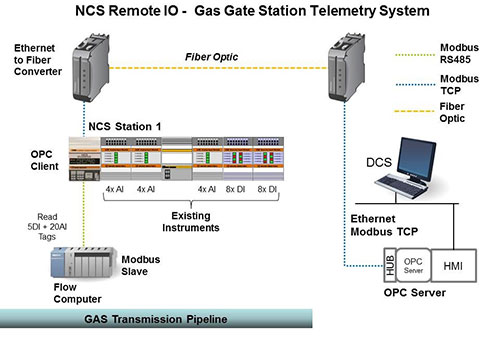
*OPC stands for OLE for Process Control. It is a platform independent open standard that supports the exchange of data between industrial hardware and host systems (OPC Foundation, 2018).
Do you want more information? Download the data sheet. Or visit the catalog.
Need to get price or availability or have a technical question? Send us a message using E-Help.

Q. We would like to use the ECA-DIN in a seismic application. In a worst case scenario of an earthquake, the ECA-DIN must retain its position. We are concerned about the robustness of DIN rail mounting. Is the ECA available with a bolt down option?
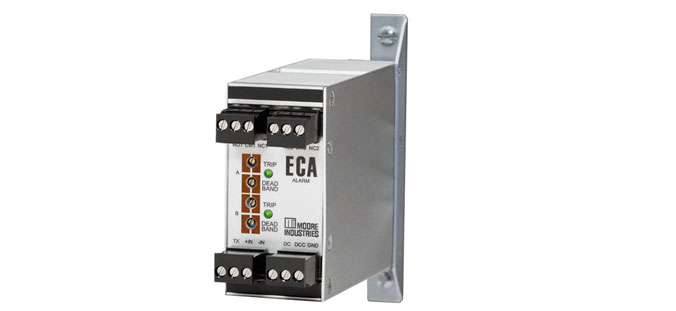
A. We can supply the ECA with side flanges for more robust gearplate mounting instead of the usual DIN rail mounting.
Do you want more information? Download the data sheet. Or visit the catalog.
Need to get price or availability or have a technical question?
Send us a message using E-Help.
A customer in Australia recently reported that one of Moore Industries' early products had been in use for well over 25 years, an EC-DCA Economy Direct Current Alarm (4-Wire). Moore Industries was proud to hear the product had been in constant service for so many years.
Figure 1. EC-DCA After 25 Years Of Service
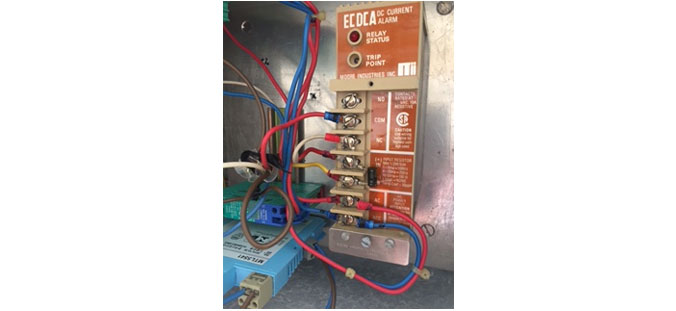
As part of Moore Industries' award winning line of products, the EC-DCA is one of the earliest products manufactured at the company. Although replaced by newer more advanced product designs such as the SPA2 Programmable Alarm Trip, the EC-DCA was a flagship product that demonstrated proven reliability and affordability with multiple input ranges, ease of adjustment by the user, AC or DC power input, and LED relay alarm status indicator, which was cutting edge in the early 70's.
Since many of the products developed are still in use, many of the manuals are kept online for users. If you'd like to see the manual, check it out online.
Do you want more information? Download the data sheet. Or visit the catalog.
Need to get price or availability or have a technical question?
Send us a message using E-Help.
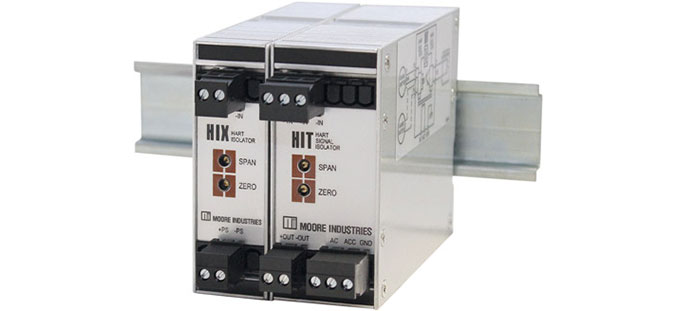
Moore Industries’ HART® Isolators provide highly economical solutions to common and costly problems that plague many of today’s “smart” process loops. Protect and enhance your HART investment with the 2-wire (loop powered) HIX or the 4-wire (line-mains powered) HIT.
Safely share the HART output of one transmitter with a secondary control or recording device. This allows for redundancy without further burden on or risk to a process loop. Protection from surges, spikes and transients of up to 1500Vrms safeguards I/O cards. Add the isolating capability of a HART Isolator to a loop to break the common galvanic path that can pass dangerous overloads from DCS to transmitter to PLC or vice-versa– even when the equipment is supposedly “isolated” already.
Do you want more information? Download the data sheet. Or see all of our HART Isolators in the catalog.
Need to get price or availability or have a technical question?
Send us a message using E-Help.

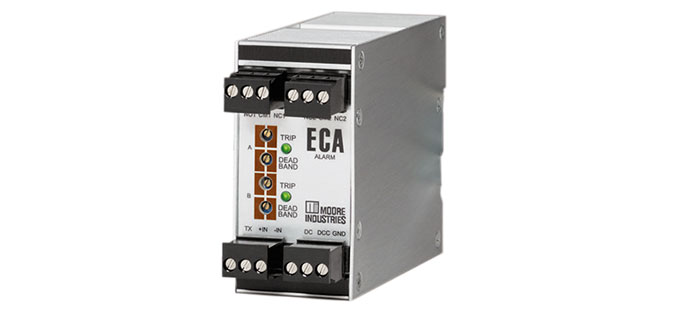
The ECA DIN-style Alarm features a solid metal housing that stands up to the continual rigors of process control and factory automation applications. Rugged and reliable, the 4-wire (line-powered) ECA is the low-cost solution when alarm trip outputs are needed to indicate high or low process conditions. Available models accept current and voltage input from field transmitters, transducers, and other process instruments. When the input falls outside of a pre-set limit (user configurable), the ECA provides contact closure outputs. These are ideal for indicating a high and/or low condition via a bell, buzzer, light or other device.
It features:
- Independently configurable dual alarms
- Wide range of input options
- RFI/EMI Protection
- Fully-adjustable trip point
- LED provides alarm indication
Visit the ECA-DIN in the catalog.
Do you want more information? Download the data sheet. Or visit the catalog.
Need to get price or availability or have a technical question?
Send us a message using E-Help.

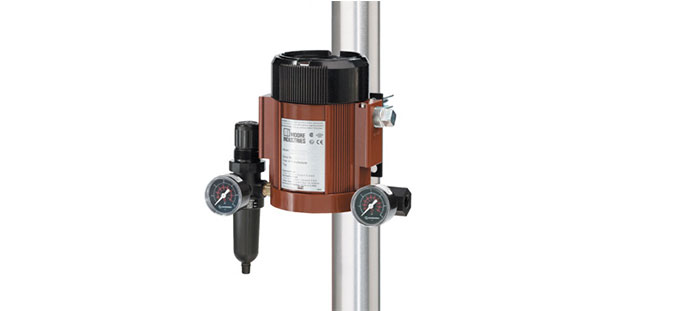
These 2-wire (loop-powered) I/P transmitters accept a current signal (such as 4-20mA) from a DCS, PLC or PC-based control system. They convert the current signal to a pneumatic signal (3-15psig, 0.2-1bar, 20-100kPa, etc.) to provide precise, proportional control of valves, actuators and other pneumatically controlled devices. The economical IPH2 (Type 4X) is watertight, dust-protected, and resistant to corrosion and chemicals. In addition to meeting Type 3X/4X requirements, the IPX2 can be installed in explosion proof environments. Both units are available with an optional coalescing filter/regulator that combines an air filter and miniature supply line regulator with a pressure gauge that reads in both psig and bars.
Features include:
- Wide variety of input and output choices
- Low air consumption and high output volume - output as much as 300SCFH and consume as little as 0.08SCFM
- Accurate and stable - exceptional ±0.25% of span accuracy and six-month stability, they are ideal for precise applications in difficult to access locations
- Immune to supply pressure variation
- Clog Resistant Filtered Nozzle and Orifice
- Removable electronics module
- RFI/EMI protection
Visit the IPX2-IPH2 product pages.
Do you want more information? Download the data sheet. Or visit the catalog.
Need to get price or availability or have a technical question?
Send us a message using E-Help.


On February 28, 2018 the Hazardex International Conference and Exhibition announcedthat Moore Industries was awarded the Event Delegate Award and was a Runner Up in the Contribution to Safety Category for the STZ Functional Safety Dual-Input Smart HART Temperature Transmitter. Contribution to Safety category recognizes a product, system or service which has made a significant contribution to safety in hazardous area environments. The special Delegates Award was voted on by attendees at the 2018 Hazardex event and announced at the Gala Dinner.

The 2018 Hazardex International Conference and Exhibition took place at the Holiday Inn Hotel in Runcorn, Cheshire, UK on February 28 and March 1. Hazardex is a magazine and online site dedicated to providing information on key aspects of legislation, certification, and products for industrial locations that are judged to carry the risk of explosion.

Part of Moore Industries’ FS Functional Safety Series, the SIL 2 and SIL 3 capable STZ Functional Safety Dual Input Smart HART® Temperature Transmitters for your SIS (Safety Instrumented System) configures quickly and easily to accept a single or dual input from a wide array of sensors and analog devices located in hazardous and non-hazardous area.
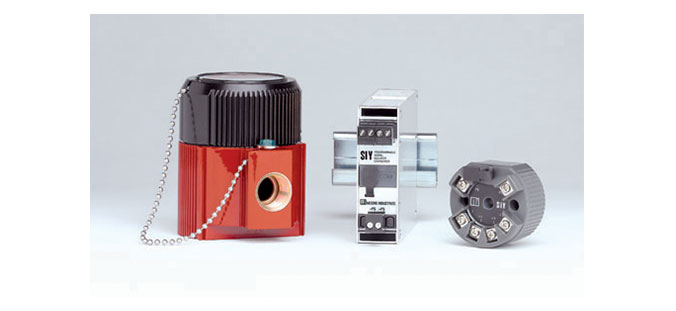
Moore Industries’ SIY PC-Programmable Signal Isolator/Converter combines smart digital technology with an advanced analog operation to deliver superior reliability, accuracy, and ease of use. The highly versatile SIY accepts a wide range of current or voltage inputs. It outputs an isolated, proportional, 4-20mA signal. As a flexible analog/digital hybrid, this 2-wire (loop-powered) transmitter programs in seconds to handle a wide range of important signal interface applications.
Features include:
- Wide range of signal input choices
- Input/output opto isolation - Superior protection against the harmful effects of ground loops and other plant “noise”
- Fast measurement cycle
- RFI/EMI protection
- Enhanced configuration software
Do you want more information? Download the data sheet. Or visit the catalog.
Need to get price or availability or have a technical question?
Send us a message using E-Help.

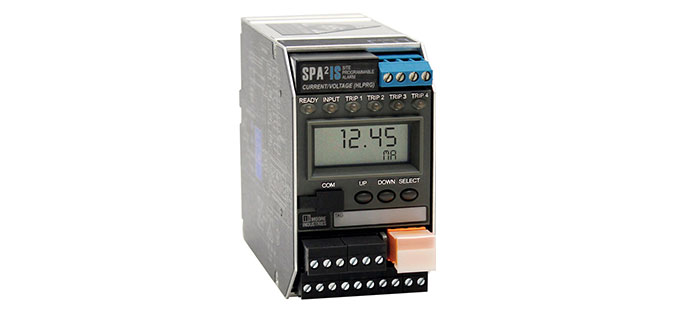
The universal SPA2IS Programmable Limit Alarm Trips provide on/off control, warn of unwanted process conditions, alarm on rate-of-change and provide emergency shutdown. Very versatile, they accept signal inputs from transmitters and temperature sensors that are located in hazardous areas where the method of protection implemented by the plant or facility is Intrinsic Safety. Normally such installations would require the additional use of an intrinsically-safe barrier. The SPA2IS includes intrinsically-safe field connections which provide the necessary protection typically afforded by a galvanically isolated intrinsically-safe barrier.
Do you want more information? Download the data sheet. Or visit the catalog.
Need to get price or availability or have a technical question?
Send us a message using E-Help.

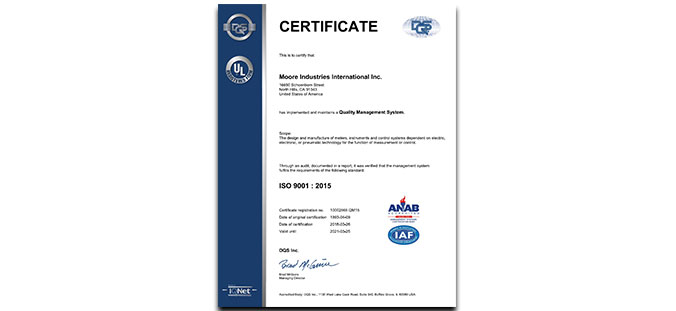
Moore Industries is proud to announce that our ISO 9001:2008 quality management system has been audited and recertified to the latest ISO 9001:2015 version. Our certification is verified evidence that every aspect of our company, from product conception to after sale support, is part of a carefully planned and implemented quality system.
For 50 years, Moore Industries has designed innovations the process industry needs. Since our start in 1968, our continued success is a direct result of listening to your needs, and then providing practical interface solutions.
A sample of our industry-first achievements include:
- Three-way input/output/power isolation as a standard feature to protect against ground loop noise
- Loop-powered hockey-puck designs for safe and simple installation in the field
- Digital cable concentrating/multiplexing technology reduces cost of sending multiple signals long distances
- Total Sensor Diagnostics - patented temperature sensor troubleshooting advantage to save time and money
- Standard high-density DIN-style rail-mount housings
- Unique RFI/EMI protection
- Flexible WORM temperature sensors that quickly install in a thermowell assembly without having to remove the transmitter enclosure or assembly components to save time and money
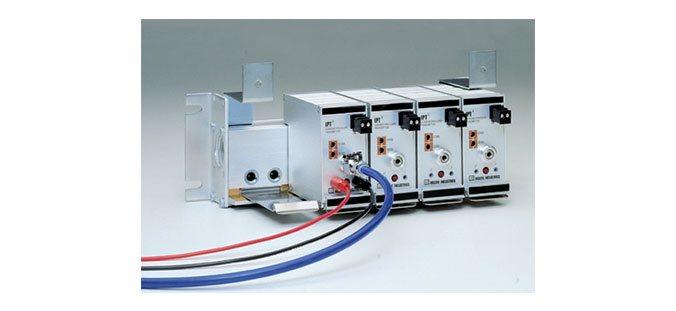
The high-performance IPT2 Current-to-Pressure (I/P) Transmitter converts a current signal to a pneumatic signal so that an electronic-based system such as a DCS, PLC, or PC can control a pneumatic actuator, valve, or damper drive. Available models accept a wide range of current inputs (4-20mA, 4-12mA, and 12-20mA) and provide a proportional pneumatic signal (3-15psig, 0.2-1 Bar, 20-100kPA, etc.).
Features include:
- Wide variety of output and air supply choices
- Low air consumption and high output volume
- High accuracy of ±0.25% of span and a six-month stability rating
- Immune to supply pressure variation
- Clog-resistant design
- Clean start-up
- RFI/EMI protection
The IPT2 is available in a compact, 40mm wide aluminum housing that can be conveniently snapped onto a standard mounting rail or Moore Industries pneumatic header rack. Standard features that raise the IPT2 above the competition include a front panel LED that varies in intensity to reflect the strength of the input current and a built-in orifice cleaning mechanism that eliminates potentially messy clogs. Time-saving equipment such as a pneumatic test jack that simplifies calibration and maintenance is also available.
Do you want more information? Download the data sheet. Or visit the catalog.
Need to get price or availability or have a technical question?
Send us a message using E-Help.

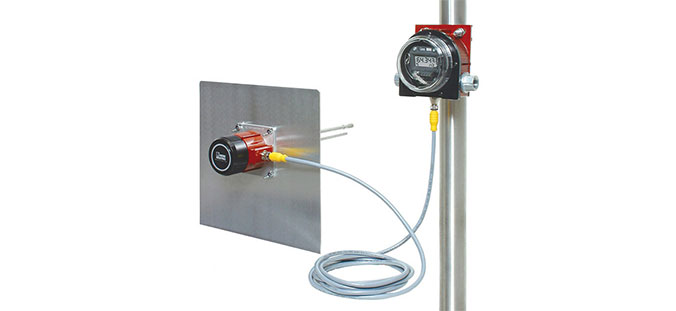
The HTZ Smart HART® Transmitter simultaneously measures humidity and temperature in industrial, commercial, manufacturing, and HVAC applications. Based on the humidity and temperature values, the HTZ also provides a dew point measurement as a calculated variable. The 2-wire (loop-powered) HTZ features dual isolated and scaleable 4-20mA outputs proportional to two of the following (user-selectable): relative humidity (RH), ambient temperature or dew point calculation. The analog output signals are ready for direct interface with HART or non-HART based DCS, PLC and other computer-based systems.
Features include:
- Versatile programming options allow set up with a HART Communicator, a HART-based system or a PC using free PC Configuration Software
- Exceptional measurement accuracy
- Simple maintenance
- Set input failure mode
- Display module shows real-time status of relative humidity, temperature, dew point, analog output #1, analog output #2 or scrolls between all variables in four second intervals
- A wide ambient temperature operating range of -40°C to +85°C (-40°F to +185°F) allows installation in most all environments, indoors and outdoors
Do you want more information? Download the data sheet. Or visit the catalog.
Need to get price or availability or have a technical question?
Send us a message using E-Help.


Since 1968, Moore Industries has been proudly serving process manufacturing businesses and fortune 500 companies in oil, gas, mining, chemical, power generation, water/waste water treatment, pharmaceutical, food, beverage, consumer packaged goods, semiconductor, and biotechnology industries. Moore Industries started out with three employees in California and has grown with offices worldwide in the United States, Australia, Belgium, China, the Netherlands and the United Kingdom.
Today Moore Industries is an award winning company that carries on the original mission of making tough and reliable products. As a world leader in the design and manufacture of interface instruments for industrial process control, system integration, and factory automation, the company’s success wouldn’t have been possible without loyal customers. Customer relationships are the primary focus as Moore Industries will continue to provide nothing less than the best quality in process industry products and exceptional services.
Appreciation for customer service and innovation over the years has led to numerous awards and recognition including multiple Control Engineering Product Recognition awards and Automation Excellence Awards. In 2009 Mr. Moore was awarded one of the process industry’s highest honors, ISA Honorary Membership. He also holds a lifetime membership in IEEE.

“Over the years, we have transformed the company’s analog instrumentation lines and solutions into microprocessor and software based smart instrumentation and control products. An overwhelming amount of the company’s long-term success and tenure within the industry belongs to our devoted and hardworking employees,” comments Scott Saunders, President and CEO.
To learn more about Moore Industries products, go to our product page or watch our video.
Class Cancelled at this Time.

Moore Industries is proud to host exida’s Security Development Lifecycle Training course on October 2 through October 4, 2018 in North Hills, CA. The course is for developers of industrial control system products with a particular focus on network-enabled embedded control systems. The objective is to train Research & Development teams using a combination of lectures and workshops on how to properly and effectively integrate software security assurance practices and techniques into existing software development lifecycles.
Training covers all phases of IEC 62443-4-1 (Product Development Lifecycle Requirements) as well as IEC 62443-4-2 (Technical Security Requirements for IACS components), and the ISASecure™ Software Development Security Assurance (SDSA) certification program. The length of the course is 3 days.
The course includes topics:
- Security Development Lifecycle Introduction
- PC & Networking Best Practices
- System Integration and Maintenance
- Security Management Process
- Software Exploitation
- Security Requirements
- Software Architecture Design
- Threat Modeling Training
- Module Implementation and Verification
- Security Integration Testing
- Security Validation Testing
- Incident response Planning and Execution
- Document Security Guidelines
To register, visit exida’s site here.
To find out about other exida courses go to exida’s training page.
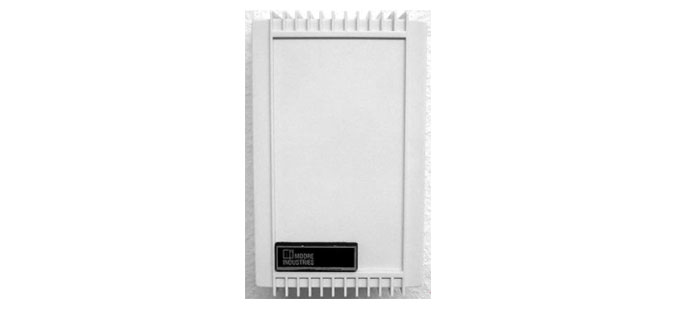
The T2X-DWB Wall-Mount Room Air Temperature Monitoring System delivers the long-term stability of Moore Industries’ T2X transmitter while being enclosed in a durable wall-mounted box. It can be used in a wide range of indoor temperature sensing applications. The PC-programmable T2X-DWB has an internal 1000 ohm RTD for room temperature sensing. It provides a proportional 4-20mA output that is linear with temperature, and ready for direct interface with a monitoring and/or control system.
Features Include:
- Mounts easily to a wall for simple installation
- Sensor placement and vented housing design allow for maximum air flow
- Sets up in a minute or less with single window Intelligent PC Configuration Software
- Provides a proportional 4-20mA output that is ready for direct interface with a monitoring/control system
- Independent input and output scaling capabilities
Do you want more information? Download the data sheet. Or visit the catalog.
Need to get price or availability or have a technical question?
Send us a message using E-Help.

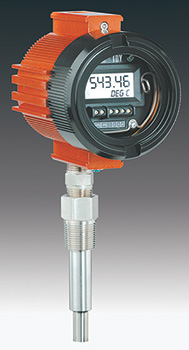
Moore Industries’ universal TDY PC-Programmable Temperature Transmitter features a large integral display that shows real-time process status and valuable loop diagnostic information. Combining smart digital technology with advanced analog operation, the TDY delivers superior reliability, accuracy and ease of use.
- 22 RTD Types (2, 3, or 4-wire; Pt, Cu, or Ni; 10 to 1000 ohms)
- 9 Thermocouple Types (J, K, E, T, R, S, B, N and C)
- Direct Millivolt Sources (-50 to 1000mV)
- Resistance & Potentiometer Devices (0 to 4000 ohms)
The TDY converts the input to an accurate 4-20mA output that is both linear and input scalable-ready to interface to readout instruments, recorders, DCS units and other computer-based SCADA systems.
- The TDY provides the highest accuracy (up to ±0.05°C) for your critical process applications
- Easy-to-read customizable display
- Auto decimal point
- Delivering output updates at least 8 times per second, these transmitters are twice as fast as comparable microprocessor-based instruments
- Sets up in a minute or less
Do you want more information? Download the data sheet. Or visit the catalog.
Need to get price or availability or have a technical question?
Send us a message using E-Help.

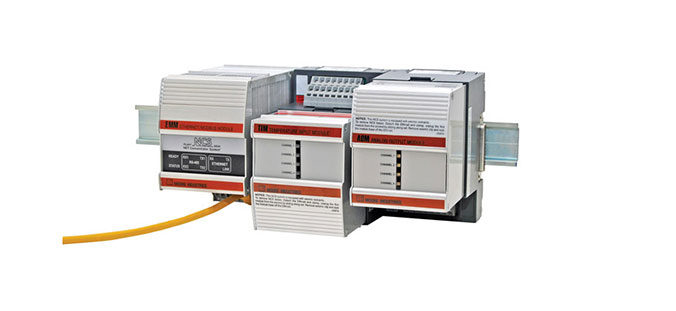
Designed specifically for demanding industrial applications, the NCS NET Concentrator System® provides a real-time signal gateway between the field or factory floor and your control strategy. The NCS is the ideal solution when you need to network new and existing “legacy” process sensors, instruments and final control elements with computer-based monitoring and control systems. Rugged and reliable, it is built to withstand harsh ambient temperature conditions ranging from -40C to +85C (-40°F to +185°F).
Universal and modular, it programs to handle a wide range of signal input and control output possibilities: Current, Voltage, discrete, relay, RTD, Thermocouple, resistance, and potentiometer.
Features include:
- Superior 20-bit input and 18-bit output resolution
- Installs in harsh ambient temperature conditions
- Quick and simple programming
- Industry-standard OPC interface
- Isolation and RFI/EMI protection
- Peer-to-Host and Peer-to-Peer operation
- Transmit any distance, over any terrain
- Data logging capabilities
Do you want more information? Download the data sheet. Or see the NCS module listings in the catalog.
Need to get price or availability or have a technical question?
Send us a message using E-Help.
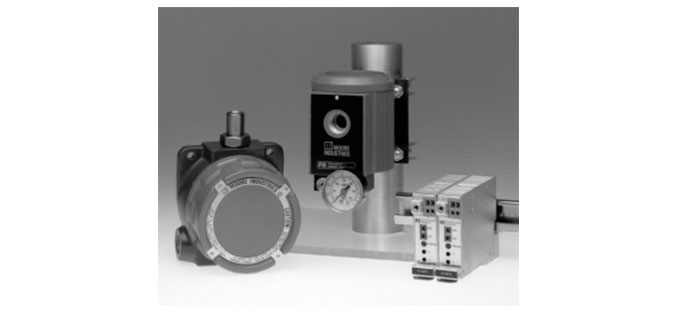
Moore Industries’ family of pressure-to-current transmitters provide an economical solution when a pneumatic device must interface with a data acquisition control system, controller, recorder, or another electronic instrument.
These compact, yet powerful units accept a pneumatic signal (3-15 psig, 0.2-1 bar, 3-27 psig, etc.) and accurately convert it to a proportional 4-20mA (or 10-50mA) output.
Our complete line of P/I transmitters includes models perfect for both control room and field mounting. Moore Industries’ P/I transmitters are available with a wide variety of housings, and with special features and options.
Features include:
- Immune to shock, vibration and position. Perform with exceptional accuracy (±0.2% of span) even in unstable environments
- Mount in any position without performance loss
- Long, trouble-free service life
- Self-sealing pneumatic connection
Do you want more information? Download the data sheet. Or visit the catalog.
Need to get price or availability or have a technical question?
Send us a message using E-Help.

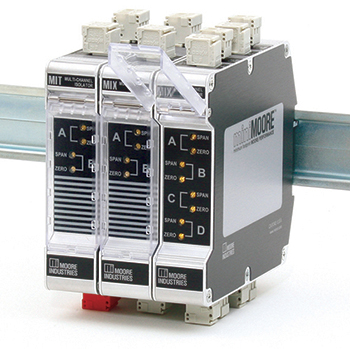 Featuring a very narrow installation footprint, miniMOORE™ Signal Isolators, Converters, Boosters and Splitters combine multiple analog signal channels in a rugged, easy-to-install signal conditioner. Reliable and very economical, the miniMOORE multi-channel family includes the model MIX 2-wire (loop) and the model MIT 4-wire (line/mains) powered models. The complete family delivers cost-effective solutions for an expansive range of signal interface applications.
Features include:
- High-density, 2- and 4-channel configurations
- Switch-selectable current/voltage inputs. The 2-channel miniMOORE models provide DIP switches for selecting input types of 4-20mA, 0-5V, 1-5V or 0-10V for each channel
- 2-wire (loop) and 4-wire (line/mains) powered
- Superior signal isolation
- Universal AC/DC power input
- RFI/EMI Protection
Visit the MIX / MIT product page.
Do you want more information? Download the data sheet. Or visit the catalog.
Need to get price or availability or have a technical question?
Send us a message using E-Help.

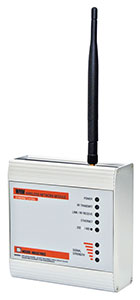 The WNM is a bi-directional, spread spectrum radio modem that delivers the flexibility and cost-saving advantages of wireless data transmission. It is ideal for use with Moore Industries’ NET Concentrator System® (NCS), as well as other SCADA and distributed I/O systems. The WNM is a bi-directional, spread spectrum radio modem that delivers the flexibility and cost-saving advantages of wireless data transmission. It is ideal for use with Moore Industries’ NET Concentrator System® (NCS), as well as other SCADA and distributed I/O systems.
The WNM employs Spread Spectrum Frequency Hopping technology, 128-bit AES (Advanced Encryption Standard) encryption, 32-bit CRC (Cyclic Redundancy Check) error detection, and ARQ (Automatic Resend Query) to provide robust and secure communications. The Spectrum Frequency Hopping technique ensures reliable, noise and interference immune, license-free wireless communications.
Features Include:
- Standard Operating Frequencies - Available models operate at frequency ranges of 902-928MHz or 2.4-2.4835GHz (RF ranges and power factory configured per country)
- Long-Distance Data Transmission - The 902-928MHz units can transmit up to 30 miles(48km); 2.4-2.4835GHz units provide up to 15 miles (24km) transmission range. WNM modules configured as repeaters allow for virtually unlimited transmission range
- Supports Ethernet and Serial Communications
- Plug-and-Play Installation and Operation
- No Regulatory License Required
Visit the WNM product page for more information.
Do you want more information? Download the data sheet. Or visit the catalog.
Need to get price or availability or have a technical question?
Send us a message using E-Help.

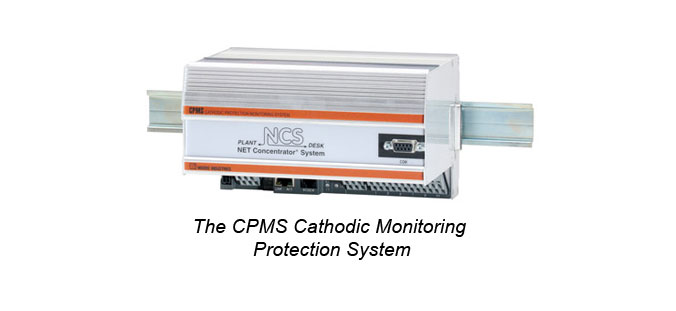 The CPMS Cathodic Protection Monitoring System monitors above and below ground impressed current cathodic protection systems to ensure that proper corrosion protection is in place and operating at the right levels. The CPMS Cathodic Protection Monitoring System monitors above and below ground impressed current cathodic protection systems to ensure that proper corrosion protection is in place and operating at the right levels.
Part of Moore Industries’ NET Concentrator System® family of intelligent distributed I/O, the CPMS monitors the critical current and voltage levels of one or two transformer rectifi ers used in cathodic protection systems. Each module provides four or eight, fully-isolated analog input channels and four discrete (contact closure) inputs. It “concentrates” this data onto one or multiple communication links, and transmits it long distances back to one or more host DCS, PLC or PC-based control systems.
The CPMS accepts up to four discrete (contact closure) inputs from the monitored system. Using an internal control engine, the CPMS can be programmed with internal set points that relate to normal operating conditions within the cathodic protection system. Should monitored parameters go outside of selected limits, or if power to the cathodic protection system is lost, the CPMS alerts of the unwanted conditions at the control system over the data link.
In addition to operating in a stand-alone mode, the CPMS integrates with any of Moore Industries’ NET Concentrator System’s analog, temperature, discrete and relay I/O modules. When coupled with the ROM (Relay Output Module), relay outputs can control rectifiers using accurate GPS time to facilitate taking cathodic protection reference electrode readings.
Features Include:
- Simultaneous dual MODBUS RTU and Ethernet communications
- MODBUS RTU master capability
- Installs in harsh environments
- Quick and simple programming
- Data logger with battery back-up
- Advanced control and math capabilities
- GPS Time feature
Visit the CPMS product page. Download the CPMS data sheet.
Need to get price or availability or have a technical question?
Send us a message using E-Help.
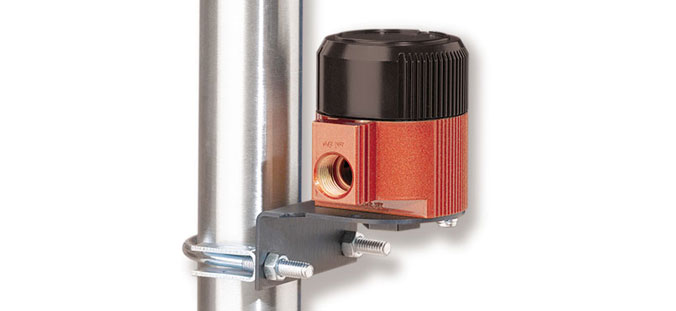 Moore Industries’ durable PIH Pressure-to-Current Transmitter provides an economical solution for any process that requires a rugged instrument capable of interfacing a pneumatic device with a data acquisition/control system, controller, recorder, or other electronic instruments. Moore Industries’ durable PIH Pressure-to-Current Transmitter provides an economical solution for any process that requires a rugged instrument capable of interfacing a pneumatic device with a data acquisition/control system, controller, recorder, or other electronic instruments.
This compact yet powerful unit accepts most pneumatic signals (3-15 psig, 0.2-1 bar, 3-27 psig, etc.) and accurately converts them to a proportional 4-20mA output. The PIH is perfect for field mounting. Its metal casing makes it a tough field-mount unit when you need strength without the added expense of an explosion-proof enclosure.
Features Include:
- Perfect for harsh field environments
- Saves installation costs
- Immune to shock, vibration, and proportional
- RFI/EMI protectionReverse Output Option
- Visit the product page & download the PIH data sheet.
Need to know more about a product, price or availability? Check out the PIH Pressure-to-Current Transmitter
Do you want more information? Download the data sheet. Or visit the catalog.
Need to get price or availability or have a technical question?
Send us a message using E-Help.

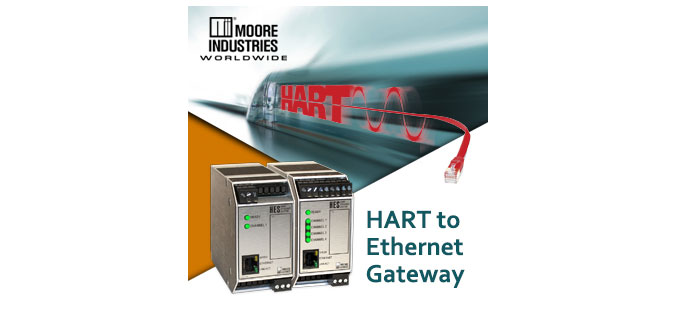 Timely knowledge about your process enables better decisions and faster preventive action. Now you can get the process detail that you need from your Smart HART devices to MODBUS/TCP and HART-IP based monitoring and control systems at the speed of Ethernet with the HES HART to Ethernet Gateway System from Moore Industries.
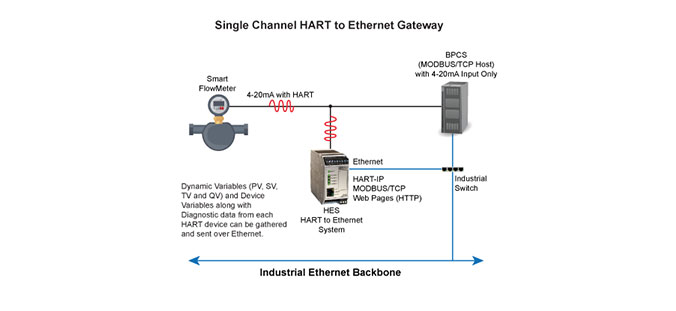
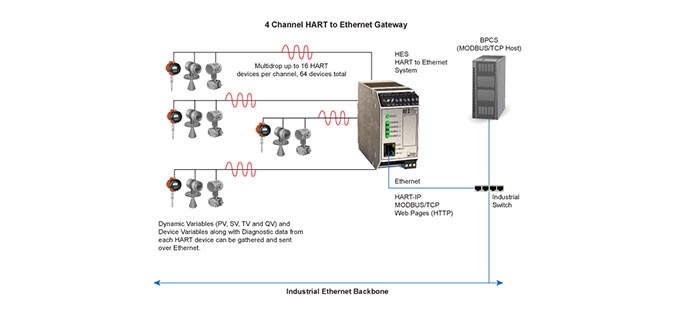
Connect up to 64 Smart HART devices to the HES and collect the Dynamic Variables and the Device Variables, along with diagnostic bits and bytes, from each device that helps deliver critical information needed to help you address process and device problems before they turn into unplanned downtime.
Whether you need data from one device or many, the HES meets your need with a single channel and four channel configurations. The single channel configuration supports up to 16 HART devices in digital multidrop mode, or it can support one device in a standard point-to-point 4-20mA loop configuration. The four channel configuration can support up to 64 total HART devices for high-density installations.
The HES supports HART field devices both old and new with HART 5, 6 and 7 revisions, including devices such as Coriolis, magnetic, vortex, ultrasonic and multivariable mass flowmeters along with pressure, pH, level, temperature transmitters, and even smart valve positioners. Its robust memory capacity can handle thousands of process variable and diagnostic data points from connected smart HART devices.
The HES is simple to configure over Ethernet using PACTware or other FDT compliant host with supplied HES DTM. Easy-to-use menus give you the ability to fully configure the HES including HART channel communications, MODBUS communication, and mapping settings and network security parameters.
You can view all of the HART data from connected field devices in read-only mode with any web browser via the HES’ built-in web server or a MODBUS/TCP compliant host. The HES also supports HART-IP, which allows you to monitor any of the connected HART device variables, HES variables, or diagnostics. Support for these open industrial protocols enables interface with any process control or asset management system while taking advantage of any Industrial Internet of Things (IIoT) initiatives that facilitate the propagation of process data to higher level corporate or analytical systems.
The new HES continues the Moore Industries reputation for rugged and reliable products that are designed and built to perform dependably year after year.
Demand Moore Reliability
Do you want more information? Download the data sheet. Or visit the catalog.
Need to get price or availability or have a technical question?
Send us a message using E-Help.

HART LINE Newsletter, June 2000
Most users of smart HART devices know how to use their hand-held HART Communicators for configuration and for the occasional loop check. Few, however, take advantage of the inherent capability of HART devices to provide valuable diagnostic and preventative maintenance information. In this article, Bud Adler, our Director of Professional Development, discusses the benefits of using HART Loop Monitors to "look inside" smart valves and transmitters, and determining what is wrong and even predicting problems before they occur.
View Article (PDF, 53K)
Canadian Process Equipment & Control News, March 2000
Our very affordable THZ Smart HART Temperature Transmitter was chosen by the editor of Canada's leading industrial-process-controls magazine for its exceptional accuracy (better than twice that of comparable transmitters). The THZ sets up with a standard hand-held HART communicator, with an AMS, or with our free PC-based configuration program featuring a comprehensive on-line help system called HelpMap.
View Article (PDF, 392K)
Plant Services Magazine, February 2000
A new breed of smart transmitters can help optimize maintenance and operations by putting the user in control. Our temperature expert and Vice President of Engineering Joe Hage covers how the powerful features of smart temperature transmitters increase functionality, speed installation, sharpen measurement accuracy, trim maintenance costs, and provide a wealth of valuable diagnostic information.
View Article (PDF, 920K)
Control Magazine, January 2000
For 8 YEARS IN A ROW, we've been voted #1 for Signal Interface instruments by process instrumentation users. We are also very proud to be rated the #2 choice for temperature transmitters (against some pretty big competition), and the VERY BEST in customer service for both signal interface and temperature transmitter technology.
View Article (PDF, 88K)
IAN Magazine, January 2000
Our smarter-than-smart TDZ HART Temperature Transmitter was chosen by Patricia Pool, the Editorial Director of Instrumentation & Automation News (IAN), for the front and center cover position of this millennium's first issue of IAN magazine. The TDZ features industry-leading measurement accuracy, an easy-to-read process display, and FM hazardous area approvals.
View Article (PDF, 115K)
Control Magazine, December 1999
The last issue of the millennium of Control magazine, a leading technical publication in the United States, includes an excellent article entitled "100 Years of Process Automation." It impressively chronicles scientific breakthroughs and innovations in the process industries over the past century. Featured in the article, in the historical timeline, is our CCS Cable Concentrator System. Listed as a forerunner of the modern fieldbus strategies, the CCS's ability to concentrate hundreds of analog and discrete signals onto one twisted wire pair made history when it was first introduced in 1987. For information on our CCS Cable Concentrator System, and our other lines of money-saving, intelligent distributed I/O products, see our selection guide.
Control Magazine, September 1999
In this exclusive product review, Joe Hage (our Vice President of Engineering) states proudly that "The TDZ is so accurate, you could actually use it as a precision current source to calibrate process instruments." Take a look at this article, and the TDZ data sheet, and you'll see why Joe has good reason to be proud. The TDZ's universality, large process display, long-term stability and HelpMap interactive help guide are just a sample of the advanced features covered in the article.
View Article (PDF, 109K)
I&CS Magazine, August 1999
I&CS Magazine's Senior Technical Editor, Tom Polischuk, gives our new THZ Smart HART Temperature Transmitter a glowing review. He draws special attention to the instrument's exceptional accuracy when matched with our precision RTD thermowell assemblies.
View Article (PDF, 101K)
Process Heating Magazine, June 1999
Moore Industries' temperature expert Gary Prentice explains the top reasons why temperature transmitters are a better choice than direct wiring RTD and Thermocouple sensors directly back to a readout/control system. Colorful illustrations and photographs reinforce Gary's argument.
View Article (PDF, 384K)
Control Engineering Magazine, June 1999
In this sidebar to Control Engineering's feature article on multivariable transmitters, Moore Industries' Senior Applications Specialist Matt Moren tells how a Smart HART Loop Monitor will facilitate the migration to smart instruments.
View Article (PDF, 34K)
I&CS Magazine, June 1999
High-accuracy temperature transmitters matched with precision sensors will cost you a little more initially, but will save you time and money in the long run by improving yields and reducing maintenance costs. Applications specialists Lori Risse and Greg Vonada provide an in-depth analysis of the advantages of high-accuracy temperature strategies.
View Article (PDF, 291K)
CONTROL Magazine, January 1999
For seven years in a row, Moore Industries has been selected as the Number 1 choice for Signal Conditioners by the readers of top industry publication CONTROL magazine.
The ranking is based on a comprehensive survey of instrumentation, process, systems, and plant engineers in every segment of the process industries. We also earned high marks for our responsive Customer Service and Smart Temperature Transmitters.
View Details (PDF, 58K)
Control and Instrumentation Magazine, 1999 Product Survey Directory
Authored by Rob Stockham, General and Marketing Manager of Moore Industries-Europe, this article discusses the cost and time-saving benefits, and performance-enhancing advantages of using intelligent temperature transmitters in place of direct wiring schemes.
View Article (PDF, 124K)
I&CS Magazine, September 1998
The use of smart loop monitors can save manpower costs and maintenance time, and prevent false shutdowns. This article by Joe Hage, Moore Industries' Vice President of Engineering, describes the advantages of using loop monitors, such as Moore Industries' SPA HART Alarm, in important monitoring scenarios.
View Article (PDF, 410K)
Control Systems Magazine, October 1998
Process signal conditioning was born out of the need to deal with the myriad of process signal types. Rob Stockham, General and Marketing Manager of Moore Industries-Europe, recalls the history of signal conditioning and looks to its future.
View Article (PDF, 121K)
Control Engineering Magazine, June 1998
On the surface, direct wiring temperature sensors directly to your DCS or PLC seems cheaper. But in the long run (especially with long sensor runs) is it really? Lori Risse, Marketing Research Specialist for Moore Industries, gives the basics of why using temperature transmitters is better than direct wiring sensors to your readout and monitoring systems.
View Article (PDF, 58K)
SENSORS Magazine, September 1997
To be sure of getting the temperature measurements you need for a process application, brush up on the options you'll have to consider when selecting an RTD. In this technical article, Moore Industries Application Engineer J.R. Madden tells what you should keep in mind when choosing an RTD for your application.
View Article (PDF, 359K)
I&CS Magazine, June 1997
Moore Industries prides itself on being customer-driven. In this article by Consulting Editor Jack Hickey, Len Moore, Moore Industries' founder and chairman of the board, talks candidly about the company's past, present, and future.
View Article (PDF, 497K)
I&CS Magazine, June 1997
Smart HART transmitters and valves are capable of providing a wealth of information beyond a simple 4-20mA process measurement. Yet they are rarely employed to do so because most monitoring and control systems won't handle HART digital data. Peter Cleaveland, Senior Technical Editor, discusses how Moore Industries' industry-first SPA Site-Programmable HART Alarm can help you take full advantage of the HART protocol.
View Article (PDF, 194K)
Plants in many industries have large demands for clean water. Monitoring and controlling the flow rate is critical for billing and usage requirements.
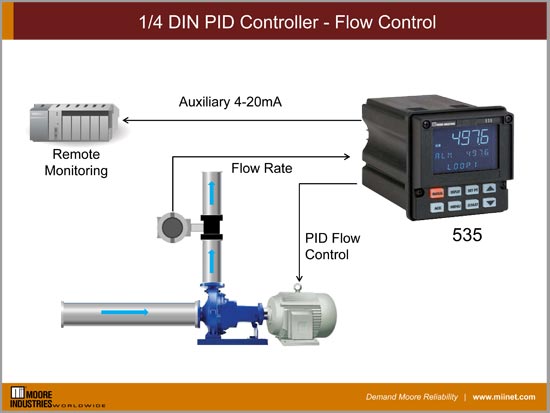
When accurate and repeatable flow control is required, consider the NEMA 4X Model 535 ¼ DIN Single Loop Controller. This versatile yet easy to program controller can perform P, PI, or PID control with built-in auto-tuning and other advanced programming features. The controller features a large vacuum fluorescent display with a large five-digit upper display and two nine-character lines of alphanumerics. In addition to the CV (Control Variable) output, up to three additional relay or analog outputs can be configured.
Key Attributes:
- Easy to setup and configuration menu
- Easy to use PID auto-tuning
- Large display and additional outputs

Water plants usually have several filter beds that are controlled by a DCS, PLC or PID controller. However, there are times when manual control close the filter bed is needed by a plant operator.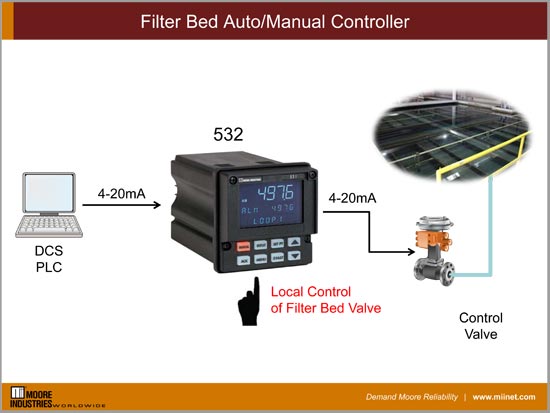
When this need arises, look to the 532 ¼ DIN Auto/Manual Station. The Nema 4X UL approved 532 allows the control signal (CV) to pass through the controller to the final control element in the normal mode. When local control is required the operator simply presses the MANUAL button on the controller to take control of the 4-20mA signal that is driving the final control element. The 532 features a large vacuum fluorescent display with a large five digit upper display and two nine character lines of alphanumerics. Additionally, soft and hard alarms can be set to notify when the 532 has been put in local MANUAL mode.
Key Attributes:
- Easy to use push button auto/manual station
- Large display with local indication of PV and CV
- NEMA 4X case with UL Approval

Pharmaceutical facilities have critical monitoring points that if not measured closely could cause serious injury to personnel. Often these critical signals need to be shared with other control devices and wiring them in series with one another is not always a good idea since a failure at one receiving device renders the loop open, or in a failed state. Pharmaceutical facilities have critical monitoring points that if not measured closely could cause serious injury to personnel. Often these critical signals need to be shared with other control devices and wiring them in series with one another is not always a good idea since a failure at one receiving device renders the loop open, or in a failed state.
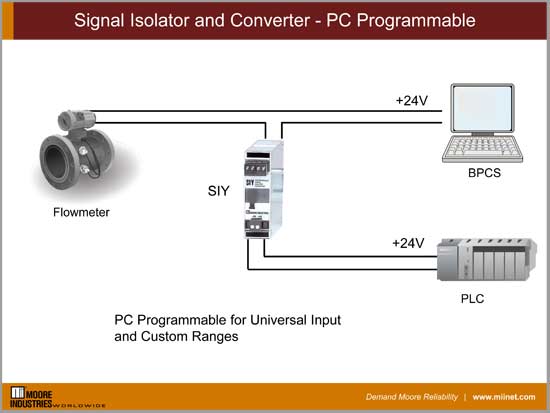
If you have critical loops like these consider looking to the SIY PC Programmable Signal Isolator. The SIY is a rugged and reliable two-wire, output loop powered isolator that can be PC programmed for just about any input, standard or special range. Additionally, the SIY allows you to create custom curves for those non-linear signals. This form of area isolation affords you the protection and added safety by not having to worry about losing your primary control loop when you work on your secondary backup-side loop, and vice versa.
Key Attributes:
- SIY is PC programmable for just about any input range
- Field mount version available with worldwide hazardous area approvals
- No exposed potentiometers for unauthorized calibration or adjustments
Process rooms and ventilation systems require tight humidity control in pharmaceutical facilities. Process rooms and ventilation systems require tight humidity control in pharmaceutical facilities.
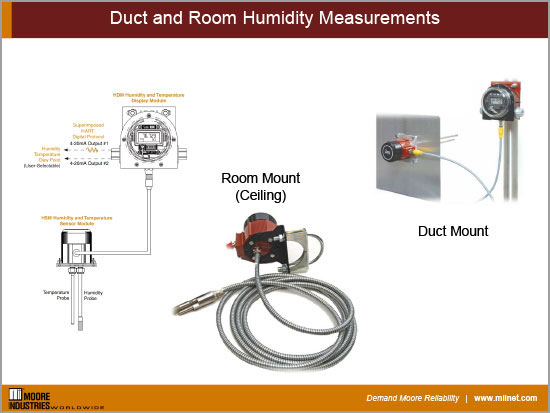
The HART Smart HTZ Humidity and Temperature Transmitter allow the accurate monitoring of humidity, temperature and dew point. Two probe designs off the flexibility for either duct mount or room monitoring. The duct mount sensor assembly comes standard with a mounting plate and wing nuts to ensure a well-sealed process connection. The room mount version features a flexible armor cable sensor that can be mounted from the ceiling so the height of measurement can be easily adjusted. Moreover, this flexible sensor prevents accidental damage since the equipment is often moved around in batch processing areas.
Key Attributes:
- Humidity or Dew Point Measurements
- Programmable via HART or Free Intelligent PC programming software
- Flexible sensor design allows mounting in small process rooms at adjustable heights