

Search Problem Solvers
 Moore Industries has released a new video showing how PACTware has been integrated into the range of monitoring and configuration options available with the new THZ3 and TDZ3 Dual Input Smart HART Temperature Transmitters. In the video below, Moore Industries’ Customer Service Director Bob Croughwell walks viewers through the steps needed to setup and monitor transmitters with PACTware
The THZ3 and TDZ3 transmitters are DTM and HART programmable with user-oriented basic configuration for fast and accurate setup. Users can program or monitor the transmitters with any FDT compliant host or program – such as PACTware – using the THZ3 and TDZ3 DTM. PACTware is gaining acceptance with customers worldwide who want a consistent and universal way to program, monitor and diagnose field devices.
Q: Do you have or do you know of a product that will filter out AC noise on an unshielded pair of wires carrying a 4-20mA signal over a distance of approximately 400 feet?
Top of Form
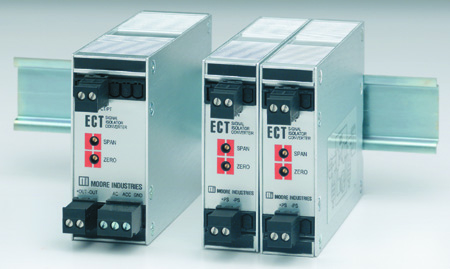
A: Any of our isolators have a common mode rejection AC filtering capability and can be used for this kind of application.
One popular and versatile option for this is our ECT line. You can see it for yourself by checking out the datasheet, which contains all three types (input loop powered, output loop powered, and line powered.)
Do you want more information? Download the data sheet. Or visit the catalog.
Need to get price or availability or have a technical question?
Send us a message using E-Help.
If Moore Industries has a secret weapon, it might be our Machine Shop.
The ability to produce our own parts and perform customization to existing products to meet customer specifications is one of the important ways that we set ourselves apart from our competition. The Machine Shop is able to produce a high volume of parts to exacting detail each month thanks to advanced technology and the knowledge and dedication shown by the nine-person team. Learn more about the Machine Shop by watching the video below:
 Moore Industries-Europe has a new employee. Steve Evans has recently joined the company as a sales engineer in the UK. He will be assisting Moore Industries with sales in the northern part of England stretching from Manchester and Liverpool up to the border with Scotland. Steve brings a wealth of experience to Moore Industries, with more than 25 years of control and instrumentation experience in various sectors in the UK including process plants, power and water utilities, chemicals and food and beverage.
Steve started his career as an Apprentice Instrument Technician, working on the repair and calibration of instruments related to microwave satellite communication power amplifiers. His experience with ATEX/IECEx certified sensors and systems for use in Hazardous Zone Areas for flow, level, pressure, temperature and gas detection, along with his knowledge of EX product certifications and approvals, will be a major benefit to Moore Industries as we continue to expand our Functional Safety lines in the UK.
“My approach has always been solution selling and putting myself in the place of the customer,” Steve said. “Moore Industries has a range of reliable field interface products with SIL2/3 approvals to ensure that customer processes and systems perform to their optimum capability which is underwritten by their personal support and product knowledge.”
Welcome to the team, Steve!
Q: Could you let me know the specific instances where the Fault Alarm trips on the STA Safety Trip Alarm are used?
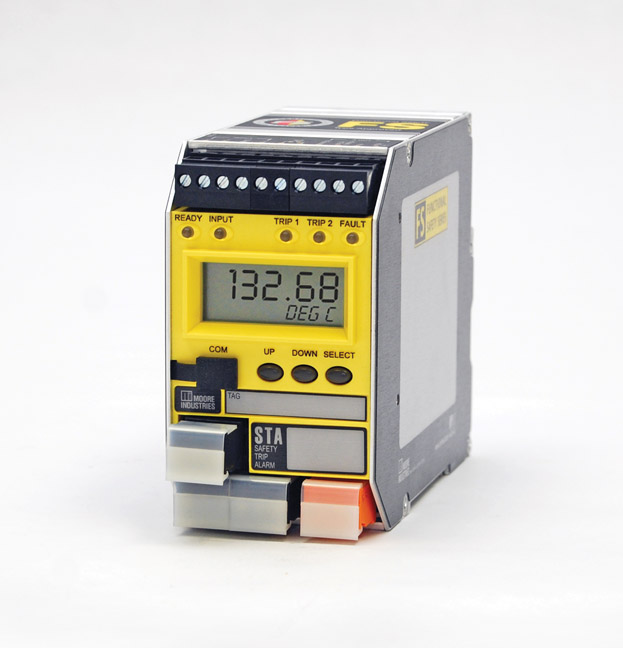
A: The Fault Alarm (Alarm #3) is permanently set as a latching fault alarm that will trip if internally diagnosed faults or external faults – such as the loss of sensor or a “bad quality input” – occur. This alarm will trip without affecting the other relays being used to monitor the process. It can be used to warn of a failure without tripping more critical process alarms or shutting down the process.
More information can be found on Page 58 of the STA/TPRG Installation Manual.
Do you want more information? Download the data sheet. Or visit the catalog.
Need to get price or availability or have a technical question?
Send us a message using E-Help.
Moore Industries’ reps are always hard at work helping customers. Here’s a look at some recent examples of how our reps were able to use Moore Industries’ products to solve their customers’ real-world problems:
- A customer in Salt Lake City, Utah was in the process of expanding their refinery. As part of the expansion, they needed two cabinets with up to 12 DIN transmitters in each and the transmitters needed to be Intrinsically-Safe (I.S.). In addition, there was a larger pending job for 166 field-mount transmitters with displays.
Regional Sales Manager Charlie Fetty worked with salesmen Carl Wilmarth and Scott Anderson at LaTech Equipment to come up with a solution: using a single transmitter for all their needs. The TDZ2 Smart HART Temperature Transmitters with DIN clips were used instead of traditional DIN-mount transmitters. This gave the customer his I.S. certification and the added benefit of the display. For the field-mount application, the TDZ2 was simply supplied with the BH housing. The result was a sale of almost $85,000.
- DanCo Systems has sold more than 100 microNCS MODBUS RTU Master and Distributed I/O Systems to a small oil production company near St. Louis. The oil company uses the microNCS as a data collection device for oil tank levels, flows and pressures. They communicate via wireless radios to a central operations building miles away from the field. DanCo builds remote boxes that go onto the well pads using the microNCS, radios and other conditioning instruments.
Do you want more information? Download the data sheet. Or visit the catalog.
Need to get price or availability or have a technical question?
Send us a message using E-Help.
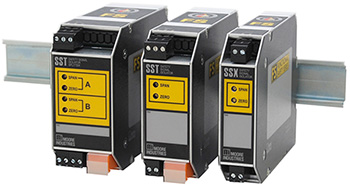 Moore Industries’ SSX and SST Safety Isolators and Splitters have achieved Factory Mutual (cFMus) approval as a Non-Incendive apparatus. This allows the products to be used in Class I, Division 2, Groups A, B, C and D Hazardous “Classified” Areas in both the United States and Canada. The SSX and SST are part of the Moore Industries FS FUNCTIONAL SAFETY SERIES and provide reliable isolation and signal conversion in potentially hazardous environments.
The two-wire (loop powered) SSX and four-wire (line/mains powered) SST have been certified by exida for single use in Safety Instrumented Systems up to SIL 2. With the new cFMus certification, the SSX and SST can now be used in both General (safe) and Hazardous Locations. This means that the SSX and SST can be used in process areas and industries where potentially explosive gases and vapors may be present including:
- Oil and natural gas refineries
- Offshore oil and gas rigs
- Chemical, petrochemical and pharmaceutical plants
The SSX and SST are ideal products for use in settings where safety is critical. They protect safety systems by isolating an SIS from basic process control or monitoring systems so that disconnections or other failures don’t impact the safety system. They also have 1500Vrms of isolating capability to protect safety I/O cards and systems from surges, spikes and transients in the field. Standard 20V/m RFI and EMI protection stops the harmful effects caused by radio frequencies and electromagnetic interference.
Do you want more information? Download the data sheet.
Need to get price or availability or have a technical question?
Send us a message using E-Help.

A plant upgraded to new Smart HART® field transmitters but was still using their original field-mounted isolators. This meant that engineers in the control room were unable to access the HART transmitters – mitigating the benefits of performing the upgrade.
Moore Industries solved this problem with an installation of SSX HART Isolators. They offer full isolation and seamless HART communication capabilities with field transmitters including:
- Unlike traditional isolators, the SSX allows the HART signal to "pass" through so that critical HART diagnostic data can be read from the control room.
- HART PV data and status information is available at any termination point on both sides of the isolator..
- Calibration, field configuration or interrogation of the HART field transmitter can be accomplished from the host control system or asset manager..
The two-wire (loop powered) SSX and four-wire (line/mains powered) SST are part of the FS Functional Safety Series from Moore Industries and are exida-approved for use in an SIS up to SIL 3 in monitor mode, where only the input circuit is part of the safety function. For single use mode, the SSX and SST are approved for use in an SIS up to SIL 2.
Find out more information about our complete line of Smart HART Transmitters, Monitors and Interfaces at our website.
Moore Industries knows that you rely on our datasheets to have the most complete and up-to-date information possible about our products. That’s why we are always updating the Interface Solution Download Center with the latest versions of our datasheets featuring new information and clarifying existing product details.
The latest round of datasheet updates clarifies the types of materials used in our housings. The ordering information for these datasheets now specifies which metals are used in specific housings for the products.
Products with updated datasheets are:
Remember, the Interface Solution Download Center is your one place to go for the most up-to-date datasheets, manuals and other product information. Make sure you check the site regularly for updates to ensure you have the most current specifications, ordering information and other product details.
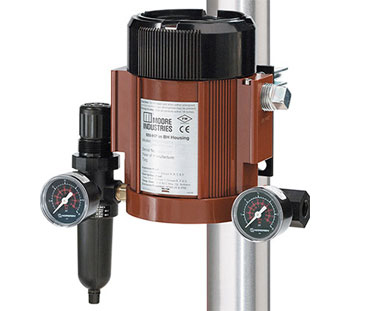 The new IPX2 video shows how the Current-to-Pressure (I/P) transmitter’s removable electronics reduces production interruptions caused by liquid slugs entering the supply line or the transmitter itself. But the removable electronics is just one key feature of this product. Here’s a look at some other product features of the IPX2:
- Explosion-Proof and Intrinsically-Safe Certifications:The IPX2 carries certifications for installation in Class 1, Div 1, and Zone0/1 areas, making it a popular choice for oil and gas applications in hazardous settings.
- Approved for Use with Natural Gas:Special design, construction and materials allow the model IPX2 with the -NG1 or -NG2 option to be used with natural gas as its pneumatic supply (commonly referred to as sweet gas consisting of up to 20ppm of H2S).
- Multiple Input and Output Ranges: The IPX2features 4-20mA or split range inputs and 22 direct and reverse output ranges including a standard switch-selectable reverse output.
- Low Air Consumption and High Output Volume: The IPX2outputs as much as 300SCFH and consumes as little as 0.08SCFM.
- Clog Resistant Filtered Nozzle and Orifice:A larger orifice, combined with an easily replaceable internal filter protects against clogging caused by debris.
- Accurate and stable:Featuring exceptional ±0.25% of span accuracy and six-month stability, they are ideal for precise applications in difficult to access locations.
More information about the IPX2 is available on our website. You can also visit our site to learn more about our entire line of I/P and P/I products.
Do you want more information? Download the data sheet. Or visit the catalog.
Need to get price or availability or have a technical question?
Send us a message using E-Help.

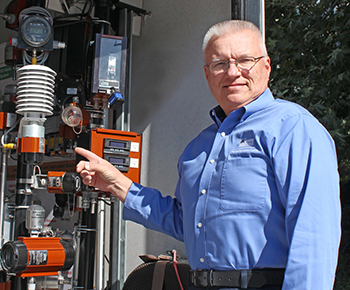 Senior Applications Engineer J. R. Madden has extensive experience with all things relating to temperature. In this recurring feature, he'll address common customer issues and Moore Industries' solutions.
Q: Do I need to order anything differently if I’m measuring cryogenic temperatures?
A: When measuring temperatures below -10°F, readings are more stable and accurate when a wire-wound RTD element is used. Typical thin-film RTD elements do not perform well at these extreme temperatures.
Q: What about measuring temperatures above 850°F with an RTD? Should I specify a thin-film or wire-wound RTD element?
A: When using RTDs to measure temperatures above 850°F, we recommend using a wire-wound RTD element that is specially built to handle these high temperatures. Many thin-film RTD elements will experience high failure rates at these temperatures.
If you require an RTD sensor for these temperature extremes, order a wire-wound (-WW option) element to ensure the best sensor performance and longevity.
Do you want more information? Download the data sheet. Or visit the catalog.
Need to get price or availability or have a technical question?
Send us a message using E-Help.
Q: I am installing 24 SPA RTD transducers (Model: SPA/RTD/2PRG/U/-AO [DIN]) and I have a question about how the 4-20mA is powered. They are currently wired as loop-powered and I would like to confirm that this model supports loop-powered field devices.
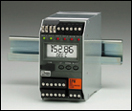
A: The SPA/TPRG/2PRG/U/-AO [DIN] supports both source and sink mode on its current analog output. The default setting for the AO (analog output) is 4-20mA with the loop voltage sourced from the SPA. Please see Figure 4 in the SPA installation manual for changing the AO (analog output) to Current Source/Sink or a Voltage output.
Do you want more information? Download the data sheet. Or visit the catalog.
Need to get price or availability or have a technical question?
Send us a message using E-Help.
Q: I need to order an FDY transmitter for monitoring up to 13600 Hz from a magnetic pickup on a gas turbine for speed indication. Do you recommend the PRG or 10-250V input option?
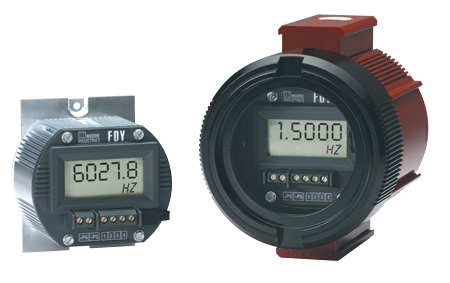
A: Either model is compatible with the frequency you mentioned. The PRG input is normally correct for magnetic pickups. Some will put out a pulse voltage above 30Vac (the maximum for the PRG input), but this can be lowered by moving the pickup farther from the target. Use the 10-250AC input if you are certain that the voltage pulse will be above the PRG’s upper limit. But with this model, the pulse must be at least 10Vac.
Please note that the 10-250Vac input is not available with I.S. approvals.
Model Examples:
FDY/PRG/4-20MA/12-42DC [HP]
FDY/10-250AC/4-20MA/12-42DC [HP]
Do you want more information? Download the data sheet. Or visit the catalog.
Need to get price or availability or have a technical question?
Send us a message using E-Help.
Q. We are looking for a signal isolator. We need an input of 0-5VDC, output 4-20mA and the unit needs to be output loop powered. What do you recommend?
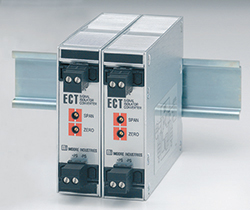
A. The ECT is available with an input 0-5VDC, you’ll need to specify when ordering. The ECT DIN-style signal isolator, converter, repeater, booster and splitter feature solid metal housings that stand up to continuous, daily rigors of process control and factory automation applications. The 2-wire, output-loop powered ECT operates on 12-42DC. A 4-wire, line powered model is also available if voltage outputs or large output drive capabilities are required.
SIY DIN-style signal isolators can also perform the same function and they are PC configurable. The highly versatile SIY programs to accept a wide range of current or voltage inputs. It outputs an isolated, proportional, 4-20mA signal. This 2-wire (loop-powered) transmitter programs in seconds to handle a wide range of important signal interface applications. If field installation is required for your signal converter, the SIY is also available in a weatherproof or hazardous area enclosure. A configuration cable is required to utilize the PC programming capability of the SIY. Use either a Serial RS232 cable with 9 pin connector or USB cable made by Moore Industries.
Another DIN-style mount option is the MIX. The model MIX is also a 2-wire (loop powered) 2-channel or 4-channel isolator/converter. The 2-channel MIX provides conveniently-located DIP switches for selecting input types of 4-20mA, 0-5V, 1-5V or 0-10V for each channel.
Read more about the ECT, SIY and MIX.
Do you want more information? Download the data sheet. Or visit the catalog.
Need to get price or availability or have a technical question?
Send us a message using E-Help.
Q. I need to boost a 4-20mA signal to get a Fisher FIELDVIEW DVC6200 to respond to a control signal. What could I use?
Q. On a 4-20mA gas detector, while we replace the cell, the output reverts to 3mA. This causes the device receiving the 4-20mA signal to go into a critical alarm condition and can shut down a critical process. What device do you have that will keep the output at no less than 4mA?
It would also be convenient to have this instrument provide me with a 'relay alarm contact output' when my input goes to 3mA. It can be 24Vdc or 120Vac. It should be in a DIN housing.
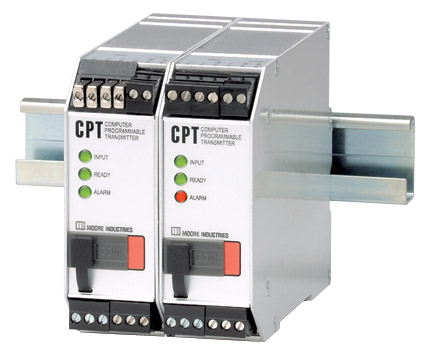
A. Moore Industries CPT PC-Programmable Temperature Transmitter and Signal Isolator/Converter CPT/HLPRG/0-20MA/117AC*/-C [DIN] can be used for this application. A configuration cable is required to utilize the PC programming capability. The selected model will have the functions of the signal repeater with an alarm relay output. You can set the alarm fault relay to trigger at your choice of input signal level below 4mA.
The CPT has a menu selection for upper and lower limits. You can set 3.9mA low limit there.
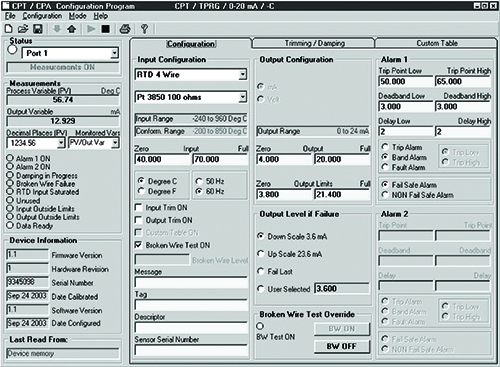
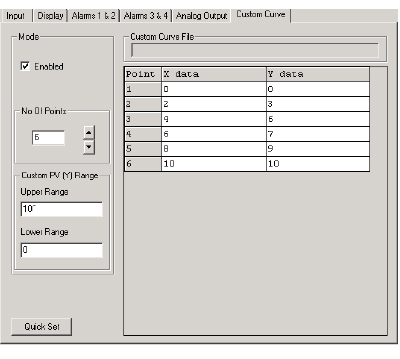
The SPA2 upper and lower limits must be defined by setting up a “custom curve” lookup table which (below), in this case, will be 5 points where in = out. By using the custom curve table, the output will not go below the lowest ordered pair or above the highest ordered pair. In this case it will define the lower output limit.
Do you want more information? Download the data sheet. Or visit the catalog.
Need to get price or availability or have a technical question?
Send us a message using E-Help.
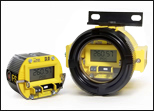 The SIL3 capable SLD features a large integral display that shows real-time process status in mA, percent, or any designated 5-character Engineering units (EGU). The latest addition to the Moore Industries’ FS Functional Safety Series products, it is certified by exida® as a SIL3 capable, non-interfering device for use in a safety loop. The SLD is the perfect solution to accurately and reliably display process status in a safety loop, and features the Loop Maintenance Diode Option which allows it to be removed from the safety loop without affecting the integrity of the safety function. Find out more here.