

Search Problem Solvers
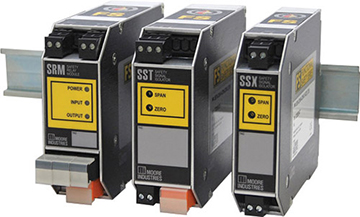 Q. I want to share a critical pressure signal with my DCS that is now part of our safety instrumented system (SIS) and have a two part question. First, do your isolators pass the HART diagnostic data that comes from my SIS smart pressure transmitter? Second, if there is a total failure of the pressure transmitter, where will the output of the isolator go to that is feeding my DCS?
A. Yes, we have isolators that were designed specifically for these types of applications. The SSX and SST are exida approved SIL 3 capable isolators that pass HART data between any HART host or handheld device and the field transmitter. The second part of your question has two answers.
The SSX is an output loop powered isolator and as such when the input goes to 0mA the output will only drop to a minimum of about 2-2.5mA. The floor or minimum output is necessary because the SSX will need some level of current to keep its electronics circuit powered.
The SST is a four wire isolator so it behaves a bit differently. The SST’s output will follow the input through the entire range. For instance, if the input goes to 0mA or open circuit the output of the SST will follow the input all the way down to 0mA. Depending on your DCS settings, you can then choose when and how you want to alarm on the pressure transmitter’s health or loop status.
Download the data sheet to learn more about the SSX and SST.
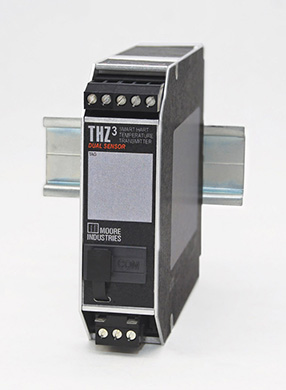 Q. Do you have a temperature control solution for a batch process chamber we have? We have a manufacturing process that uses a critical batch process chamber requiring an RTD that senses the temperature. When the process chamber is being used, we need to maintain temperature, so we have a secondary temperature monitor to help in case of a fail-over. To do this, I need to connect to our RTD that has dual 4-wire inputs and be able to switch from the primary to secondary if the primary is disconnected or fails.
A. You can use a Moore Industries’ THZ3-DIN temperature transmitter to precisely control the temperature. The THZ3-DIN can accept two 3-wire RTDs and can be configured so that its 4-20mA analog output is configured for failover/backup. If the primary RTD fails or is disconnected, the THZ3 automatically switches to the secondary RTD, it gives you a HART®alarm (and display an error if TDZ3 is used), and allows you to maintain the temperature measurement in the chamber.
You can use your existing 4-wire RTDs as 3-wire elements by taping off one of the leads. You will still have lead length compensation with the 3-wire RTDs as long as the leads are the similar length and have equal resistance.
The THZ3 can be configured by using a HART® hand held configurator or with PACTware running on a PC. A CDROM is provided with the PACTware installation files and DTM for the THZ3 with the shipment of the device. The THZ3 data sheet, manual, HART®DD, PACTware installation files, and the DTM are also available for download on Moore Industries site.
An easy-to-use yet robust Dual Input Smart HART® Temperature Transmitter, the THZ3 configures quickly and easily to accept a direct signal input from a wide array of sensors and analog devices including 14 RTD types and direct millivolt sources. The THZ3 has dual sensor input for Backup and Failover Protection, Average and Differential measurement and Low or High Select. It also has advanced RFI/EMI protection and ambient temperature compensation that helps guard against environmental factors that can quickly degrade measurement accuracy. Built-in 20 bit input resolution delivers exceptional digital accuracy of ±0.1°C (±0.18°F) with all Pt RTDs and is HART® 7 compliant with exception based reporting and dynamic variable mapping. There's even a High Availability Option that enables the user to select how the AO behaves when there is an input failure or out-of-range value detected by the transmitter that prevents nuisance alarms on startups.
Do you want more information? Download the data sheet. Or visit the catalog.
Need to get price or availability or have a technical question?
Send us a message using E-Help.
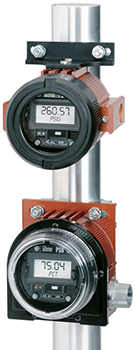 Q. Can the PSD PC-programmable loop display pass HART® data without problems through the device if placed in a loop with a HART® capable transmitter?
A. The input of the PSD connects in series to the existing 4-20mA/HART®loop as if it was just an added resistance and only reads the analog 4-20MA signal. The PSD does not interfere with the HART®digital signal being transmitted on the loop.
Since the PSD does not have a path to ground or an output that could connect to another device, ground loops or other issues like extraneous conducted noise are not a problem.
However, when these loops do connect to devices that have separate ground paths or outputs problems can certainly arise. For these situations we recommend HART® pass-through isolators such as the HIX 2-wire output-loop powered unit or the HIT, a 4-wire mains powered isolator.
Moore Industries’ HART Isolators are a highly economical solution to common and costly problems that plague many of today’s “smart” process loops offering protection from surges, spikes, and transients up to 1500Vrms. You can safely share the HART® output of one transmitter with a secondary control or recording device allowing for redundancy without further burden or risk on a process loop. As an added bonus, you can perform equipment maintenance without loop downtime by isolating legs of the loop, making it possible to remove those instruments from the circuit without affecting other equipment. Protect and enhance your HART® investment with the 2-wire (loop powered) HIX or the 4-wire (line-mains powered) HIT.
Learn more about the HIT/HIX HART Isolator and the PSD PC-programmable Loop Display.
Do you want more information? Download the data sheet. Or visit the catalog.
Need to get price or availability or have a technical question?
Send us a message using E-Help.
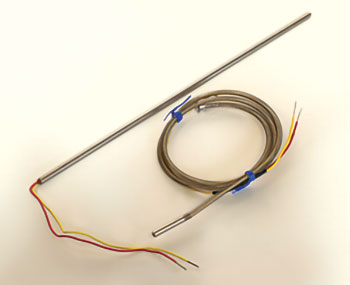 Q: A Type K thermocouple is being used in a high temperature furnace environment for temperature measurement. However the Type K thermocouple is drifting too much. Is there something I could do so I don't have to change it out frequently or is there another type of thermocouple I could use?
A: You could use a Type N with Inconel 600 Material, which is designed to perform well at high temperatures (over 2000F) and helps prevent corrosion in environments where atmospheres are reducing or alternately oxidizing and reducing. This would be particularly helpful for a furnace process that includes heating and cooling with moisture present, creating potential for oxidation to form from the process. Other high temperature environments that benefit from Type N with Inconel 600 Material include boilers and cookers processes or extreme environments where the thermocouple cannot be replaced easily.
In terms of their basic function, Type K and Type N thermocouples are similar. Type K is one of the most common type of general purpose thermocouple. However, the environmental setting that your thermocouple will be used in can affect your choice. Type N thermocouples provide a higher level of stability and durability in adverse environments than Type K thermocouples.
To be more specific, Type K thermocouples are susceptible to a phenomenon called Green Rot, or oxidation around the thermocouple. Green Rot is oxidation inside the thermocouple sheathing caused by operation at certain low oxygen environments, creating large negative calibration drifts leading to curve changes over time. Potential IR failure can happen, where the internal elements short and touch the outer sheathing due to oxidation (Green Rot).
Type N is also a viable choice when adverse environmental factors and high temperature requirements are an issue and there is difficulty in frequently changing out the thermocouple. While a Type N with Inconel 600 Material is only 20% higher in cost than Type K, the Type N can perform longer without the drift that oxidation causes, preventing the need to shut down the process to change out the oxidized thermocouple.
If you decide that Type N thermocouple isn't for you and are using a Type K thermocouple where your environment is the key factor instead of temperature, you can reduce the chances of Green Rot by increasing the oxygen supply through the use of larger diameter protecting tubes. The opposite approach can also work by inserting a mechanism to absorb oxygen inside a tube which can bring oxygen levels below what will promote oxidation.
Moore Industries can help when you are deciding if Type N is viable replacement for your Type K thermocouple application. You can contact us with your questions or if you need to know more about a product, price or availability.
Do you want more information? Download the data sheet. Or visit the catalog.
Need to get price or availability or have a technical question?
Send us a message using E-Help.
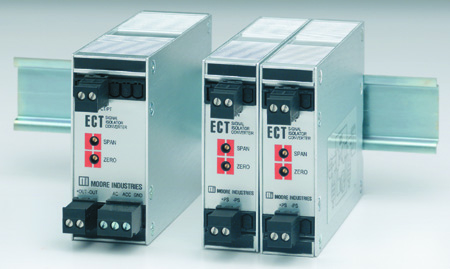 Q. I have two different control systems and I need some splitters to split a 4-20 mA signal. I may need to have the loop isolated. Can you help specify a splitter that can send the signal to both control systems where I can use the splitter connected in a series on the original loop? My company has used the SIX in the past, would this work?
A. The SIX can be used in a “splitter” application when its input is connected in series on the original loop. The output of the SIX 2-Wire Signal Isolator/Converter gives you the isolated loop. The versatile SIX can be used as a signal isolator, converter, and repeater. It is an excellent choice for installation in the plant or control room. The 2-wire (loop-powered) SIX derives its power from the output loop, eliminating the need to install an additional power supply.
If you decide you need to have the two control systems isolated from the original signal, then you can use the ECT-DIN model ECT/4-20MA/2X4-20MA/117AC* [DIN] Signal Isolator, Converter, Repeater, Booster and Splitter for more versatility. The ECT-DIN features a solid metal housing that stands up to the continuous, daily rigors of process control and factory automation applications.
Like the SIX, the ECT's input is wired in series with your original loop. The ECT then gives two separate and isolated outputs for your two control systems. Each output is capable of driving 600 ohms of output load. This version of the ECT also offers a TX option that powers a two-wire transmitter connected to its input.
If you have functional safety in mind, the SSX/SST Model number SST/4-20MA/2X4-20MA/117AC* [DIN] works like the ECT but is part of Moore Industries’ FS Functional Safety Series. The SSX/SST Safety Series Isolator and Splitters are exida® approved, SIL 3 capable. The SSX is 2-wire (loop powered), and the SST is 4-wire (line/mains powered). The SSX/SST provides isolation and signal conversion for your SIS (Safety Instrumented System) needs. These units protect and enhance loops and also pass valuable HART® data from the field transmitter to host systems and vice-versa.
The ECT and SST are line powered and supply the voltage to their outputs, so the control systems receiving their outputs must have passive inputs. If your control system inputs are active (providing power), contact us and we can modify the ECT or SST for those loops too.
Other things to consider:
Do you need to pass digital HART signals between the input and outputs?
- The ECT filters the HART component
- The SST passes HART on the outputs (both or neither)
- The SST is from our line of Functional Safety products
Do you want more information? Download the data sheet. Or visit the catalog.
Need to get price or availability or have a technical question?
Send us a message using E-Help.
Q: Is there a less complicated and economical solution to replace a failed thermocouple than a complete shutdown of a boiler?
A: To address this issue, we need to note that furnaces, boilers, and reactors present an interesting problem when trying to replace a failed thermocouple. Typically to replace thermocouple sensors, the entire furnace or boiler must be shut down for long periods of time creating downtime and lower productivity. Most facilities will try to schedule this type of shut down once every 4 to 5 years because shutdowns are time consuming and costly. Once the boiler is down, most customers will remove all of the sensors, and perform a full replacement, to prevent shutdowns for as long as possible. Facility maintenance personnel with special training in “Small Space Confinement” must do the replacements.
Because this kind of replacement is costly in both downtime and new sensors, if a sensor fails, that particular temperature measurement is lost until the next maintenance schedule. A facility will not shutdown a boiler earlier than originally scheduled even if more than 50% of the sensors fail before the maintenance schedule, unless there is a critical safety issue requiring shutdown.
Thermocouples are long, typically about 20 to 40 feet long. They have a small metal pad welded to the tip of the sensors sheath with the weld pads tack welded to the surface of the Protection Tube (pipe) inside the high-temperature area making them typically expensive to replace.
Moore Industries has a simple and economical solution to this complicated process: The WORM Flexible Temperature Sensor. It lets you replace the sensor without removing the Protection Tube or disassembling the thermowell by just replacing the broken sensor. The High Temperature WORM is a flexible sensor for thermowell temperature assemblies that is available in standard sensor types including 100 and 1000 ohm platinum, nickel and copper RTDs, and J-, K-, T-, E- type thermocouples with step response times 13% faster than standard sensors. The WORM comes in a universal length so there’s no need to stock an expensive array of different sensor lengths. With a quick measurement and a simple trim-to-length, the WORM handles nearly every thermowell assembly.
For boiler tube applications, the WORM ships with a hollow protection tube that includes a weld pad with a thermocouple WORM Sensor that enables sensor replacement from outside of a boiler. The tube is hollow and allows a flexible Worm Sensor to slide down inside the Protection Tube from outside the boiler. This allows the customer to replace a sensor, if it should fail, anytime while the furnace is still up and running.
Do you want more information? Download the data sheet. Or visit the catalog.
Need to get price or availability or have a technical question?
Send us a message using E-Help.
Q. Is there a signal conditioner with 0-2Vdc input and two isolated 4-20mA outputs with 24Vdc? I need it as compact as possible because I need to install it horizontally in a cabinet.
A. The ECT-DIN series dual 4-20mA output can be provided with a modified input to accept a 0-2Vdc signal. Moore Industries offers a build option from the factory (the ECT which acts as a Splitter). The model number for an ECT with this configuration is ECT/0-2V/2X4-20MA/24DC [DIN]. Typical installation of an ECT is a DIN mount so the housing we offer is a DIN-style housing which mounts on 32mm G-type (EN50035) and 35mm Top Hat (EN50022) rails.
The ECT-DIN is rugged as well as reliable and is available in 2-wire (loop) or 4-wire (line/mains) powered models.
The complete family delivers economical solutions for an expansive range of signal interface applications such as protecting equipment and signals by eliminating common electrical paths, amplify signals allowing more instruments on an overburdened loop, isolate signals to prevent erratic measurements, convert signals so field devices can interface with equipment such as an indicator or PC-based SCADA system, split one signal to allow one primary measurement to be sent to two separate systems, and solve bucking power supplies. The ECT has superior signal isolation up to 1500Vrms and stops ground loops, motor noise, and other electrical interference from affecting process signals.
For more information on the ECT, view the product page.
Do you want more information? Download the data sheet. Or visit the catalog.
Need to get price or availability or have a technical question?
Send us a message using E-Help.
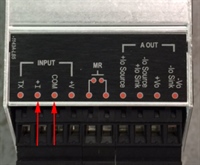 Q. Can the SPA2 be placed in an existing 4-20mA loop as passive?
A. The SPA2 can be wired using the passive input (+I and COM) in series in your 4-20mA loop. It will add about 20 ohms to the loop.
When ordered with the Analog Output (-AO) option, the SPA2 provides a proportional and isolated analog retransmission of the input signal that can be sent to remote monitoring/control devices like a DCS, PLC, PC, indicator or data recorder, making it completely isolated from the input. All analog parameters can be selected using the SPA2 push buttons or the free easy-to-use Intelligent PC Configuration Software.
The SPA2 Programmable Limit Alarm Trips provide on/off control, warn of unwanted process conditions, alarm on rate-of-change, and provide emergency shutdown. Very versatile, the SPA2 accepts a signal input from transmitters, temperature sensors, and a wide array of other monitoring and control instruments such as current and voltage signals, 23 RTD Types, 9 Thermocouple Types, resistance and potentiometer devices, and Direct Millivolt Sources. Features of the SPA2 include 20-bit input resolution, long-term stability with up to 5 years between calibrations, large 5-digit process and status readout, and isolated RFI/EMI protection.
Do you want more information? Download the data sheet. Or visit the catalog.
Need to get price or availability or have a technical question?
Send us a message using E-Help.
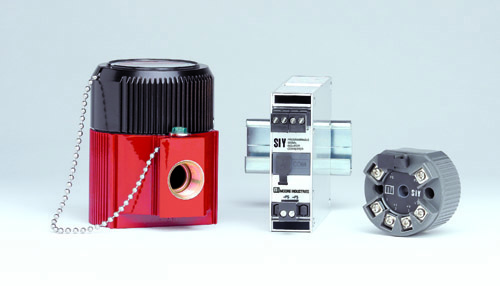 Q. Currently, I have an application where I need to configure my SIY input to 0-1mA. Is this possible?
A. Yes, the minimum input span possible on the SIY is 1 mA, allowing you to configure it to 0-1 mA.
Not only can you configure the SIY to 0-1 mA, the enhanced configuration software allows you to trim input sensor readings, customize input linearization curves, program output damping, and calibrate other loop instruments. The SIY handles the majority of current/voltage interface applications you are likely to encounter.
Moore Industries’ SIY PC-Programmable Signal Isolator/Converter combines smart digital technology with advanced analog operation to deliver superior reliability, accuracy, and ease of use. To learn more about the SIY visit our website.
Do you want more information? Download the data sheet. Or visit the catalog.
Need to get price or availability or have a technical question?
Send us a message using E-Help.
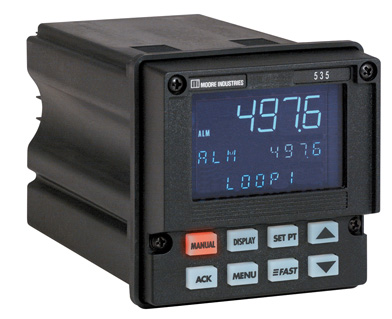 Q. When the 535 1/4 DIN Single Loop PID Process Controller loses power with remote setpoint on, it comes back up in local setpoint mode. Is there a way to have the 535 always come back up in remote setpoint mode when power is restored?
A. Yes, the 535 can come back up with remote setpoint. To make the 535 power up using remote setpoint:
In the configurations menu
- Go to the SPECIALmenu
- Go to PWR. UP: SP
- Select REMOTE
Details are on page 51 (number on the bottom right or page 58 of the PDF) in the user manual. For your convenience, the image is attached at the bottom of this page.
Check out more on the 535 1/4 DIN Single Loop PID Process Controller.
Do you want more information? Download the data sheet. Or visit the catalog.
Need to get price or availability or have a technical question?
Send us a message using E-Help.
Q. As part of a power distribution process I need a dual signal isolator/converter/splitter that has an input of 0-1mA, outputs of 0-1mA and 4-20mA with 117VAC power input? It needs a DIN housing so it can be mounted in an existing cabinet.
A. Moore Industries has the ECT Signal Isolator, Converter, Repeater, Booster and Splitter and comes in 2-wire (Input-Loop Powered) and 4-wire (Line/ Mains Powered) versions with input 0-1mA, with outputs 0-1mA and 4-20mA, with 117VAC power input in an aluminum DIN rail mounted housing.
- When ordering, specify the model number in this format: Unit / Input / Output / Power / Options [Housing]
- To order the model discussed use this model number: ECT/0-1MA/0-1MA,4-20MA/117AC [DIN]
Moore Industries also offers optional NIST Traceable Test Reports with recorded test data.
To read more on the ECT or on other products please go to our website
Do you want more information? Download the data sheet. Or visit the catalog.
Need to get price or availability or have a technical question?
Send us a message using E-Help.
Q. On a 4-20mA gas detector, while we replace the cell, the output reverts to 3mA. This causes the device receiving the 4-20mA signal to go into a critical alarm condition and can shut down a critical process. What device do you have that will keep the output at no less then 4mA? It would also be convenient to have this instrument provide me with a relay alarm contact output when my input goes to 3mA. It can be 24Vdc or 120Vac. It should be in a DIN housing.
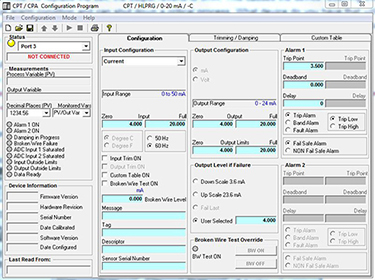
A. Moore Industries CPT PC-Programmable Temperature Transmitter and Signal Isolator/Converter CPT/HLPRG/0-20MA/117AC/-C [DIN] can be used for this application.The selected model allows you to limit the minimum and maximum output, even when you are replacing the cell. The alarm relay option allows you to set an alarm at whatever level below 4mA for maintenance notification. Figure 1 below shows a configuration that would work for your application. A configuration cable is required to utilize the PC programming capability.
The CPT has a menu selection for upper and lower limits. You can set the low alarm limit there, such as 3.5mA.
Figure 1. CPT PC Configuration
Do you want more information? Download the data sheet. Or visit the catalog.
Need to get price or availability or have a technical question?
Send us a message using E-Help.
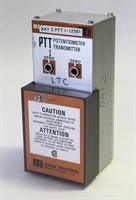 A few years ago, we heard from a customer that they had many PTT, Potentiometer Transmitters in use at a large dam on a branch of the Colorado River. The dam is part of a system to deliver water and power via one of the largest public power utilities for consumers and businesses in the southwest..
All of the PTT units had operated flawlessly in service, even after they were sent back for refurbishment due to capacitor wear out (dry out of electrolytic) four years after the calculated 15-year lifespan.
The customer inquired of whether or not we had a site programmable potentiometer transmitter that was line powered that he could start keeping in stock and consider replacing the PTTs over time. This would alleviate the downtime he has while waiting on PTT refurbishment.
Moore Industries recommended the CPT, a PC-Programmable Temperature Transmitter and Signal Isolator/Converter, as the most economical product suited to the application at the time.
Today, we would recommend the 4-wire (universal line/mains-powered) SPA2 Temperature Alarm Trip/Transmitter with the analog output option. The SPA2 can be ordered with two or four alarms and accepts a potentiometer input of 0-4K Ohms as standard and can accept higher range inputs with externally fitted custom input resistors (contact Moore Industries for assistance). The SPA2 is push button field configurable or PC programmable and comes standard with a display. The analog output can be field configured for either voltage or current, any range between 0-10V or 0-20mA and supports reverse, split range or linear outputs. The universal power supply input (22-375VDC or 90-260VAC) and full field configurability makes the SPA2 an ideal universal transmitter to keep in stock to meet a variety of last-minute instrument needs.
See the SPA2 datasheet for a full list of features at or visit the catalog.
Need to get price or availability or have a technical question?
Send us a message using E-Help.
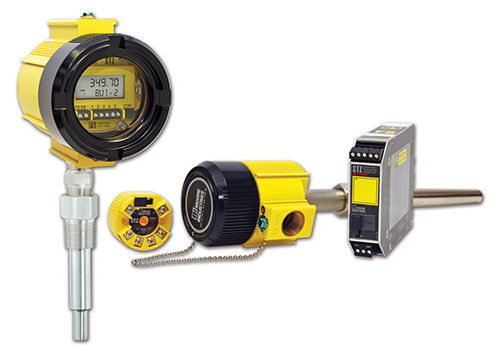
Hazardex is an exhibition and conference that focuses on protecting plant, process and personnel. The conference incorporates world-renown experts and leaders in process safety while refining decades of subject matter experience from across Europe that fosters a practical knowledge forum and exchange. This year the STZ Functional Safety Dual-Input Smart HART Temperature Transmitter, with Associated IS Option has been nominated for its Contribution to Safety - A product, system or service which has made a significant contribution to safety in hazardous area environments.
If you are a Hazardex journal & website reader/user and like Moore Industries’ products, please vote for us. More information on voting is can be found on the Hazardex website.
STZ product information can be found on our product page. (This voting page is closed now)
Do you want more information? Download the data sheet. Or visit the catalog.
Need to get price or availability or have a technical question?
Send us a message using E-Help.

Q: I want to use a SIX Signal Isolator/Converter in a loop with a cable run of 1200’. Are there cable parameter values (i.e. maximum inductance/capacitance) that must be met in order to maintain the FM Non-Incendive certification?
A: The certification by FM of the SIX for Non-Incendive Class 1 Div 2 does not include any cabling restrictions. The maximum cable length is a function of the available compliance voltage and the total resistance (loss in the wire and device loads).
Do you want more information? Download the data sheet. Or visit the catalog.
Need to get price or availability or have a technical question?
Send us a message using E-Help.
 Congratulations to Raymond Ko of Macguire and Crawford, who was named Salesman of the Year for 2014! Moore Industries Regional Sales Manager Greg Feliks passes along a bit of information about Raymond:
"He has been a key salesman at MacGuire and Crawford for over 25 years after an earlier career as a regional sales/service manager for an instrument manufacturer. He is a consistent top performer for Moore Industries with multiple NCS/panel projects, MooreHawke projects, and sizable project orders for isolators, temperature assemblies, and more.
Raymond’s most recent project success in 2014 was a single order for over 110 STA safety alarms. He is tireless in pursuit of projects, a great help to his customers, and has a deep technical familiarity with most everything from Moore Industries."
Do you want more information? Download the data sheet. Or visit the catalog.
Need to get price or availability or have a technical question?
Send us a message using E-Help.
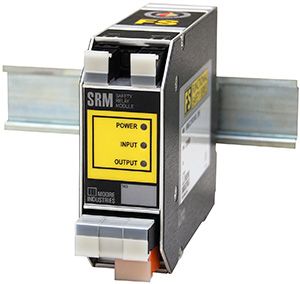 Q: The SRM Safety Relay Module only has three contacts. Is it possible to add extra contacts? Also, is there specific wiring required to obtain a SIL 2 rating?
A: You can connect a wetted contact to the power terminals of two SRMs in order to have more than three contact outputs. Connect jumper wires to the input terminals of these SRMs. The wetting current must be sufficient to drive the coils of the two SRMs.
The SRM installation manual has detailed directions for installation in Safety Instrumented Systems (SIS) as well as information about connecting the coil (input) side to either dry or wetted contacts. In addition, Figure 5.3 in the manual shows how to connect a wetted contact to a single SRM.
Do you want more information? Download the data sheet. Or visit the catalog.
Need to get price or availability or have a technical question?
Send us a message using E-Help.
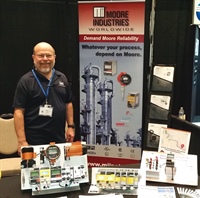 Moore Industries Sales Application Engineer Robert Marousek was in Carson, CA on July 21 to help showcase our products at the ISA Los Angeles Instrumentation 2015 show. The event is billed as “the largest exhibition, technical training and career fair on the West Coast dedicated to the design, application, installation, operation and maintenance of state-of-the-art instrumentation, process control and process automation.” It represented an opportunity to present our instrumentation to engineers in the field and answer questions about our solutions.
Moore Industries’ products were exhibited as part of the booth of Patten Systems, our sales rep in Southern California. Robert complemented the Patten crew at the show with their knowledge of our product line, particularly John Capitano.
We had a wide range of products displayed at our booth during the event, including our FS Functional Safety Series and a panel showing how the SPA2 Programmable Limit Alarm Trips can increase the accuracy of temperature readings.
Moore Industries will also be part of these shows during the rest of 2015. Make sure to see us if you are planning on attending:
- Fieldbus Seminars in Calgary (Sept. 22), Edmonton (Sept. 24) and Long Beach, CA (Nov. 5)
- Emerson Global Users Exchange in Denver (Oct. 12-16)
Do you want more information? Download the data sheet. Or visit the catalog.
Need to get price or availability or have a technical question?
Send us a message using E-Help.

California's largest oil spill in 25 years occurred when at least 101,000 gallons of crude oil spilled out of a pipeline near Santa Barbara. While the cause of the rupture is still unknown, federal investigators found that almost 80 percent of the pipeline had been worn down due to corrosion near the point where the break happened. This accident highlighted the need to take steps to mitigate the impact of corrosion on pipelines and other sites.
A popular method of achieving this is cathodic protection, where the important metal in a pipeline is made into a cathode. According to Corrosionpedia:
“Cathodic protection is a widely used method for controlling the corrosion of metallic structures in contact with most forms of electrolytically conducting environments such as soils, seawater and natural waters. Cathodic protection essentially reduces the corrosion rate of a metallic structure by reducing its corrosion potential, bringing the metal closer to an immune state.”
Larger pipelines use Impressed Current systems to protect the metal. According to Corrosionopedia, “Impressed Current systems employ inert anodes and use an external source of DC power to impress a current from an external anode onto the cathode surface.”
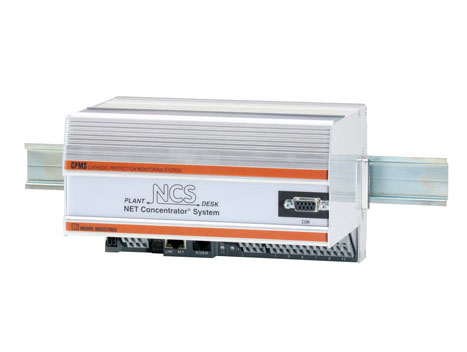
Engineers need to know that the cathodic protection system is in place and operating at the right levels to maintain a safe operating environment. Moore Industries helps companies with this with our CPMS Cathodic Protection Monitoring System. It is specifically designed to monitor the critical current and voltage levels of one or two transformer rectifiers in Impressed Current Cathodic Protection Systems. It provides an engineered, field rugged and compact monitoring solution for reading and data logging specific Vdc, mV and mA inputs with embedded digital communication protocols including MODBUS/TCP over Ethernet and dual MODBUS RTU ports (master or slave capabilities).
The CPMS also accepts up to four discrete (contact closure) inputs from each impressed current system. Using an internal control engine, the CPMS can be programmed with internal set points that relate to normal operating conditions within the cathodic protection system. Should monitored parameters go outside of selected limits, or if power to the cathodic protection system is lost, the CPMS alerts of the unwanted conditions at the control system over the data link.
The CPMS offers several advantages:
- Flexibility: CPMS I/O capabilities can be expanded with the addition of Moore Industries' NCS NET Concentrator System modules. This allows the CPMS to handle current inputs and outputs, temperature (RTD and thermocouple) inputs, additional discrete inputs and relay outputs.
- Ease of Installation and Use: The CPMS sets up in minutes using simple web-based software. Special skills or programming languages are not required. It also offers a standard and open OPC interface that delivers plug-and-play integration with popular off-the-shelf PC-based HMI/SCADA packages.
- Data Logger with Battery Backup:For historical performance trending and analysis, the CPMS can archive up to 64,000 time and date stamped values.
- GPS Time Receiver: The CPMS can be ordered with a GPS Time Receiver option that allows the syncing of CPMS clocks in order to control multiple rectifiers. This facilitates monitoring the effectiveness of the cathodic protection system and structure.
Do you want more information? Download the data sheet. Or visit the catalog.
Need to get price or availability or have a technical question?
Send us a message using E-Help.

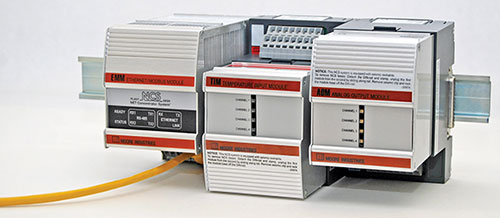 When precision synchronizing of time is required on your processes, automatically coordinate all of your activities using Moore Industries’ NCS NET Concentrator System time sync features.
In July 2015, a Simple Network Time Protocol (SNTP) server feature was introduced into the EMM Ethernet/MODBUS Interface Module of the NCS, the CPMS Cathodic Protection Monitoring System and the microNCS MODBUS RTU Master and Distributed I/O System models. Previously, any of these models could be synchronized to an external SNTP time server via an Ethernet link so that each NCS site has the precise Coordinated Universal Time (UTC). Now, these models can also become their own SNTP server to provide timing to one or several compatible SNTP devices including the EMM, CPMS and microNCS along with other instrumentation or PLCs.
The CPMS and microNCS also have a new GPS Time option with an internal GPS receiver providing precise UTC time. Remote sites with no ability to connect to an existing external SNTP service can now obtain the same time as other remote sites anywhere in the world. The remote site equipped with GPS Time also automatically becomes an SNTP server to serve instrumentation from other vendors and PLCs capable of using SNTP.
We now have two solutions to provide high accuracy time for process coordination activities without using expensive “time server” instruments – the SNTP connection available in the NCS family and the GPS Time option available in the CPMS and microNCS modules. This gives you a high accuracy time method regardless of the availability of an Ethernet connection.
With the NCS family, configuration of time requires simple connection of an Ethernet cable and activating the feature via a webpage configuration screen. This clock runs continuously – even when the NCS unit is powered down. Configure the NCS’s clock using one of the following methods to best meet your precise timing application:
- Utilizing the configuration webpages, select “Workstation Time” to set the internal clock to the time of the host computer (such as a laptop). The internal crystal oscillator clock is set and then maintains this time.
- Select “Manually” to set a time other than the local time.
- Select “Use Time Server” along with entering the Ethernet SNTP at your local facility, one external to your plant, or the IP address of another applicable NCS family unit. This clock will be accurate to the SNTP server clock. As the SNTP clock updates periodically, so will the NCS’ internal clock
- Select “GPS” (requires the GPS Time option on the CPMS or mNCS). The unit will now be synchronized with the GPS clock.
Should the signal be temporarily lost from the SNTP server (such as a temporary loss of Ethernet connection) or the GPS (such as having fewer than four satellites locked), then the NCS’ internal clock automatically maintains time until the SNTP server or GPS service is restored.
There are several applications where these features are extremely useful:
Cathodic Pipeline and Tank Protection
A large pipeline and storage tank complex may require simultaneous shutdown of several cathodic systems at the same time to minimize contamination of the “reference signal” should one of the nearby rectifiers continue to operate. Using the CPMS’s internal clock to know when to perform shutdown and readings, this can be accomplished with the cathodic system unattended. Data is collected using the data logger and extracted remotely at a convenient time later. This eliminates the need for human intervention to synchronize the exact time of a few to hundreds of cathodic protection sites.
Transportation Switch Logging
This requires the precise timing when opening gates, transitioning vehicles and performing ID recognition. Using the GPS and SNTP features provides accurate time stamping of all process activities worldwide.
Transportation
Vehicle, trailer, pallet and other transportation systems stay synchronized when the GPS Time feature is activated. No additional time corrections are required for the internal time bases of the individual portable sites. Precise latitude, longitude or altitude data is available in addition to time. Contact Moore Industries for technical details.
Enterprise Timing
Coordinate the precise timing of two or more independent network activities such as power grid transfers and inter-company pipeline transfers in which the network of one site is not permitted to be physically linked to another site for reasons such as network security. Independent GPS at each network site assures precise time coordination for transfers between facilities.
Notes:
- Access to an external SNTP server requires an Ethernet connection to the outside world. Make sure these network connections aren’t blocked by the security firewalls of your IT department.
- The GPS feature requires an external antenna that can “see” the orbiting GPS satellites without obstructions (such as trees, buildings or ceilings). A building’s walls and ceilings will typically block the GPS RF signal from the satellites so the external GPS antenna may need to be relocated. There is no security firewall involved in GPS satellite protection.
- For process control, the precise timing for a small to large system is considered to be timing precision of approximately 0.1 seconds. This includes automatic correction of time delays of wireless links, LAN repeaters and more without human intervention.
Do you want more information? Download the data sheet. Or visit the catalog.
Need to get price or availability or have a technical question?
Send us a message using E-Help.

Oil & Gas Production News ran Moore Industries’ new white paper “A Practical Guide to Temperature Accuracy” in the July/August edition of its publication. The paper shows how to select the best sensor for a particular application and ways to improve the accuracy of the sensor. Written by National Sales Manager Gary Prentice, it details the reasons why 4-wire RTD sensors are almost always the best choice for high-accuracy temperature applications.
You can download a PDF version of “A Practical Guide to Temperature Accuracy” along with other technical white papers from our web site.
In addition, Director of Engineering Tina Lockhart was part of a panel of experts discussing “Should You Use Solid-State or Electromechanical Relays?” in this month’s issue of Control Design. The article discusses the various benefits for manufacturers using either electromechanical relays (EMRs) or solid-state relays (SSRs).
Lockhart points out that that it’s beneficial to use EMRs for any application where you need closed contacts when there is no power. Additionally, SSRs are particularly useful in applications with frequent on/off cycles because of their long cycle life.
You can find more media coverage of Moore Industries at the "In the News" section of our website.
Do you want more information? Download the data sheet. Or visit the catalog.
Need to get price or availability or have a technical question?
Send us a message using E-Help.
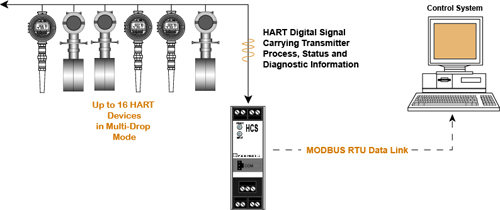
Q: We are interested in your HCS HART Concentrator System. What are the options for converting a single HART transmitter or for converting 16 transmitters with one unit?
A: You don’t have to choose between connecting one or multiple transmitters to the HCS. A single HCS unit can be configured by the user to interface with a single drop HART loop (one HART device) or to a multi-drop HART loop (2 to 16 HART devices).
In point-to-point HART mode, the HCS is set to monitor a single instrument. All process and diagnostic data carried on the HART data string is converted to MODBUS RTU.
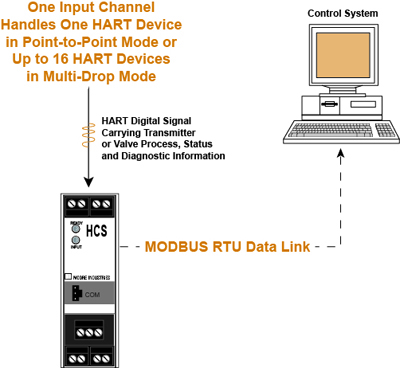
In a digital multidrop HART network, up to 16 HART instruments digitally communicate on the same wires. The HCS can be set to monitor any or all instruments and/or valves within the network. Only one MODBUS address, and one communication link (such as twisted wire pair), is needed to send the process and diagnostic data from up to 16 HART devices to a MODBUS host.
Do you want more information? Download the data sheet. Or visit the catalog.
Need to get price or availability or have a technical question?
Send us a message using E-Help.
 Under normal conditions, the loop resistance of thermocouples in service will gradually change over time. However, it is not uncommon to see the resistance of thermocouples start to quickly rise or even spike.
An unusual increase in thermocouple resistance can be caused by various factors including:
- Corrosion
- Poor junction connections with T/C extension wire
- Extended use in oxidizing atmospheres
- Wire thinning
- Hot end junction failure
This sensor degradation can compromise thermocouple measurements and eventually lead to sensor failure. This can be avoided when using the THZ3 and TDZ3 Dual Input Smart HART Temperature Transmitters and the STZ Functional Safety Dual Input Smart HART Temperature Transmitters. They can be configured to monitor the thermocouple loop for resistance changes and alert the user before the sensor fails.
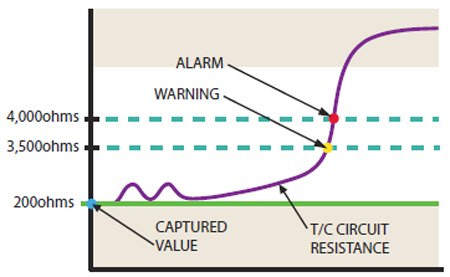
On installation, the transmitter captures a baseline resistance level and continuously monitors the thermocouple resistance. As shown above, the THZ3 and TDZ3 can be configured to send warnings or alarms once the resistance passes set levels. Detecting these changes in resistance levels can help detect and reduce sensor failures and a subsequent halt to processes.
Do you want more information? Download the data sheets: THZ3 and TDZ3 or STZ or see the Temperature Transmitters in the online catalog.
Need to get price or availability or have a technical question? Send us a message using E-Help.

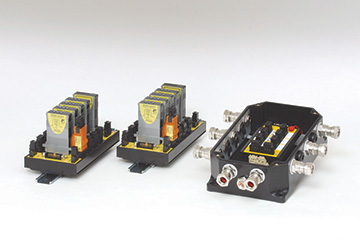 Find out about the best method for maintaining continuous communication between a control system and instruments on a FOUNDATION fieldbus H1 or PROFIBUS PA segment while attending upcoming Fieldbus Foundation End User seminars in Canada. Visitors to the booth of MooreHawke (a division of Moore Industries) can see a demo of the TRUNKSAFE Fault-Tolerant Fieldbus System when they attend seminars in Calgary on Sept. 22 or Edmonton on Sept. 24.
TRUNKSAFE is a cost-effective and highly reliable solution that creates a completely redundant physical fieldbus layer. In the event of a failure on a fieldbus segment, TRUNKSAFE makes it possible for the control system to switch immediately and automatically to a redundant path. This helps prevent the loss of a complete segment, the shutdown of associated plant or equipment, and potential catastrophic process failures.
Designed for important and plant-critical fieldbus segments, TRUNKSAFE utilizes two trunk cables (or “legs”) for physical layer redundancy to ensure no single point of failure will shut down the network. Under normal operation, the fieldbus segment is terminated at each end of the segment at the TRUNKSAFE Redundant Power Conditioners. TRUNKSAFE maintains fieldbus communications throughout the entire segment until a fault (open- or short-circuit) is detected. Upon fault detection, theTRUNKSAFE Device Coupler initiates its automatic segment termination so that the healthy leg is properly terminated. This patented, automatic system for fault detection and termination allows uninterrupted fieldbus communications throughout the segment. The host is informed about the fault via a contact closure output.
The upcoming Fieldbus Foundation events in Canada are free and you can register at their website.
Do you want more information? Download the data sheet. Or visit the catalog.
Need to get price or availability or have a technical question?
Send us a message using E-Help.

Q: We have been using the ECT-DIN in our applications where we need to split one 4-20mA input to two outputs. The model number for our current units is ECT/4-20MA/2X4-20MA/117AC/DIN. We now need to split a signal to three outputs. Do you have a product that will help us to do this?
A: If you need the splitter to provide the loop voltage for the third 4-20mA output, as you did in the previous installation, you can use two of the ECT/4-20MA/2X4-20MA/117AC/-TX [DIN] models and wire your 4-20mA in series to each of the ECT's inputs. This will provide you with up to four isolated outputs. This ECT model also comes standard with a -TX option which provides loop power, if required, to a power a two-wire transmitter.
An alternative option would be to use our MIX four channel isolator, model number MIX/4X4-20MA/4X4-20MA/12-42DC [DIN]. The input signal needs to be connected in series to at least three of the four inputs to meet your requirements. This option will also provide you with one spare channel.
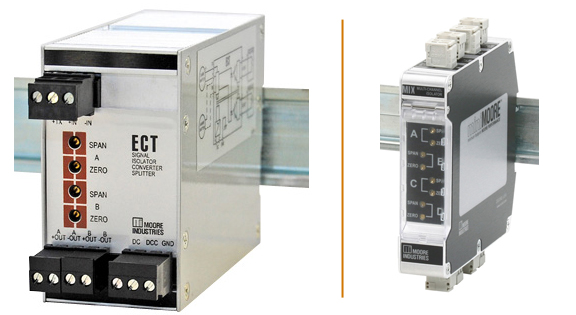
It is important to note that your receiving device will need to provide the loop power for each channel since each of the four MIX channels are output loop powered (passive outputs).
Do you want more information? Download the data sheet. Or visit the catalog.
Need to get price or availability or have a technical question?
Send us a message using E-Help.
 Moore Industries has added a new section to our website highlighting how the EMPHASIS assessment tool is applied to our products. Moore Industries worked with the Control and Instrumentation Nuclear Industries Forum (CINIF) in the United Kingdom in the original development of the EMPHASIS assessment tool for "Smart" instruments, with the STA trip alarm achieving SIL 2.
Since 2005 EDF Energy has assessed and qualified Moore Industries Smart devices using EMPHASIS including:
This section of our website has information relating to the EMPHASIS assessment tool. This includes a link to download our recent “Vetting Smart Instruments for the Nuclear Industry” white paper, which details how Moore Industries has designed and configured key products for nuclear safety-critical applications – particularly in the United Kingdom.
Released in 2005, EMPHASIS provides a common framework for determining the suitability of devices in nuclear industries. Earlier designs for process control and safety systems used “good engineering practices and experience” as guidelines. As functional safety awareness grew and software-based products became more complex, standards such as IEC 61508 evolved to create more comprehensive guidelines for implementing safety.
Moore Industries’ compliance with IEC 61508 significantly contributes toward the EMPHASIS assessment for Production Excellence, one of two “legs” used to substantiate safety to the regulator. The second leg involves Independent Confidence Building Measures – measures and techniques such as Static Analysis or Statistical Testing on a product’s source code to prevent potential systemic failures and also taking into account the application demands of the device to be deployed.
Do you want more information? Download the data sheet. Or visit the catalog.
Need to get price or availability or have a technical question?
Send us a message using E-Help.
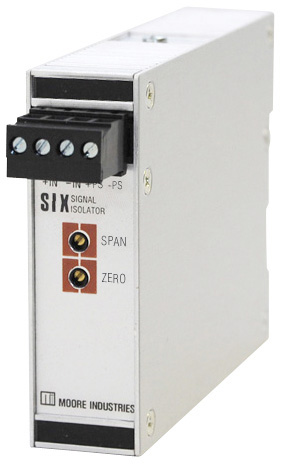 Q: Will the SIX Signal Isolator/Converter pass input signals through if the output is disconnected? We will be replacing our DCS, so we need to know if the input side will continue to work while the DCS is disconnected.
A: The SIX’s input has a passive 50 ohm resistance. Connecting the input of the SIX in series with the loop is the same as adding a 50 ohm resistor. This passive resistance is maintained whether the SIX’s output is receiving power or not.
Stay up-to-date on future developments and enhancements on this product and our other product lines, sign up for our customer newsletter.
Do you want more information? Download the data sheet. Or visit the catalog.
Need to get price or availability or have a technical question?
Send us a message using E-Help.
Q: I have an application where we are getting a very weak 4-20mA signal back to the pump control panel. Will using an ECT unit (model ECT/4-20MA/4-20MA/117AC-TX (ECD) help to boost my signal at all?
A: I assume that by “weak signal” you mean that the current input to your pump control panel is unable to reach 20mA? If this is the case you may have too many devices (too much voltage drop) in your loop now. This is often referred to as an overburdened loop. You may need to check the total loop resistance to assure that it is within your required specifications.
Adding this ECT to the loop will add 50 ohms to the input circuit, so if the resistance is already high, it will need to be reduced (possibly by moving devices to the output side of the loop). This ECT also has the ability (not required) to power the input loop (24v at 25mA), provides up to 1200 ohms of drive capability on the output side of the loop, and provides full three-way isolation between input, power and output.
Do you want more information? Download the data sheet. Or visit the catalog.
Need to get price or availability or have a technical question?
Send us a message using E-Help.

Here's a quick story from Mark Kuhlman at Temco highlighting just how durable our products are - even in the most extreme conditions:
According to Mark, one of his clients had a coal mill explosion and fire in a plant where our 535 Controllers were in use. Fortunately, no one was injured, but damage to instrumentation and other equipment near the source of the incident was extensive.
During cleanup, the client came across a 535 that was installed about 50 feet from where the explosion and initial fire occurred. To their amazement, it was operational despite having sustained obvious cosmetic damage because of the fire and explosion.
The photo above shows you just how severe the damage was to the 535 (click the gallery image below to see a larger view). It truly did take a licking and kept on ticking. This is a very extreme example of the reliability of Moore Industries' products. Our products are engineered and built to the highest specifications of quality and durability. When you buy our instrumentation, you can feel comfortable that it will operate in the harshest and most challenging situations.
Do you want more information? Download the data sheet. Or visit the catalog.
Need to get price or availability or have a technical question?
Send us a message using E-Help.

Moore Industries is always thinking about solving real world problems customers commonly face. In addition to providing world class instruments, we often get requests from customers regarding mechanical mounting challenges and retrofit situations. One example is a quick and convenient solution for cabinet and field installations called the G-Type DIN-rail adapter. This clever solution allows any Top Hat 35mm DIN-rail instrument to be immediately installed on an existing G-Type 32mm DIN-rail. This includes instruments from Moore Industries or any other manufacturer.
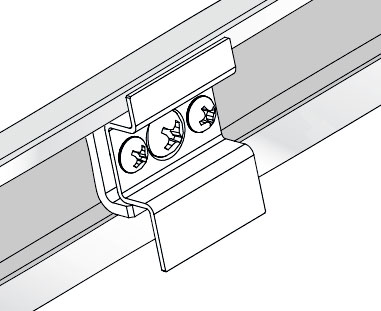
We’ve put together a video highlighting how the DIN-rail adapter works. Available for viewing at our Interface Solution Video Library, the video shows step-by-step instructions on how to assemble the DIN-rail adapter and use it to install an instrument. A link to the video is also available on the printed instructions that come with the DIN-rail adapter kit (part number 209-832-00).
Check out more informationon the G-Type DIN-rail adapter.
If you are interested in learning more about this product or getting a quote, contact us using EHELP or call us at +1 818-894-7111 or in the US, 800-999-2900.
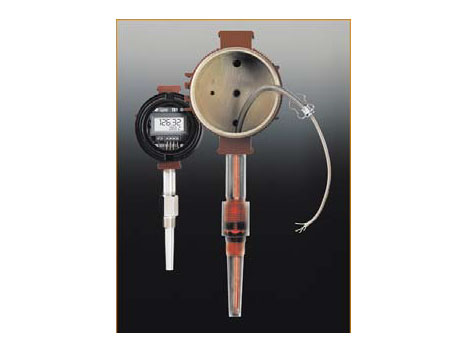 Q: Does the WORM Flexible Sensor RTD have a 3-wire option? If not, can I eliminate the fourth wire by jumping two of the parallel wires together?
A: Yes to both questions. If your transmitter or other measurement can only deal with a three-wire RTD, you can stow the orphan lead or connect it to the other wire of the same color. The alternative is to purchase a special three-wire version of the WORM RTD. However, to achieve greater measurement accuracy we recommend using a 4-wire RTD. You can learn more about the benefits of 4-wire RTDs and other ways to improve accuracy in our A Practical Guide to Improving Temperature Measurement Accuracy white paper.
Do you want more information? Download the data sheet. Or visit the catalog.
Need to get price or availability or have a technical question?
Send us a message using E-Help.
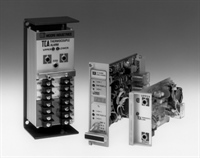 Q: We currently are using TCA Thermocouple Alarm units in our plant (model TCA/K-10MV/SX1/117AC/[STD]). The user’s manual says that the deadband is fixed at 1% of the input range. However, we need the TCA to trip at a set point of 190°F and reset at 180°F. Is this model capable of meeting this requirement and do you still manufacture this model?
A: Your model with the 1% deadband is not sufficient to handle the application. The model you need requires the Adjustable Deadband (-AD) option, which provides you a deadband adjustment of 1-20%. If you have a need for a larger deadband, the factory can assist you with selecting a newer microprocessor-based alarm module featuring increased configurability.
Do you want more information? Download the data sheet. Or visit the catalog.
Need to get price or availability or have a technical question?
Send us a message using E-Help.
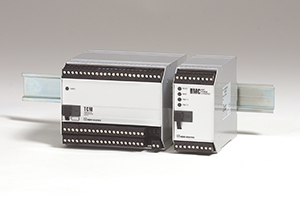 Moore Industries’ TCS Temperature Concentrator System is an ideal solution for low-cost temperature measurements. At its heart is the 16-channel, loop-powered (2-wire) TCM Temperature Concentrator Module. When two TCM modules are used in a TCS, up to 32 signals can be monitored over one twisted wire pair. The TCM is approved for use in hazardous areas (Div 2/Zone 2 and Div 1/Zone 0/1) and can be used with an HMC (HART to MODBUS RTU Converter) when communication with a MODBUS RTU master is required.
Using the TCS provides a precision measurement at less than 25 percent of the cost of a comparable standalone smart temperature transmitter. Hardware, wiring and installation costs are reduced because the TCS eliminates the need to install a dedicated transmitter and twisted-wire pair for each measurement. The compact design of the TCS also means a significant savings in real estate needs to measure temperatures.
These cost savings are just a few of the benefits of the TCS solution. Other key features include:
Universal Input Options: The TCM can be set to accept RTD (2-wire, 3-wire, 4-wire, PT, Cu or Ni), thermocouple (Types J, K, E, T, R, S, N, B or C), resistance/potentiometer (0 to 4000 ohms) and millivolt (-50 to 1,000mV) inputs. Custom input linearization can be defined for any input.
Deployment of HART and MODBUS RTU Communications: The HMC allows for communications with a MODBUS RTU-based host system. The ability to use either the standard HART or MODBUS communications protocols allow easy interface to a wide range of DCS, PLC and computer-based networks.
Generating Alarms: If the HMC is utilized it can be programmed to provide two alarm relay outputs. The relays can send a master alarm when the HMC detects one, any or all of the following fault conditions within the system:
- No HART signal
- Broken wire
- Hardware error
- Bad configuration
- Input saturated
- Input out of table range
Both alarms can be set with a time delay, which specifies how long the alarm condition needs to exist before the alarm trips.
Versatile Programming: The TCM’s operating parameters can be configured from any HART-based system or, using a standard HART handheld, from anywhere along the twisted wire pair. The TCM can also be configured using our Intelligent PC Configuration software.
Q: In specifying the Moore STA / HLPRG / 3PRG / U / -AO [DIN] our end user has a concern about electrical protection for the analog output. The desire is to use 4-20mA Output Loop Voltage sourced by DCS for the AO; however, this voltage may fault at up to 132 VAC. Should our design add fuse protection in the external voltage circuit upstream of the STA to protect it from these surges? Or does the STA include features that protect it from these faults?
A: A fuse will limit current but not excessive voltage. If the DCS cannot be configured for a sinking input, then I recommend using a “sacrificial” isolator. Connect the sourced output of the STA into the input of an output loop powered isolator. The output of the isolator goes to the DCS’s sourcing input. If there is a 132V fault voltage from the DCS, it will risk damaging the isolator and not the STA.
An example of such an isolator that would work is an ECT/4-20MA/4-20MA/12-42DC [DIN].
If this analog output from the STA is part of a safety path, then consider using the SSX/4-20MA/4-20MA/12-42DC [DIN] as it is a Functional Safety isolator designed for safety instrumented systems.
Download the ECT-DIN data sheet for more information.
Do you want more information? Download the data sheet. Or visit the catalog.
Need to get price or availability or have a technical question?
Send us a message using E-Help.
Moore Industries has done its part to get a historic World War II boat back in the water. We've donated products that helped The National WWII Museum in New Orleans to restore a classic Higgins Industries PT (Patrol Torpedo) boat that made it seaworthy again.
 The PT-305 is a small, light ship that launched fast torpedo attacks against enemy warships in the European Theater, becoming one of the few PT boats to engage in a gun battle with another ship when it sunk an Italian MAS boat in 1945. After the war, most PT boats were sold by the military to private companies. In the case of the PT-305, it was converted into an oyster boat and fished in the Chesapeake Bay until 2001. The PT-305 is rare: only five PT boats are known to exist in the United States with just one being operational.
The National WWII Museum is restored the boat back to its original glory, with as many original parts as possible. Unfortunately, the original master monitoring and control electronics panel could not be restored. Therefore, a modern PLC (Programmable Logic Controller) was installed to control the engines and monitor all the critical operating parameters of the boat. This is where Moore Industries’ THZ3 Dual Input Smart HART temperature transmitters came into play.
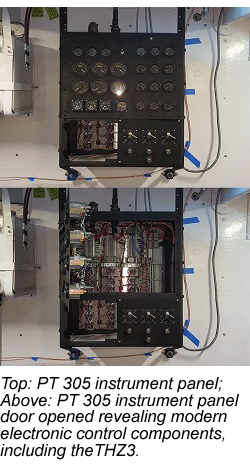 Many of the sensors monitoring the engine and other key parameters of the boat, such as strain gauges, thermometers, and torque sensors use older analog circuits and instruments that provide non-linear resistance (ohms) outputs. Since the THZ3 has the ability to build up to a 128-point custom input curve, these resistance signals can be linearized and converted to linear 4-20mA signals and sent to the PLC for control and monitoring.
One monitoring unit needs to be near the engine room that housed one of the three Packard 1500 horsepower, 2500 cubic inch engines. Because these engines run on aviation fuel, it is possible that under abnormal circumstances, aviation fuel fumes could be present. Therefore, the THZ3’s Class I Div 2 hazardous area approval and small hockey puck were additional features that led to its selection.
After 10 years of restoration efforts, PT-305 relaunched in March 2017 and became the world’s only fully restored combat-veteran PT boat in operation, offering rides and tours on the water of Lake Pontchartrain. On July 9, 2022, PT-305 completed her final journey going from Lake Ponchartrain to the Port of New Orleans.
Starting in early 2023 PT-305 will have a new permanent home on the National WWII Museums campus in the John E. Kushner Restoration Pavilion. Having PT-305 back on the museum’s campus will allow the opportunity for all museum visitors to observe the fully restored vessel up close and learn of her wartime crew members and tours of duty. The team at Moore Industries is proud to be a part of honoring and restoring such a historic and pivotal World War II vessel.
Learn more about the Higgins Industries PT-305 Restoration Project
Do you want more information? Download the data sheet. Or visit the catalog.
Need to get price or availability or have a technical question?
Send us a message using E-Help.

 Q: Do you have a signal alarm unit for a tank level application? I need it to meet the following requirements:
- Input signal accepts 4-20mA.
- Contacts opened or relay de-energized @ EL 208 ft.
- Equipped with up to four alarm trip relays.
- Individually configured for: set point, high or low trip, normally open or normally close, failsafe or non-failsafe, and latching or non-latching.
- Deadbands adjustable over 100% of span.
- Output relay equipped with form C contacts rated at 10A, 120VAC.
- All operating parameters adjustable from the front panel keypad.
- Operate on a 120V 60 Hz power source.
- Capable of supplying 24V dc power to two-wire transmitters.
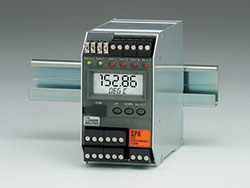
A: This is a perfect match for the Moore Industries SPA2 alarm trip unit. The SPA2 can handle all of your above requirements, with an exception and a clarification. Alarm set points for 208 feet should not be a problem assuming you have ranged your 4-20mA input to equal some engineering unit range of at least 208 feet, i.e. 4-20mA = 0-500 feet. The exception is with the the form C relays on the SPA2. They are rated for 5A, not 10A. Therefore, if you need a 10A relay we recommend using an interposing relay in conjunction with the SPA2 outputs. An example model number is: SPA2/HLPRG/4PRG/U [DIN]
Do you want more information? Download the data sheet. Or visit the catalog.
Need to get price or availability or have a technical question?
Send us a message using E-Help.
Q: HIX Application - It appears that if the "Primary Master" loop (input loop side of the HIX) is broken or open circuited, the "Secondary" loop (output loop side of the HIX) will be 0mA. Is this true? Maybe I can put a zener across the primary process terminals to keep the current loop when the process opens? Also, are both or either loops bi-directional HART? I have a 4-20mA input signal that I'd like to share between two 4-20mA/HART process loops. Actually, we currently use another vendor's device to "split" one 4-20mA input to four process loops but it doesn't pass HART.
A: The HIX is an output loop powered device that is an analog circuit, so the output will follow the input as far down as possible. If the input goes to zero mA on the HIX input circuit, the output will go down to about 2mA, but not all the way down to zero. This is due to the active parts of the power supply circuit, on the output side of the HIX, that continue to consume some trickle power to keep the unit “alive”. Yes, the HIX supports bi-directional HART communication.
If you are looking for a single input, dual output device that passes HART, then take a look at the SST series. Utilizing two of these SST splitters will offer you the four process loops with HART pass through capability. This device also supports bi-directional HART communication.
The outputs of the dual output SST normally source the loop voltage, but there is an option to make both outputs “passive”.
Download the HIX/HIT data sheet or the SST data sheet.
Do you want more information? Download the data sheet. Or visit the catalog.
Need to get price or availability or have a technical question?
Send us a message using E-Help.
 When something happens in your plant, whether it's a signal peak or fall, you have to know about it. A limit alarm trip can be a life saver, triggering the response needed to maintain normal, safe operations.
But nowadays just having an effective alarm trip solution may not be enough. Pushing forward in ways to protect life, community, environment and facilities, the process industry is experiencing dramatic increases in the need for functionally safe solutions. Alarm trips utilizing the IEC 61508 Functional Safety standards are designed to reduce risk by following established hardware and software safety lifecycle procedures as well as maintaining its stringent documentation requirements.
In addition, the application of intrinsically safe methods of protection to prevent explosions and fires in hazardous areas continues to grow. You can reduce your risk while saving money when you know about the option of using alarms that are associated apparatuses vs. separate barriers when implementing intrinsically safe alarm trip solutions.
Moore Industries’ technical paper Alarm Trips: The Ups and Downs has been expanded with added material on these topics to help keep you informed on the best solutions employing these safety standards and technologies.
 MODBUS still remains the most popular industrial networking standard in the process industries. MODBUS devices communicate over twisted pair, Ethernet, Fiber and even communicate via industrial wireless radios. Most often MODBUS slave devices communicate over RS-485 twisted pair networks that are abundant in most plants. The recent installation of Ethernet and Fiber backbones has led way to the use of many MODBUS/TCP devices.
The NCS NET Concentrator System has always supported peer-to-host and peer-to-peer network solutions via MODBUS RTU or MODBUS/TCP. However three common challenges still remained with MODBUS implementation.
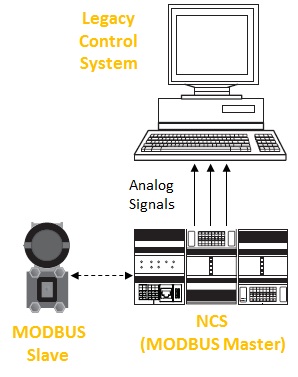
First, not all legacy control and monitoring host systems supported MODBUS; second MODBUS RTU slaves cannot communicate with one another without the assistance from a host control or monitoring system; and last the field device and the host system supported different versions of MODBUS - i.e. MODBUS RTU for the field device and MODBUS/TCP for the host system. Recently a MODBUS Master feature was added to the NCS to alleviate all three of these issues.
When there is a need to gather or monitor data from a MODBUS slave device by a legacy control system, the NCS now acts as a MODBUS Master to poll the MODBUS slave and convert its digital data to proportional analog signals (4-20mA or 1-5vdc) that can be wired directly to the legacy host system. The NCS has two independent MODBUS RS-485 ports which allows for more advanced MODBUS communication functions. For instance, when MODBUS RTU devices need to communicate with one another, the NCS can now poll a MODBUS RTU slave and write that data to another MODBUS RTU slave. Lastly the NCS can act as a gateway by gathering MODBUS RTU data from slave(s) and offering that as MODBUS/TCP data to a compliant MODBUS/TCP host.
If MODBUS is installed, or you are considering installing MODBUS in your plant, consider the NCS as universal MODBUS interfacing tool. The NCS has hazardous area approvals so installation in most field locations is not a problem.
Do you want more information? Download the data sheet. Or visit the catalog.
Need to get price or availability or have a technical question?
Send us a message using E-Help.
If you are involved in the production of natural gas and oil, you understand the challenge of providing power for monitoring and control instrumentation at site locations with limited power resources. One way to combat this is with the use of the HCS HART® Concentrator System from Moore Industries.
Watch a video showing how the HCS saves money and time by consolidating wiring and reducing power consumption at remote natural gas and oil production sites. The video is available for viewing at the Moore Industries Interface Solution Video Library and uses a real-world example from a natural gas site to show the value of the HCS in these settings.
The video shows a typical natural gas wellhead set-up, which includes tanks that store liquid and gas remnants. These tanks need to be monitored by level transmitters while temperature, flow and pressure transmitters are at other points in the process, with signals sent to a Remote Terminal Unit (RTU). Power is typically supplied by solar panels and batteries. Each of these transmitters can consume up to 20mA per measuring point, creating significant power needs and often requiring the use of large and expensive solar panels and battery packs. Using the HCS allows up to 16 HART smart transmitters to be multidropped onto one twisted pair, locking each of the smart HART transmitter’s power consumption at 4mA. The HCS also solves issues relating to hazardous area wiring requirements when installed in conjunction with a HART-capable Intrinsically Safe barrier.
Do you want more information? Download the data sheet. Or visit the catalog.
Need to get price or availability or have a technical question?
Send us a message using E-Help.

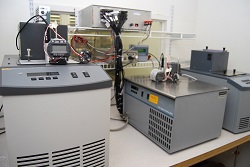 Q: I have a project for six RTD measurements that makes using standard fixed length sensors difficult because there is little clearance near the top of the thermowell for sensor insertion. It looks like your “WORM Sensor” would be an ideal fit for the application because of its flexible design. These RTD sensors need to be 100 or 1000 ohm platinum elements with Class A or 1/3 DIN accuracy ratings. They will be used to monitor chilled and hot water lines with min and max temperature limits of 30 F and 180 F. Maximum insertion length in these ¼ inch ID thermowells is about 10 inches. I noticed that your standard WORM length is 24 or 36 inches. Are custom length WORM sensors available? If so, what cost is associated with ordering multiple sensors at custom lengths? Lastly, we usually request test data with all of our sensors and check them in our air bath or heat block calibration units. Can you offer a test report or test data points with these WORM sensors?
A: We stock the WORM Sensor in standard lengths of 24 and 36 inches for quickest delivery. At any time, you can order shorter lengths at any quantity at no additional cost. However, one of the many unique advantages of the WORM sensor is that it is field-trimmable. All that you need to do to shorten the insertion length of any WORM sensor is trim the length of the spring and lead wires. This makes it the perfect sensor for stores or stockroom. If you need a WORM sensor longer than 24 or 36 inches, contact us and we can build custom length WORMs to match your application requirements.
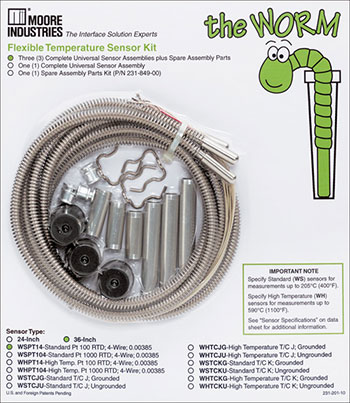 The 24 and 36 inch WORM sensors are sold separately or you can save money if you purchase our prepackaged WORMs in a three pack or 10 pack. The 10 pack of sensors, called the “Can of WORMS”, offers the greatest cost savings for your application of six elements. The WORM sensor was designed to handle two temperature ranges: Standard and High Temperature, designated respectively by “WS” and “WH” in the model number. The temperature limits in your application can easily be handled by the WS standard WORM element.
With regard to sensor accuracy, we only build our RTD sensors to meet the newest IEC 60751 standards. This standard addresses the requirements needed to meet tolerance levels required for different classes of RTDs that include Class AA, A, B and C. Moore Industries only supplies Class AA and A sensors when increased accuracy or calibration requests are mode on sensors and assemblies. Additionally we thermally age our sensors for 1,000 hours. When the RTD element is temperature aged, it ensures that the platinum substrate material inside the sealed element will provide a more stable and long term repeatable output. This helps reduce the frequency of transmitter and input card calibration due to sensor drifting.
Moore Industries offers certified calibration services for sensors and sensor-transmitter assemblies. For your application we can offer you a –VTD calibration option. With this option we will use our NIST traceable oil calibration bath to take and record five temperature/resistance points within your requested temperature range, and offer a test data report. This test report will list the sensor serial number, date of calibration and all of the NIST traceable calibration equipment we used to perform the test.
Most often our customers request that we calibrate and certify the full temperature assembly, using our –VTB option. This offers the best accuracy since we are matching your sensor to the transmitter and calibrating them as an overall measurement assembly or system. We only certify these assemblies utilizing Class A (.06%) or Class AA (.04%) sensors since they drift less and offer the most long term repeatable measurements.
For customers who are required to validate accuracy performance on a regular cycle, our -VTB calibration option reduces the need to calibrate so often. In many cases customers do not have the equipment with the required accuracy levels to perform onsite calibrations. Moreover, the cost of calibration performed by us is only a fraction of the cost that it would cost them.
Get the details on Moore Industries WORM Flexible Sensors. Download the Get Rid of Rigid technical paper for insights to using flexible sensors, and the WORM data sheet.
Do you want more information? Download the data sheet. Or visit the catalog.
Need to get price or availability or have a technical question?
Send us a message using E-Help.
The new Industries section on the Moore Industries website makes finding industry-specific applications easier. With one click you can now directly access information relevant to your industry instead of having to search through the website.
One of the featured industries is Oil & Gas: Downstream/Refining. Delays at refineries can waste resources and push out deliveries so we’ve put together content on this page that will take you directly to Applications, Case Studies, Papers and Articles, Problem Solvers and Product links that can address concerns before they become real-world issues. Whether you process products such as gasoline or petrol, kerosene, jet fuel, diesel oil, heating oil, fuel oils, lubricants, waxes, natural gas, liquefied petroleum gas or any of hundreds of petrochemicals, this is an easy place to go for information on ways that Moore Industries know-how and products can help improve downstream processes.
You can also save this bookmark to go straight to the new pages.
The Industries section will keep growing as we continue to publish new material.
For a summary of all Moore Industries product lines, visit our Main Products Selection Index page.
Do you want more information? Download the data sheet. Or visit the catalog.
Need to get price or availability or have a technical question?
Send us a message using E-Help.
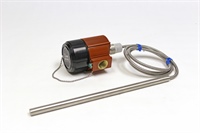 Q: We want three 100 ohm, .00385 Alpha RTDs to measure heated glucose in railroad cars. We heat the glucose to 140-150°F, and want to use a 5-foot long flexible sensor with a head on top containing a terminal strip. We also want to run flexible conduit from the head with copper wire for easy replacement access. We can fabricate a bracket that would span the midway above the railcar that supports the housings and includes holes that allow the flexible RTDs to drop down for installation. What do you offer that is a fit for our application?
A: Moore Industries has several variations of its WORM sensor precisely for liquid measurement applications. Using the WORM with our specially-designed 12-inch weighted bar, which is potted at the end of its capsule, offers stability from swinging or moving when suspended in liquids. We also offer a -30G potted option which provides added protection from extreme shock in harsh environments.
One of the best features of this assembly is the Teflon insulated leads sealed inside a Teflon jacket. This protects the lead wires from liquids penetrating the insulation and potentially causing shorts. For maximum protection against very harsh abrasive environments, we have also added flex armor cable over the Teflon jacketed leads. Flex armor also acts as an additional weight to the entire assembly yet is still flexible enough to raise and lower the tip of the WORM.
Another feature of this assembly is the 0.50-inch outside diameter of the weighted bar. This allows insertion of the bar through a ½-inch NPT threaded hole for easy installation.
At the transmitter where the lead wires enter the housing, we use a sealed stainless steel sleeve attached to the flex armor cable which is sealed at the lead wires. This provides a sealed and rigid spot where we add a compression fitting for securing the assembly to the housing. In addition this sleeve and compression fitting allow the installer to adjust the depth of the WORM assembly.
For additional reading on Moore Industries’ WORM Flexible Temperature Transmitter, download these white papers: Measuring Molasses with the WORM and Get Rid of Rigid.
Do you want more information? Download the data sheet. Or visit the catalog.
Need to get price or availability or have a technical question?
Send us a message using E-Help.
When you add a single safety loop, have a few points to isolate or need to augment a larger Safety Instrumented System, Problem Solver application examples can help. They provide an at-a-glance example intended to convey solutions for particular application scenarios. Along with our white papers, this series of Problem Solvers for Functional Safety can be a useful resource for your functional safety project. Currently, available Problem Solvers include:
- Monitoring for Thermal Runaways Due to Exothermic Reactions
- Passing HART Signals While Maintaining Safety Isolation
- Using the SSX to Isolate Your Safety Instrumented System
- Using the STA as a SIL 2 Temperature Transmitter
- Using the STA as a Single Loop Logic Solver
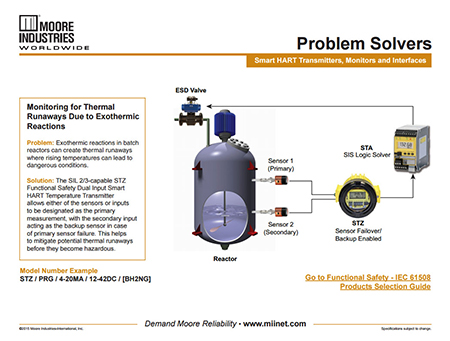
To learn about the Functional Safety products we design and manufacture, visit the Product Information page.
We also have Problem Solvers for many other types of applications which you can get by visiting the main Problem Solvers page. Since we add new applications from time to time we suggest subscribing to our newsletter to get the latest updates.
You can also contact our EHELP support team with questions on products, applications and pricing.
Do you want more information? Download the data sheet. Or visit the catalog.
Need to get price or availability or have a technical question?
Send us a message using E-Help.
 Q: We want to install an
STA / HLPRG / 3PRG / U / -AO [DIN] into our process and plan to use 4-20mA output loop voltage sourced by a DCS for the analog output, however this voltage may fault at up to 132 VAC. Should we design in fuse protection to the external voltage circuit upstream of the STA to protect it from these surges? Or does the STA include features that protect it from these faults?
A: A fuse will limit current but not excessive voltage. If the DCS cannot be configured for a sinking input, then we recommend using a “sacrificial” isolator.
To do this, connect the sourced output of the STA to the input of an output loop powered isolator. The output of the isolator goes to the sourcing input of the DCS. If there is a 132V fault voltage from the DCS, it will risk damaging the isolator and not the STA.
For information on the STA, download the data sheet.
Do you want more information? Download the data sheet. Or visit the catalog.
Need to get price or availability or have a technical question?
Send us a message using E-Help.
Moore Industries has been around a long time and serves numerous industries. Over the years, we have accumulated a broad spectrum of information and resources. In response to suggestions by our reps and customers, we have created the new Industries section on our website to make finding industry-related information easier. With one click you are now able to directly access information relevant to your industry instead of having to search through the website.
One of these Industry pages is Oil & Gas: Upstream/Extraction. Content on this page will take you directly to Applications, Case Studies, Papers and Articles, Problem Solvers, Videos and Product links specific to this industry. It is an easy place to direct end-users for information on ways that Moore Industries products and know-how can improve their processes.
The Industry section will keep growing as we continue to publish resources and add links.
For a summary of all Moore Industries product lines, visit our Main Products Selection Index page.
Do you want more information? Download the data sheet. Or visit the catalog.
Need to get price or availability or have a technical question?
Send us a message using E-Help.
 Q. What is the least expensive way to speed up the response time of a sensor installed inside of a thermowell? We have a reactor associated with a quickly changing process and need to be able to control any sudden changes. What do you suggest?
A. We can suggest several solutions:
If you reduce the mass of the thermowell stem, which is the portion inserted into the process, sensitivity to the response will increase.
Another option is to add temperature sensitive paste to the inside of the thermowell to fill in the air space and allow temperature changes to more quickly conduct to the sensor sheath.
Our last recommendation is to reduce the sheath length, which you can do by using one of Moore Industries’ WORM flexible temperature sensors. The WORM has a very short sheath length of 1.5-inches and responds to temperature changes 13% faster than a longer fixed sheath. (Keep in mind: The longer the sheath length the longer the response time). Also, reducing the sheath diameter will speed up response. The WORM sensor also has a reduced tip outside diameter (OD) of 6mm. The shorter and smaller the OD of the sheath, the faster the response rate. Replacing your existing sensor with the WORM sensor should immediately show improved response time.
To read more about the WORM, download the data sheet.
You can also download the Getting Rid of Rigid White Paper for insights to using flexible sensors.
Do you want more information? Download the data sheet. Or visit the catalog.
Need to get price or availability or have a technical question?
Send us a message using E-Help.
 Q: We have several outdoor temperature applications where we measure the temperatures of pipes running alongside cooling towers. These sensors are in several different locations and zip-tied to the outer surface of the cooling pipes. Our problem has been that exposure to rain, sun and heavy snow causes signals to drop off or spike. We believe moisture is getting into the wire jacket and the environmental exposure is causing false readings. The sensors we use have a PVC jacket over the lead wires and it shows cracking over time. We need to replace the sensors and would like a 4-20mA output signal to go from our junction box out to the field instead of running the sensor lead wires all the way back to our monitoring system. What type of solution do you have for this?
A: Surface mounted temperature measurements is an area Moore Industries excels in and we build a variety of mountable measurement devices. Our WORM sensors offer Flex Armor Cable or Stainless Steel braid options to provide greater protection from exposure. Also, we offer sensors that have Teflon insulated leads with a Teflon jacket that can withstand liquids and provide protection from cracking with a temperature tolerance from -200 to +500°F.
To secure the WORM sensor to your pipe, use our “CLAMP” fitting which uses a pipe band for a secure fit. We can add Flex Armor over the Teflon jacket and run it along the surface of the pipe and back to your junction box. At the junction box you can install one of our TRY/TRX or THZ3 two-wire loop powered Hockey Puck (HP) housed temperature transmitters to achieve a 4-20mA output that can be wired back to your monitoring system over your existing lead wires (we also have additional installation options if an HP transmitter will not fit in your existing junction box).
Do you want more information? Download the data sheet. Or visit the catalog.
Need to get price or availability or have a technical question?
Send us a message using E-Help.
Q: Currently we monitor the temperature level in our oven with a thermocouple and let our PLC control the oven. We now need to implement a high-temperature Safety Instrumented Function (SIF). Do we need duplicate temperature sensors and do you have a Functional Safety device that can provide oven shutdown capability on high temperature?
A: A requirement of the SIF is for a safety function to be independent from the control system with the expectation that the safety loop will not fail should the regular process control loop incur a sensor, controller or any other failure. Therefore, it is recommended you not use the same sensing devices (thermocouple in your instance) for the safety function and control system. Other considerations to factor in are maintenance and proof testing of the SIF. If either affects the control system, interruptions to normal operation during this time will be experienced. If a common sensor is used, then a risk analysis must be performed.(Please refer to IEC61508 standard section 7.4.2.3 and ISA84/IEC61511 Part 1 11.2.10 and Part 2 11.2 for more information.)
To maintain a safe, operable system, SIL (Safety Integrity Level) guidelines state that your SIF would have an independent temperature sensor housed in a different thermowell. For improved safety, use of different technologies for these sensors avoids common cause failures in the control and safety functions; either different types of thermocouples or an RTD if temperature limits allow. Best practice is to duplicate transmission of the safety sensor signals to the control system. Such an arrangement can lead to improved diagnostic coverage by allowing signal comparison between control and safety sensors.
For this SIF, we recommended using products from Moore Industries’ Functional Safety Series which are independently assessed and certified by exida. The STA Functional Safety Trip Alarm can be used to monitor the oven’s thermocouple sensor and includes two user-configurable failsafe process trip alarms. It also has an isolated 4-20mA analog output signal which can be sent to the primary control system for comparison with the process control temperature signal.
If additional process relay outputs are required you can use the SRM Functional Safety Relay Module. The SRM accepts an input from one of the STA process relay outputs and offers three additional relays that can be used to drive other output loads.
The STA Functional Safety Trip Alarm and SRM Functional Safety Relay Module are available with IEC 61508 certificates from exida, safety manuals and FMEDA reports for your SIF calculations.
For more questions regarding application concerns and compatibility, contact us at
E-HELP EXPRESS.
Do you want more information? Download the data sheet. Or visit the catalog.
Need to get price or availability or have a technical question?
Send us a message using E-Help.
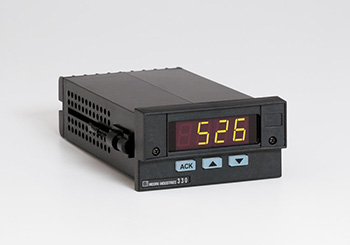 Q: My Model 330R process monitor with display has configurable threshold output relays that I need to set in order to activate a 125Vdc battery powered circuit which is part of a failsafe control room application. How would I set these up when standard instrument relays are rated at 125/240Vac and 24Vac/dc?
A: The Model 330R process monitor threshold alarm relays are ‘compact’ relays designed to activate ‘external intermediate’ relays. High DC voltage (and/or current) switching is always performed on the output contacts of a stand-alone external intermediate relay because high voltage DC switching (opening of relay contacts) creates a sustained high temperature plasma arc. This arc cannot be readily extinguished in a small instrument package, therefore, the relay sacrificially absorbs the excess energy. This ultimately requires replacement of the relay however this is a more economical alternative to replacing a blown panel meter.
A proven solution for the high DC current at high voltages need is to use Form ‘X’ style relays with a built-in magnet (this is a readily available industrial relay product which also comes in a DPDT configuration) as your intermediate relays. The coils of these intermediate relays are driven by the standard voltage/current relays as in the Model 330R series. A quick Internet search of ‘Form X relay schematic’ will provide you with wiring instructions.
A Form X relay has an optional magnet (recommended for DC voltage applications). As the relay opens, a small to moderate sized electrical plasma arc always occurs. The magnet pushes the arc away from a straight line and onto a longer distance pathway. Thus the Form X relay’s mechanical doubling of contact separation distance along with the properties of the installed magnet significantly increase the arc travel distance and more quickly extinguish the DC plasma arc. When wiring for DC switching, be mindful of the polarity of the electrical contact pathway through the magnetic field to ensure that you are extending the arc distance.
To optimally select a Form X relay:
- Perform an Internet search for ‘Form X relay with magnetic blowout’
- Specify a clear relay package referred to as an ‘ice cube’. This permits visual inspection of the relay’s internal movements.
- Specify the relay ice cube package with either a DIN rail socket or a panel mount socket with a retaining clip so the relay does not fall out of the socket as may occur in high vibration applications.
To learn more about the Model 330R, download the datasheet.
Do you want more information? Download the data sheet. Or visit the catalog.
Need to get price or availability or have a technical question?
Send us a message using E-Help.
Q. We have several short thermowells in our process, ranging from 2-inches to 6-inches. Our process is very stable, but we have noticed a temperature measurement shift when the outside air temperature rises or falls. We have tried calibration, but it still doesn’t correct the temperature swing we see. What would you suggest we change that will prevent these temperature swings?
A. The most active area of a sensor can be approximated as 4 to 10 times the length of the installed element. As temperatures change outside the process, the upper portion of the sheath is exposed to these fluctuations. This part of the sheath senses a temperature difference then measures it, influencing the temperature along the full length of the sheath. We regularly see this occurrence when calibrating sensors with long sheath length exposed outside of calibration baths. The only way to measure true process temperature is to keep the sheath as short as possible.
Moore Industries manufactures the WORM, a sensor with a very short sheath length of 1.5-inches. Worm sensors are spring loaded to stay at the bottom of the thermowell. They have a faster response time and the lead wires do not measure temperature changes outside the process connection. They do not sense any outside temperature swings and only measure temperature inside the bottom area of the thermowell.
To read more about the WORM, download the data sheet.
You can also download the Get Rid of Rigid White Paper for more information on using the WORM in your process.
Do you want more information? Download the data sheet. Or visit the catalog.
Need to get price or availability or have a technical question?
Send us a message using E-Help.
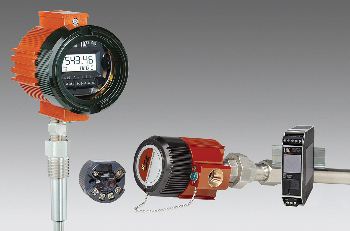 Moore Industries’ release of the THZ3 and TDZ3, our next gen Smart HART temperature transmitters, officially replaced the retired THZ2 and TDZ2 product lines.
Moore Industries is no longer building or fulfilling orders placed for the THZ2 and TDZ2, offering the THZ3 and TDZ3 in their place.
The 3rd generation temperature transmitters continue to offer our industry leading durability and reliability and introduce several new features that increase usability and functionality. The most significant feature is the new dual sensor input.
There are, however, a few THZ2-HPP units still available for replacement business. For new applications, you should continue specifying THZ3/TDZ3 temperature transmitters and assemblies.
The THZ3 and TDZ3 2-wire (loop powered) transmitters provide everything that made their 2nd gen predecessors popular products:
- Isolated and linear 4-20mA output proportional to input
- Quick and easy configuration
- Direct signal input from a wide array of sensors and analog devices including 14 RTD and nine thermocouple types; Resistance and potentiometer devices; Direct millivolt sources
- Sensor drift and corrosion detection
- Smart range alarms with four HART alarms
- High Availability option that allows nuisance alarm prevention settings
- Input simulation capability allowing users to test the AO or any HART diagnostic and range alarms
- Industry-best input-to-output analog accuracy of up to ±0.014°C (±0.025°F)
- Industry-best 20-bit input resolution and exceptional input accuracy for all sensor types
- Moore Industries’ patented continuous sensor diagnostics feature saving you from costly lost production and troubleshooting time
- Advanced RFI/EMI protection and ambient temperature compensation
- Long-term stability providing up to 5 years between scheduled calibrations
The new dual sensor input takes the transmitters to the next level by allowing the THZ3 and TDZ3 to:
- Offer backup and fail-over protection
- Multidrop up to 15 THZ3or TDZ3 transmitters on one digital HART loop to monitor up to 30 temperature points
- Perform Averaging and Differential measurements
- Continuously monitor, and designate a source, for the analog output or PV
- Utilize Dynamic Variable Mapping to assign either the input, or the calculated result of the inputs, to any of the four HART variables
The THZ3 and TDZ3 transmitters are also:
- HART 7 compliant
- HART and DTM programmable with user-oriented basic configuration
- Configurable with HART handheld communicator and/or HART compatible hosts
- Programmable or monitored using any FDT compliant host or program, such as PACTware, when using the THZ3/TDZ3DTM
Do you want more information? Download the data sheet. Or visit the catalog.
Need to get price or availability or have a technical question?
Send us a message using E-Help.
For in-depth specifications and overview of the THZ3 & TDZ3
 Moore Industries was founded in 1968 by Leonard W. Moore, who is still chairman of the board and has a daily presence at the company’s North Hills, CA, headquarters. The company started out as a three-person operation in a garage in California, and now has offices worldwide in Australia, Belgium, China, The Netherlands and The United Kingdom. It is one of the last independent, privately owned instrument companies left in North America.
Moore Industries started out making signal conditioners. “After working in the instrumentation industry for a few years, I saw a market for tough, reliable, noise-resistant signal conditioners,” says Mr. Moore. At that time, reliable and rugged devices were difficult to find and in some cases gaps existed where a device that could have streamlined an operation did not yet exist. As a natural progression of the company’s forward-looking vision, a broad catalog of offerings developed to fill those gaps.
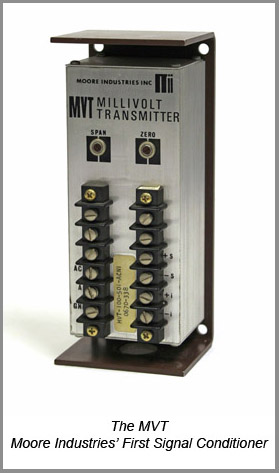
Moore Industries kept taking the natural next steps in its evolution in the process world. From his years in the instrumentation industry, Mr. Moore recognized the inherent need for durability and safety in products that would be housed in closed spaces around electricity, volatile gases and personnel. In 1972, the company was the first to build products with RFI protection, extruded aluminum housings and interlocking corners—before any certifications existed making these features necessary. The company was also an industry leader in building products with input-to-output isolation.
Today, Moore Industries designs, manufactures and sells many types of instruments including alarms, HART interface devices, complete temperature sensing and transmitting products, signal conditioners and isolators and IEC 61508-certified Functional Safety devices and Explosion/Flame-proof enclosures. The company’s dedication to safety ranges from hazardous area protection, as provided with Explosion/Flame-proof enclosures and intrinsically-safe devices, to internal circuitry, firmware and development process design as it moved into the Functional Safety arena.
Moore Industries maintains numerous stringent certifications for many of its products ranging from CE compliance, Non-Incendive, Intrinsically-Safe and Explosion/Flameproof approvals. The company was an early adopter of IEC 61508 and was engaged by British Energy (known today as EDF Energy) to help develop guidelines for the assessment of ‘Smart’ devices to be used in safety-related or safety-critical applications within the UK nuclear industries, called EMPHASIS. In addition to providing EMPHASIS approved products, the company has received functional safety certifications from exida and TUV on products as well as its design, development, manufacturing and documentation process.
It is far from unusual for an employee at Moore Industries to tell you that they have been with the company for 15, 20 or even 30 years. Each year, during Years of Service awards, multiple names of individuals who have been with the company in double-digit years are announced. This speaks to the respect and pride employees have in working for a company that feels like family, still designs and manufactures in the U.S and has safety of people and processes as its utmost focus.

To learn about Moore Industries products, visit our Product page.
Do you want more information? Download the data sheet. Or visit the catalog.
Need to get price or availability or have a technical question?
Send us a message using E-Help.
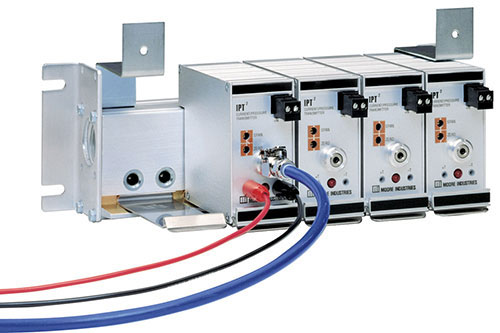 Q: We need to combine a new system for reading tank levels with an existing system by replacing a Hagan instrument with a new Rosemount device. However, we need to ensure we can still run an existing 3-27psi pneumatic chart recorder. We’re considering using an I/P, but aren’t sure if the 4-20mA output from the new transmitter can be piggybacked. Is this possible?
A: If the 4-20mA loop can drive the load presented by Moore Industries’ I/P then you can piggyback the output and run your chart recorder. Our model IPT2 (DIN rail mounted) consumes 7.5V of the available loop compliance voltage. Our model IPX2 (field mounted) consumes 5V of the available loop compliance voltage. Both models offer a 3-27psi output.
For additional information, download the datasheet: IPT2 and IPX2.
Do you want more information? Download the data sheet. Or visit the catalog.
Need to get price or availability or have a technical question?
Send us a message using E-Help.
Q: You have a product called HART Interface Module (HIM) that will pull the 2nd, 3rd and 4th HART variables from a transmitter signal and create one 4-20mA signal for each. Do you have or know of an instrument that will take multiple 4-20mA signals and output them on one 4-20mA signal as HART dynamic variables? I would like to read three transmitters on one 4-20mA signal by reading the variables on my DCS system.
A: We have two products that take multiple inputs and output a HART signal that can be read by a HART host. Those two products are the TCM and the THZ3/TDZ3.
The TCM is a 16 channel input module that accepts multiple temperature, resistance and millivolt signals and offers a HART output or a MODBUS RTU output. For 4-20mA inputs the TCM accepts them across a resistor or shunt input as a mV input. Those signals can then be read by a HART host using a custom HART command. For a MODBUS RTU output a separate HART to MODBUS converter, called the HMC, is used. For more information on the TCM and HMC (which together comprise the TCS) download the TCS data sheet.
The THZ3/TDZ3 Smart HART Temperature Transmitter can accept two (not three) 4-20mA
signals and write them to two of the HART dynamic variables riding on the analog 4-20mA
output.
A wiring diagram showing how to wire the THZ3 to accept two 4-20mA input signals is available in the Installation Manual which you can download here. For more information, download the THZ3 data sheet.
For more information on the HIM, download the data sheet.
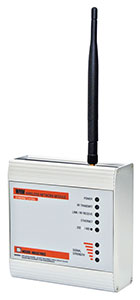 Our WNM Wireless Network Module now has both Serial and Ethernet interfaces conveniently included into one model and has been updated with a new, sleeker housing.
The WNM provides accurate and reliable point-to-point and point-to-multipoint wireless connectivity between remote field sites when wires can’t be run for practical or economic reasons. It is a bi-directional, spread spectrum radio modem that delivers the flexibility and cost-saving advantages of wireless data transmission. Its Frequency Hopping Spread Spectrum (FHSS) communication ensures reliable, noise and interference immune, license-free wireless communications.
To learn about the updated WNM, see its new dimensions or for updated ordering information, download the data sheet.
Do you want more information? Download the data sheet. Or visit the catalog.
Need to get price or availability or have a technical question?
Send us a message using E-Help.

Q. We have been using 3-wire RTDs in our process for years and are required to check the calibration once every 6 months. Each time we have checked the sensors we’ve noticed they have drifted. This requires us to re-calibrate our temperature transmitters. Do you have something you can suggest to help us reduce the drifting problem we regularly see in these sensors?
A. The problem with 3-wire RTDs is that the lead wires build up small amounts of corrosion causing a lead wire imbalance which results in measurement errors. If these are Platinum 100 ohm RTDs, just one ohm of resistance change on any lead wire can represent a +4.7°F degree error. We suggest using 4-wire RTDs which compensate for unequal resistance in the lead wires. For this to be an option your temperature transmitters need to accept a true 4-wire sensor input. Some temperature transmitters, PLCs, and DCS input cards only accept 3-wire RTDs. Others indicate a place to connect a fourth wire, but do not use it for measurement.
You can also use Class A RTDs with 4 wires and a transmitter that can accept and be calibrated with a 4-wire RTD. Our Class A element RTDs with a .06% accuracy have been cycled for 1000 hours, and will hold their accuracy for a 5 year period.
You can learn more about using 3-wire and 4-wire RTDs in the white paper: A Practical Guide to Improving Temperature Measurement Accuracy.
These Moore Industries temperature transmitters are designed to accept true 4-wire RTDs: RIY, STZ, TCS, TDY, TFZ, THZ, THZ3/TDZ3, TPZ, TRY, TRX. For these and other Moore Industries temperature solutions, visit our Temperature Sensors, Transmitters and Assemblies page.
Do you want more information? Download the data sheet. Or visit the catalog.
Need to get price or availability or have a technical question?
Send us a message using E-Help.
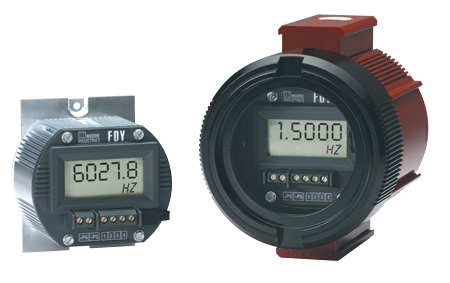 Q: I would like to use either FDY/PRG/4-20MA/12-42DC [HPDN] or FDY/PRG/4-20MA/12-42DC [BH2NG] and I want to install it in a control panel enclosure rated Type 4X. I need to ensure it is suitable for Class I, Div 2. Which one is the best solution?
A: The FDY/PRG/4-20MA/12-42DC [HPDN] without the BH2NG enclosure is Class I, Div 2 rated. It meets the Div 2 requirements when installed in your Type 4 box. You can download the certificate here.
The FDY/PRG/4-20MA/12-42DC [BH2NG], is an explosion proof transmitter approved for use in Class I, Div 1 hazardous areas. This is the same FDY device except it is housed inside the explosion proof/flameproof BH2NG enclosure. This BH2HG enclosure is also rated Type 4X & IP66 which means that it offers sufficient environmental protection to allow it to also be classified as a Class I, Div 2 or Non-Incendive device. The FDY/PRG/4-20MA/12-30DC/-ISF with the [HPDN] housing designation or enclosed in a BH type housing carries intrinsically-safe approvals.
Download the FDY datasheet.
Do you want more information? Download the data sheet. Or visit the catalog.
Need to get price or availability or have a technical question?
Send us a message using E-Help.
Q. I have a temperature application that requires a 12-inch thermowell which can withstand a high temperature of 2,000°F. Most of what we have been using becomes brittle and breaks off at the tip. What would you suggest we use, and what type of sensors do you have that will work for us?
A. We have several different types of metals we can suggest with maximum temperatures up to 2,160°F. Materials that will work well for the thermowell in your application are SS446, SS310, and Inconel 600.
For the sensor type, we recommend a thermocouple Type “K” with Inconel 600 material for the sheath. Also, using 2-inches of thermal-lagging for the thermowell will reduce heat going into the head.
If possible, remote mount the temperature transmitter away from the process connection. Even though Moore Industries temperature transmitters are rated up to 185°F, it could get too hot inside the head if it were mounted directly on top of the process. If you must mount the transmitter near the process connection, we suggest using a stainless steel housing and a ceramic terminal block to terminate the sensor at the process.
Do you want more information? Download the data sheet. Or visit the catalog.
Need to get price or availability or have a technical question?
Send us a message using E-Help.
 Q: We have an R-BOX in a Class 1 Div 2 location with a 120VAC instrument inside. Is this enclosure rated for this atmosphere? It does not appear to have a very good seal for this environment.
A: The R-BOX was designed to meet a Type 4X and IP66 rating, which is suitable for housing a Div 2 approved device. The hazardous area protection is provided by the non-incendive nature of the Div 2 rated device mounted inside. The enclosure simply needs to provide protection from the ambient elements or other flying conductive material.
Learn more by downloading the R-BOX datasheet.
Do you want more information? Download the data sheet. Or visit the catalog.
Need to get price or availability or have a technical question?
Send us a message using E-Help.
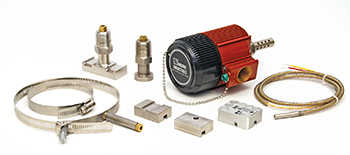 Q. We want to measure bearing temperature in our motors to alert us of overheating. We have used a type of sensor which inserts into the side of the motor, but they leak and fail often. We would like to put something on the surface of the motor outside of the bearing housing, but we do not want something welded to the housing. What can you suggest?
A. The best solution for your application is a WORM sensor with a Magnetic Pad (-MPAD). The -MPAD has 40lbs of attraction and will hold up to a vibrating surface. We also suggest adding our 30G option to the RTD, in order to protect the RTD element inside the sheath from high vibration during motor operation. Standard fixed length sensors cannot withstand this vibration over time. The -MPAD with WORM sensor is easy to install on any ferrous metal surface.
Download the RTI-3 datasheet for more information.
Do you want more information? Download the data sheet. Or visit the catalog.
Need to get price or availability or have a technical question?
Send us a message using E-Help.
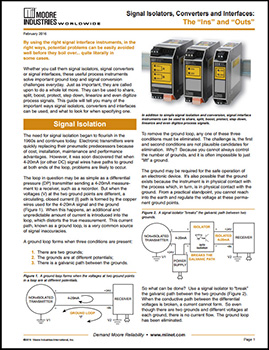 With electronic equipment making up much of process hardware, the potential for system noise and interference with process signals can come with the package. Frustrations from downtime and troubleshooting in your plant can be avoided by understanding the principles of signal isolation, conversion and interfaces. A comprehensive resource for determining which instrumentation to use, and how to use it, is Moore Industries’ Signal Isolators, Converters and Interfaces: The “Ins” and “Outs” White Paper. It has recently been updated and is ready for download from the Technical White Paperssection of the Moore Industries website.
The white paper delves into the important ways signal isolators, converters and interfaces can be used and what to look for when specifying products for applications. It also expands on the specifics related to isolation in Safety Instrumented Systems (SIS) which are used to control dangerous processes and require installation of SIL-capable instruments.
Do you want more information? Download the data sheet. Or visit the catalog.
Need to get price or availability or have a technical question?
Send us a message using E-Help.

 Intrinsic safety is increasing worldwide as a method of hazardous area protection with monitoring and measurement instruments. Significant savings, both initial installation and ongoing maintenance costs, can be realized in intrinsically-safe (IS) facilities or projects by selecting an associated apparatus that encompasses the required IS barrier protection for your system. Available for download from the Technical White Papers section of the Moore Industries website, “Associated Apparatus: The Safe and Most Affordable IS Solution” gives you a brief introduction to intrinsic safety, the different components in an intrinsically-safe system, and the two different types of barriers.
Written by Tina Todd, Director of Engineering at Moore Industries, this paper explains the basic differences between simple apparatus with separate intrinsic safety barriers and associated apparatus with intrinsically-safe field connections. It addresses why selecting an associated apparatus which includes the IS barrier provides the most economic and effective use of IS technology. Additionally it addresses design, installation and maintenance considerations in selecting the best approach when choosing an intrinsic safety solution.
The techniques outlined in this paper are most applicable to the industrial process control sector including such industries as oil and gas production, oil refining, petrochemical, chemical, mining, pharmaceuticals, food & beverage, and pulp & paper.
Do you want more information? Download the data sheet. Or visit the catalog.
Need to get price or availability or have a technical question?
Send us a message using E-Help.
Q: I am evaluating the SIX 2-wire Signal Isolator and Converter. Is this device auto-calibrated or will we need to calibrate it ourselves? Does it require two separate power supplies? The specs state that the output is loop powered but I am not clear on the input. Also, is it a problem if we supply both the input and output with the same power source? In our case, it would be the 53.5VDC power supply in the loop currently. We would need to run a parallel path. The input is intended to be a 4-20mA.
A: The SIX is provided pre-calibrated from the factory for the input and output indicated in the model number. The device has potentiometers accessible on the front panel for making adjustments to the zero and span.
The SIX derives its operating power from the voltage that is applied to its output. It consumes 12V of the available voltage applied to its output. The SIX accepts a voltage or current input. If the input is 4-20mA, then the SIX will add 50 ohms of impedance to that loop.
Regarding supplying both the input and output with the same power source, the primary purpose of the SIX is to provide input to output galvanic isolation. Using the same power supply for both would defeat that isolation.
Do you want more information? Download the data sheet. Or visit the catalog.
Need to get price or availability or have a technical question?
Send us a message using E-Help.
Q: We have been using your SPA series temperature transmitters in our hydroelectric power plants with excellent results. These devices have high protection against electromagnetic interference. We would like to purchase temperature transmitters for head mounting and rail mounting that have the same high level of isolation and protection against electromagnetic interference. The sensors are 10 Ohm Cu three wire RTDs and they represent the temperature of generator windings in the hydroelectric power plant.
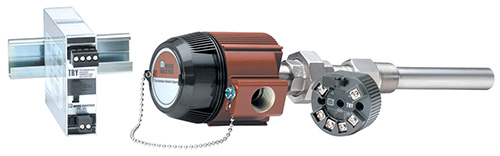
A: Model SPA/TPRG/2PRG/U/-AO [DIN] provides 0.25 mA RTD excitation current. If it is performing well then our PC configurable temperature transmitters, which have the same excitation current, should also perform well. In that case we recommend the TRY series. The head mount style is model TRY/PRG/4-20MA/10-42DC [LH2NS]
If your SPA has the SP2 option instead (Model SPA/TPRG/2PRG/U/-AO-SP2 [DIN] ), that option provides 5mA of excitation current to the 10 ohm RTD instead of the usual 0.25mA. This ensures that a robust input signal from the RTD to the SPA resists interference from the generator’s very strong electro-magnetic fields.
The choices available for a head mounted transmitter with similarly high current RTD excitation are limited. Bear in mind that the objective when designing RTD temperature transmitters is to reduce the excitation current as much as possible to minimize self-heating of the RTD, thereby maximizing the measurement accuracy.
Also due to the reduced power budget of loop powered transmitters there isn’t sufficient power available for the 5mA excitation current of the SP2 option.
A possible solution is one of our older analog loop powered transmitters, the RBX series, which has a relatively high excitation current of 1mA. The RBX, however, is a strictly analog design and must be specified according to the intended resistance range instead of temperature span. For example, for 10 ohm Cu and 0-200 deg C, the resistance is 9.035 to 16.776 ohms. The span is 7.741 ohms. The 7.741 span falls within the 3W5-10 input range.
The head mounted model number is: RBX/3W5-10/4-20MA/12-42DC/-EZ9 [BH2NS].
Do you want more information? Download the data sheet. Or visit the catalog.
Need to get price or availability or have a technical question?
Send us a message using E-Help.
 Making Product Selection and Ordering Easier
In 2015 Moore Industries’ flagship product line, Temperature Assemblies and Sesors, was expanded with two new product families: the THZ3 and TDZ3 Dual-Input Smart HART Temperature Transmitters, and the newest member of the Functional Safety Series, the SIL 3 capable STZ Functional Safety Smart HART Temperature Transmitter with Dual Sensor Input. These new products meant we needed to update all of our temperature assemblies and sensors data sheets including the Ready-to-Install series, Assemblies for High-Tech, and the WORM Flexible Sensor. These newly improved data sheets give you all the information you need to more easily select and order the right product for your temperature application.
All of these data sheets include new temperature notations on WORM sensors and improved ordering information to make it easier to select and order.
RTI Ready-to-Install Temperature Transmitter Assemblies for both Head-Mount Transmitters and Hockey-Puck Transmitters have the THZ3, TDZ3 and the STZ added.
Hi-Tech Temperature Monitoring Solutions for High-Tech Facilities and Processes is completely redesigned with order info included on the page with each product. It features:
- Surface-Mount Air Duct Averaging Temperature Monitoring
- Duct-Mount Temperature Assembly for Monitoring Clean Rooms and Air Ducts
- Wall-Mount Room Air Temperature Monitoring
- Bath Calibration
- Humidity & Temperature Solutions
The WORM Flexible RTD and Thermocouple Sensors for Thermowell Temperature Assemblies and the CAN OF WORMS Economical 10-Pack of WORM Flexible Sensors features new Dual sensors and updated order information.
You can download any of these using the links above.
Do you want more information? Download the data sheet. Or visit the catalog.
Need to get price or availability or have a technical question?
Send us a message using E-Help.

Q: I need confirmation that the THZ2 is a functional like-for-like replacement for the THZ and that basically it will perform the same.
A: With the exception of the THZ/PRG/4-20MA/12-42DC [DH2NG], which has an integral display, the THZ2 has all of the functions of the THZ and the same form and fit.
However, we suggest you consider the newer THZ3, since the THZ2 is being phased out (although it will continue to be available while supplies last). The THZ3 has all of the functions of the THZ2 and the same form and fit. The THZ3 offers additional functionality over the THZ2, can accept two sensor inputs, and utilizes PACTware for PC configuration in addition to HART programmability.
Other features found in the THZ3 that are not included in the THZ are:
- Backup and Fail-Over Protection allows either of the sensors or inputs to be designated as the primary measurement, with the secondary input acting as the backup sensor in case of primary sensor failure.
- Average and Differential Measurement allows you to average the two input measurements or select the differential (A-B or B-A) or absolute differential between the two inputs.
- High-Select and Low-Select Feature enables the transmitter to continuously monitor two separate inputs and designate either the highest or lowest input to represent the analog output.
- Dynamic Variable Mapping permits the user to assign either input or the calculated result of inputs to any of the four HART variables (PV, SV, TV or QV) that can be read by any HART compatible host system.
- Smart Range Alarms offer four HART alarms set to any input or calculated input that detect when the variable is within or outside user preset limits.
- High Availability Option enables the user to select how the AO behaves when there is an input failure or out-of-range value detected by the transmitter. This prevents nuisance alarms on startups or batch process shutdowns.
Download the THZ3 data sheet.
Do you want more information? Download the data sheet. Or visit the catalog.
Need to get price or availability or have a technical question?
Send us a message using E-Help.
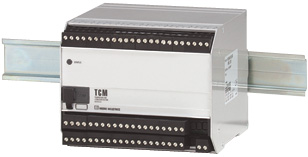 Q: You have a product called HART Interface Module that will pull the 2nd, 3rd and 4th HART variables from a smart HART transmitter and create one 4-20mA signal for each. Do you have or know of an instrument that will take three 4-20mA signals into it and place themdin on one 4-20mA signal as the 2nd, 3rd and 4th variable? I would like to read three transmitters on one 4-20mA signal by reading the variables on my DCS System.
A: We have three products that can take multiple analog inputs and provide that signal data in the form of HART protocol. Those products are the TCM and THZ3 / TDZ3, which are temperature input devices that can take a 4-20mA input across a resistor (shunt) as a mV input.
The TCM is a 16-channel temperature input module that can be polled by a HART master using a device-specific HART command. This HART command retrieves all 16 channels of PV data in one HART message packet.
The THZ3 Dual Input Smart HART DIN-Rail or Field Mount Temperature transmitter can accept two (but not three) 4-20mA signals and write them to two of the HART dynamic variables riding on the analog 4-20mA output signal.
The TDZ3 has the same functionality as the THZ3 but includes a display and can be field mounted in hazardous or non-hazardous areas or mounted on DIN-Rail.
Do you want more information? Download the data sheet. Or visit the catalog.
Need to get price or availability or have a technical question?
Send us a message using E-Help.
 Moore Industries’ Functional Safety Line Card gives you all the information you need to know about our line of products for process safety-related applications. This includes our line of FS Functional Safety Series products designed and built to strict IEC 61508 standards, ensuring safe and reliable function – particularly in environments where hazardous or emergency situations are likely to occur.
As with other Moore Industries line cards, the Functional Safety Line Card is available as a PDF download at our website. It gives an overview of the instrumentation that makes up our FS Functional Safety Series:
- STZFunctional Safety Dual Input Smart HART Temperature Transmitter
- SSX and SST Functional Safety Isolators and Splitter
- STA Functional Safety Trip Alarm
- SRM Functional Safety Relay Module
- SLD Functional Safety Programmable Display (2-Wire)
- SFY Functional Safety Frequency-to-DC Transmitter with Display
Along with the product information, the Functional Safety Line Card has valuable information for selecting the right Functional Safety instrument. The charts and safety-related information help determine whether instruments meet the required Safety Integrity Level (SIL) for use in a Safety Instrumented Function (SIF).
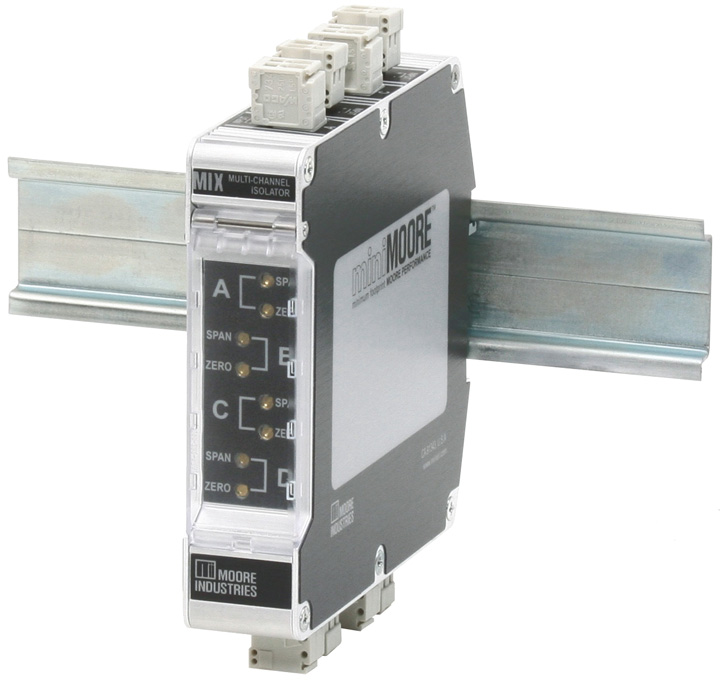 Q: I am looking to take a signal from an analyzer and send the analog output signal to four different locations. Do you have a product that can help me with this?
A: We offer a 4-channel output loop powered isolator and a line powered single input to dual output isolator.
If the receivers at the four locations can supply loop voltage to their respective 4-20mA inputs, then the 4-channel output loop powered MIX isolator (Model: MIX/4X4-20MA/4X4-20MA/12-42DC [DIN]) will work. Wire your 4-20mA signal in series to the four inputs of the MIX.
If the receivers at the four locations have passive (sinking) 4-20mA inputs, then you can either use two of the line powered ECT splitters or two of the dual channel MIT isolators (Models: ECT/4-20MA/2X420MA/117AC/-TX [DIN] or MIT / 2XPRG / 2X4-20mA / U [DIN]). Wire your 4-20mA signal in series to the inputs of the two ECT/MITs.
Do you want more information? Download the data sheet. Or visit the catalog.
Need to get price or availability or have a technical question?
Send us a message using E-Help.
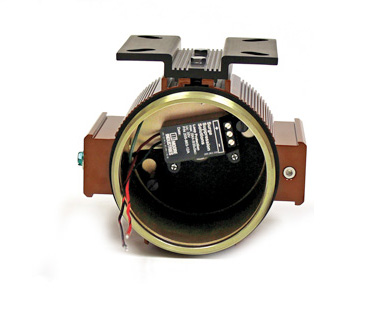 A surge suppressor kit is now available for use in the BH and SB housings with our field transmitters. This easy to install and wire kit is approved for use in Explosion Proof applications in the United States/Canada (cCSAus) and Australia/New Zealand (ANZEx).
Exceeding Severity Level 4 of 61000-4-4, the advanced surge suppressor provides 3kA(8/20μsec) of surge protection. Lightning-fast response time stops failures due to lightning, spikes, and overvoltage surges while minimizing other electrical noise. It can be used to suppress or protect both analog and HART digital/analog signal lines because of its ability to allow HART signals to pass through.
The surge suppressor works with many Moore Industries products including our temperature and signal transmitters, signal isolators and signal convertors. The kit is available as Part Number 205-863-12. Read the details in the data sheet available on the Surge Suppressor product page.
Do you want more information? Visit the catalog.
Need to get price or availability or have a technical question?
Send us a message using E-Help.

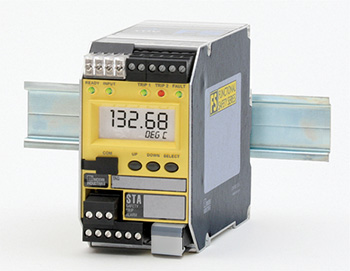 The SIL 2/3 capable STA Safety Trip Alarm performs as a logic solver and acts on potentially hazardous process conditions by providing emergency shutdown or early warning indication in Safety Instrumented Systems (SIS).
In response to customer feedback, the STA has been updated to provide more flexibility in handling input faults. This allows for spurious alarms to be minimized and for alarms to be cleared without power cycling or needing physical access to the unit.
New configuration options that have been added include:
- Out-of-range input tolerances can now be set from 0-5%. There is a 2% restriction in use for safety systems.
- Startup delay from 0-120 seconds, which allows instruments providing input to the STA to stabilize on power up.
- Input fault alarms can now be non-latching or cleared remotely using the Manual Reset terminals.
For more information, please download the latest versions of the Data Sheet and Installation Manuals available at the STA product page.
Do you want more information? Download the data sheet. Or see the Functional Safety Solutions in the catalog.
Need to get price or availability or have a technical question?
Send us a message using E-Help.

 Rob Stockham of Moore Industries-Europe delivered lectures earlier this month on the topic of “Producing High-Reliability Software for Instruments Used in Safety Applications.” The lectures covered the specifications, design, production and testing of firmware suitable for use in applications up to SIL 3 as defined by BS IEC 61508 Part 3.
The first lecture was to students at Liverpool John Moore’s University in the morning. This was followed up with an evening talk to the Central North-West Local Section of the Institute of Measurement & Control. A total of 39 people attended the two lectures.
“Thanks to Rob Stockham for presenting these lectures,” said Tom S. Nobles, Central North-West Programme Secretary for the Institute of Measurement & Control. “It’s particularly kind of him to lecture to the students. These young people represent potential future customers as well as people who need to interface with the industry and the measurement and control community in general. The attendance in the evening was also great, showing the interest and possible concern that users have about this subject.”
Rob said that he received positive interactions and feedback on the topic, although it was clear that more education is still needed on the topic. He was pleased that the EMPHASIS assessment tool and nuclear qualification of smart instruments were mentioned several times by lecture attendees.
Do you want more information? Download the data sheet. Or visit the catalog.
Need to get price or availability or have a technical question?
Send us a message using E-Help.
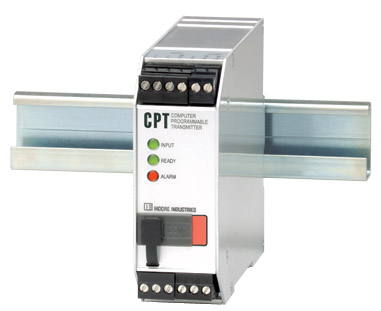 Q: I want to replace a THZ Temperature Transmitter (Model THZ/PRG/4-20MA/12-42DC [DIN]) with a CPT PC-Programmable Temperature Transmitter (Model CPT/TPRG/0-20MA/117AC/-C-RF [DIN]). The THZ unit we are replacing gets its power from the 4-20mA current loop while the CPT unit is going to be powered by 120Vac. Does the CPT need to be specified as "source" or "sink" to work as a drop-in replacement for the THZ unit?
A: The default version of the CPT provides voltage on its output (source). If you would like the output to be passive so it can be wired to an active (voltage supplied) input, specify the "-SINK" option. The CPT will still require 120Vac power on the power terminals.
Note that the newer two-wire output loop powered THZ3 Dual Input Smart HART Temperature Transmitter (Model THZ3/PRG/4-20MA/12-42DC [DIN]) is now available.
Q: My concern is that we will damage the unit or the equipment it is connected to it if we specify the wrong type of output. This unit will be connected to an Allen Bradley 4-20mA analog input module. The previous THZ device got its power from the analog input module so I believe the correct specification would be "sink" for the CPT. Is this correct? Also, can the "source" or "sink" option be changed in the field or does this have to be set at the factory?
A: You are correct that you will need to choose the "-SINK" option on the CPT. The choice of "source" or "sink" for the CPT must be specified in the model number and supplied from the factory that way. It cannot be field changed. Your complete model number for this application would be: CPT/TPRG/0-20MA/117AC/-C-RF-SINK [DIN]. Note that you have also selected an auxiliary alarm contact and enhanced RFI/EMI protection.
Do you want more information? Download the data sheet. Or visit the catalog.
Need to get price or availability or have a technical question?
Send us a message using E-Help.
 BPP Sales, Moore Industries' manufacturer’s representative for Louisiana and areas of southern Arkansas and Mississippi, held an Open House last month at their offices. We helped to make the event a big success by sponsoring the event and contributing one of the most popular prizes - a kayak with Moore Industries logo.
According to Regional Sales Manager Greg Feliks, several hundred people attended the event, which featured three bars, live music by the country group Parish-County Line and door prizes given away at the end of the night. Greg said that the kayak was one of the most popular items, with the emcee for the evening saying that Moore Industries "gets the Most Creative Giveaway Award." Greg even said that someone offered to buy the kayak from Marlene Bruce, the winner of the raffle, on the spot.
Moore Industries wants to help our manufacturer's reps with their events in any way possible. If you are a manufacturer's rep planning an event or tradeshow appearance and would like to partner with Moore Industries, contact your Regional Sales Manager.
Do you want more information? Download the data sheet. Or visit the catalog.
Need to get price or availability or have a technical question?
Send us a message using E-Help.
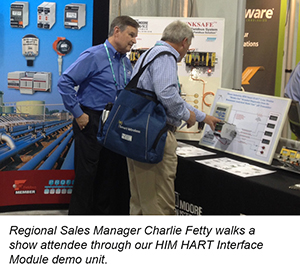 Moore Industries had a very successful time at the Emerson Exchange show last week in Denver. According to Marketing Manager Tom Watson, a prime position next to Emerson’s “theater” helped to ensure a steady flow of traffic to the booth during the event.
“For the first day of the show on Monday, traffic to the Moore Industries booth was the heaviest that I have experienced in any previous Emerson Exchange,” Tom said. “It was non-stop with visitors from all over including Kuwait, Trinidad & Tobago, Argentina, Saudi Arabia, Peru, Ecuador, Chile and the US. Our booth was located right next to the Emerson ‘Theater’ at one end of the hall which had a steady stream of conference and exhibit attendees listening to a variety or presentations. In the Moore Industries booth, we talked with a wide spectrum of visitors from veteran Moore Industries customers to users who were unfamiliar with our company and products. There was significant interest in Fieldbus solutions from South American visitors, and several people asked about our HART and Functional Safety products.”
Moore Industries’ next event is the FieldComm Group’s FOUNDATION Fieldbus End User Seminar in Long Beach, CA on November 5. Registration is currently open for the show.
Do you want more information? Download the data sheet. Or visit the catalog.
Need to get price or availability or have a technical question?
Send us a message using E-Help.
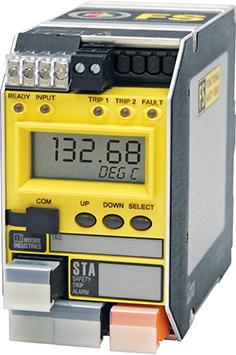 Q: I need to use the STA Safety Trip Alarm in a hardwired panel. Is it possible to configure two different levels of alarm for each of two relays in the STA, in order to have two different trips (one for each relay)?
A: Only one set point can be assigned to each alarm relay of the STA. However the dead-band is adjustable from 0% to 100% of the input span. Therefore you can specify one signal level at which the relay engages and another for when it disengages. If your input signal is 4-20mA, you can connect it in series to the inputs of two STAs in order to obtain 4 independent relay/setpoints.
Q: To clarify my situation: if I have a 0 to 100 bar transmitter, can I trigger Relay 1 at 25 bar and Relay 2 at 75 bar? We need to do this in order to shut down two different pieces of equipment at these pressure levels.
A: This is a typical function of the STA. One relay setpoint is often used for a warning at one level while the second relay setpoint is used for shutdown at the next level.
Do you want more information? Download the data sheet. Or visit the catalog.
Need to get price or availability or have a technical question?
Send us a message using E-Help.
 Moore Industries has updated our Temperature Solutions Line Card. Now available for digital download at our website, the line card reflects recent additions to our line of temperature-related products including the THZ3 and TDZ3 Dual Input Smart HART Temperature Transmitters and the STZ Functional Safety Dual Input Smart HART Temperature Transmitter.
The line card has new information on the use of our temperature products in hazardous areas. The STZ and the STA Safety Trip Alarm are both SIL 3-capable, exida-approved products in our line of FS Functional Safety Series products. These products have been designed and built to strict IEC 61508 standards for use in a Safety Instrumented System (SIS), ensuring safe and reliable function – particularly in environments where hazardous or emergency situations are likely to occur. Other products in the FS Functional Safety Series are the SSX and SST Functional Safety Isolators and Splitter and the SRM Functional Safety Relay Module.
All of our product line cards are available for download at our website.
Do you want more information? Download the data sheet. Or visit the catalog.
Need to get price or availability or have a technical question?
Send us a message using E-Help.

The SIL 3-capable STZ Functional Safety Dual Input Smart HART Temperature Transmitter has several features designed to reduce process interruptions safely in your SIS. One of the most important is the new dual sensor input that allows for Backup and Fail-Over Protection, which is the topic of a new Problem Solver on the Moore Industries website.
This example of a potential real-world application focuses on reducing the risk of exothermic reactions in batch reactors. These reactions can create thermal runaways where rising temperatures can lead to dangerous conditions. Backup and Fail-Over Protection allows either of the sensors or inputs to be designated as the primary measurement, with the secondary input acting as the backup sensor in case of primary sensor failure. This helps to mitigate potential thermal runaways before they become dangerous.
Visit the Problem Solvers section of our website to see more applications featuring the range of Moore Industries’ products.
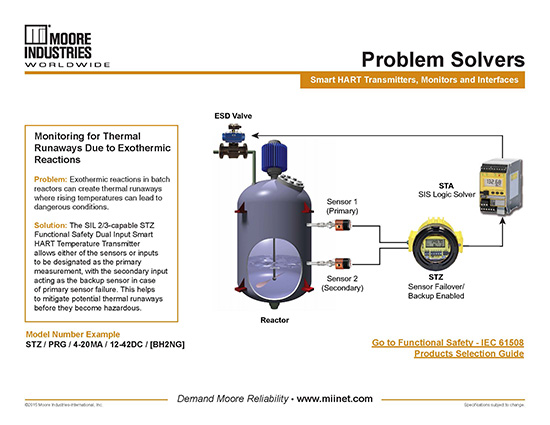
Do you want more information? Download the data sheet. Or visit the catalog.
Need to get price or availability or have a technical question?
Send us a message using E-Help.

Moore Industries has released a video highlighting the features of our STZ Functional Safety Dual Input Smart HART Temperature Transmitter family. You can view the video at our Interface Solution Video Library or watch it below:
Part of the FS Functional Safety Series, the exida approved, SIL 3-capable STZ family provides an isolated and linear 4-20mA output proportional to the input with advanced features that give you far more control over your temperature measurements. This includes a dual sensor input that reduces process interruptions. Backup and Fail-Over Protection allows either of the sensors or inputs to be designated as the primary measurement, with the secondary input acting as the backup sensor in case of primary sensor failure. The dual sensor input also allows for Average and Differential measurements along with High-Select and Low-Select options.
The STZ family includes a wide range of housing options, all of which are shown in the product video. This is just one of the informative videos available for viewing at our Interface Solution Video Library. Along with videos highlighting product features, the library also includes videos showing real world examples of applications using our products.
Do you want more information? Download the data sheet. Or visit the catalog.
Need to get price or availability or have a technical question?
Send us a message using E-Help.
Q: We are in need of a signal converter that converts a 4-20mA logarithmic signal into a 4-20mA linear signal. We need one input and one output per device. Do any of your devices perform this function?
A: We offer several models of signal converters which have look-up table linearization/characterization capability.
The SIY is an output loop-powered unit that can be configured for up to 85 ordered pairs. With this model, each ordered pair must be keyed in using the provided configuration software.
The CPT is a line-powered model that can be configured for up to 128 ordered pairs. The ordered pairs are computed with a spreadsheet, saved as a two column CSV file and then loaded into the provided configuration software. The configuration is then loaded into the CPT.
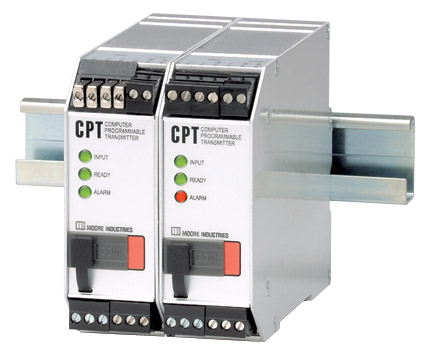 With both models you specify the X and Y values so you can cluster points at the most non-linear part of your table.
Do you want more information? Download the data sheet. Or visit the catalog.
Need to get price or availability or have a technical question?
Send us a message using E-Help.
Q: We are a boiler/burner company dealing with a rising amount of computer-based burner controls. We have installed several and have some blowers that are controlled by VFDs (Variable Frequency Drives). We have run into issues with noise on certain systems. We get occasional problems with 4-20mA feedback from the VFD despite going through the proper grounding techniques. We are wondering if installing an opto isolator on the feedback loop might eliminate our issue. We have used the SIX Signal Isolator many times on the signal going to the VFD to offset impedance issues on the VFD. Can we put an opto isolator on both signals?
A: Whether the SIX or another isolator will cure your problem depends on the nature of the noise and how the loop is energized. Sometimes you can install an isolator without additional analysis and see if it works.
If you have data about the noise, compare it to the noise rejection specification of the isolator. For example, the Common Mode Rejection for the ECT-DIN Signal Isolator exceeds 95dB @ 60Hz with a limit of 1500 Vrms.
When selecting the appropriate isolator, take into account which device is providing the loop voltage on the input and output sides. Per the ECT datasheet, you can see that it is available as an output loop powered, input loop powered or line powered device.
Do you want more information? Download the data sheet. Or visit the catalog.
Need to get price or availability or have a technical question?
Send us a message using E-Help.
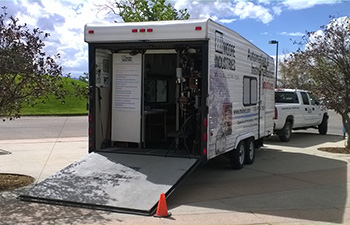 Senior Sales Engineer JR Madden took the Moore Industries Instrumentation Trailer on the road to the Wyoming Oil and Gas Fair in Casper last month. He was able to get a prime “parking space” for the trailer as well – right between the main parking lot and the show entrance. It was a very popular show with an estimated attendance of 1,000. JR said that the attendees who stopped by the trailer were high-level employees interested in our instrumentation for the oil and natural gas industries.
Being able to set up shop outside of the show floor is an excellent advantage of having the Instrumentation Trailer. JR is able to get on the road and bring our range of instrumentation solutions to the public, both by attending trade shows and going on site to customers in conjunction with our reps.
Moore Industries will be at another big event next week as we will be one of the exhibitors at the Emerson Global Users Exchange 2015 from October 12-16 in Denver. If you are attending the show, make sure to stop by and see the latest instrumentation. We’ll be at Booth 212 next to the Integrated Operations section.
Do you want more information? Download the data sheet. Or visit the catalog.
Need to get price or availability or have a technical question?
Send us a message using E-Help.
The Moore Industries SIL 3-capable STZ Functional Safety Smart HART Temperature Transmitter family, part of the FS FUNCTIONAL SAFETY SERIES, is a dependable and accurate temperature transmitter for use in Safety Instrumented Systems (SIS) where dangerous processes occur. The STZ has been certified by exida after rigorous evaluation to ensure conformance with strict IEC 61508:2010 standards for safety-related applications.
The STZ offers a dual sensor input that reduces process interruptions. Backup and Fail-Over Protection allows either of the sensors or inputs to be designated as the primary measurement, with the secondary input acting as the backup sensor in case of primary sensor failure. The dual sensor input also allows
for Average and Differential measurements along with High-Select and Low-Select options.
The STZ also features Moore Industries’ Device Intelligence, a series of features designed for smarter control and monitoring including:
- Sensor drift and corrosion detection that checks and alerts users when the sensor is drifting out of a preset range or when the resistance due to corrosion exceeds set parameters.
- Smart range alarms with four HART alarms – set to any input or calculated input – that detect when the variable is within or outside of user preset limits.
- A High Availability option that enables the selection of how the AO behaves when there is an input failure or out-of-range value detected by the transmitter. This helps prevent spurious trips or nuisance alarms in Safety Instrumented Systems (SIS).
- Input simulation capability allowing manual input of a direct or calculated value. This essentially simulates a real input, allowing users to test the AO or any HART diagnostic and range alarms – which assists in proof test procedures.
The STZ is HART 7 compliant with exception-based reporting and dynamic variable mapping. It is HART and DTM programmable with user-oriented basic configuration for fast and accurate setup. Utilizing the HART DD, it can be configured and interrogated on the 4-20mA loop via any HART handheld communicator or HART compatible host. To prevent unauthorized or accidental reconfiguration of the STZ while it’s performing its safety function, it has an added security feature to allow users to set HART communication into a Read Only or Off mode. Users can also program or monitor the transmitter with any FDT compliant host or program such as PACTware using the STZ DTM.
The intrinsically-safe -AIS option for the STZ-DIN allows direct connection of sensors located in hazardous locations by including an embedded intrinsically-safe barrier in the front end of the STZ-DIN. The STZ-DIN -AIS is an associated apparatus suitable for mounting in Non-Hazardous or Class I, Division 2/Zone 2 hazardous locations with sensor input terminals connected to sensors or equipment in Class I, II, III, Division 1/Zone 0/1 hazardous locations.
See a video highlighting the key features of the STZ at our Interface Solution Video Library.
Do you want more information? Download the data sheet. Or visit the catalog.
Need to get price or availability or have a technical question?
Send us a message using E-Help.
The STA Safety Trip Alarm datasheet and installation manuals have been updated. The new change reflects the addition of a Universal power supply to the unit. Previously, customers needed to select either a 24DC or UAC power supply. The new Universal power supply accepts any power input range between 21.6-375Vdc or 90-260Vac.
Adding the Universal power supply option simplifies the ordering process for customers. In addition, it makes it easier for customers to plan additions or upgrades to their facilities without having to worry about the type of power being used.
The specifications in the datasheet and installation manuals have also been changed to reflect the new Universal power supply. Updated specs include Power Supply, Power Consumption and Alarm Trip Delay. In addition, the Relative Humidity specs have been updated.
Do you want more information? Download the data sheet. Or visit the catalog.
Need to get price or availability or have a technical question?
Send us a message using E-Help.
Sensor drift is a common problem that can lead to inaccurate temperature measurement readings. It can be caused by several factors including environmental contamination, vibration or extreme temperature fluctuations. Because this drift causes the measurement error to get worse over time, it’s not possible to calibrate out the error. Traditionally, reducing inaccurate measurements caused by sensor drift has meant undertaking a regular and time-consuming preventative maintenance calibration program.
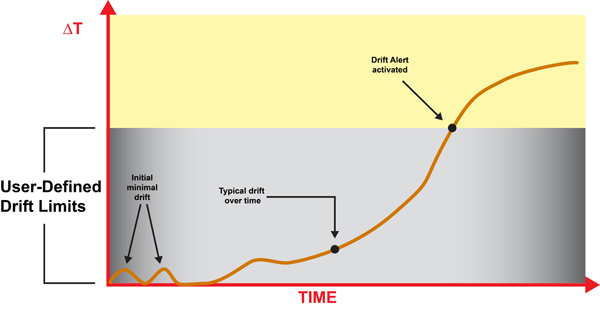
You can avoid having to do constant preventative maintenance to avoid inaccurate temperature readings by using the THZ3 and TDZ3 Dual Input Smart HART Temperature Transmitters. The Drift Alert feature lets you configure the transmitter to monitor the differential between the readings of the dual sensors. If the readings drift apart by an amount greater than your preset range, an out-of-range warning or alarm is triggered. This alerts plant engineers that maintenance is needed.
This sensor drift alert can be configured to send a drift alert via HART or you can drive AO to your preferred fail state.
If your BPCS does not have HART inputs cards, you can use the HIM Smart HART Loop Interface and Monitor to deliver the HART alarms and diagnostic data via relay contacts.
Interested in learning more tips for getting accurate temperature readings? Read our “A Practical Guide to Improving Temperature Measurement” white paper.
Do you want more information? Download the data sheet. Or visit the catalog.
Need to get price or availability or have a technical question?
Send us a message using E-Help.
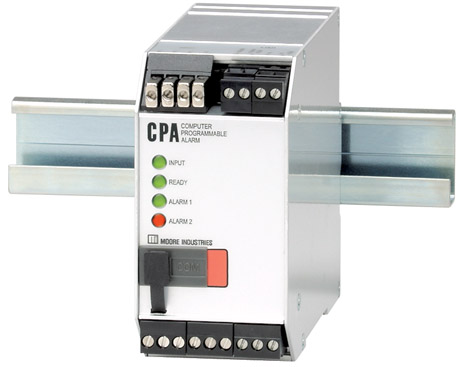 Q: I am looking for a device to create a temperature switch. I currently use a simple temperature switch with a 230°F setting, but at times the temperature of the unit goes over 400°F briefly and destroys the switch. I need to be able to hook a thermocouple up to the device and program a setpoint (with no display required) and have a set of dry contacts open when the temperature rises above the setpoint.
A: Our model CPA PC-Programmable Alarm can accept a thermocouple or RTD input and trip a relay based on the setpoint that you have configured. It can be configured using our software and a USB cable.
Do you want more information? Download the data sheet. Or visit the catalog.
Need to get price or availability or have a technical question?
Send us a message using E-Help.
 Moore Industries has integrated PACTware into the range of monitoring and configuration options available with products including the STZ Functional Safety Dual Input Smart HART Temperature Transmitter and the THZ3 and TDZ3 Dual Input Smart HART Temperature Transmitters. Using an FDT host such as PACTware with a DTM is quickly becoming a worldwide standard as customers search for a universal method of programming, monitoring and diagnosing their field instruments. FDT/DTM technologies eliminate problems caused by vendors having different software programming packages or programming for multiple protocols (such as HART, FOUNDATION™ Fieldbus and PROFIBUS PA). Moore Industries has integrated PACTware into the range of monitoring and configuration options available with products including the STZ Functional Safety Dual Input Smart HART Temperature Transmitter and the THZ3 and TDZ3 Dual Input Smart HART Temperature Transmitters. Using an FDT host such as PACTware with a DTM is quickly becoming a worldwide standard as customers search for a universal method of programming, monitoring and diagnosing their field instruments. FDT/DTM technologies eliminate problems caused by vendors having different software programming packages or programming for multiple protocols (such as HART, FOUNDATION™ Fieldbus and PROFIBUS PA).
We’ve put together a single place for all the resources you’ll need to utilize PACTware. You can visit our PACTware Resource Center to get all the downloads and information you’ll need to set up and configure your instruments or to perform monitoring and diagnostic capabilities.
This includes:
PACTware Configuration Software and DTMsDevice DTMsMISP Comm DTMWhile on the resource page, you can also view a tutorial highlighting the basics of PACTware by Moore Industries Director of Customer Service Bob Croughwell.
Do you want more information? Download the data sheet. Or visit the catalog.
Need to get price or availability or have a technical question?
Send us a message using E-Help.

Many plants have process stages with several points of temperature that have to be monitored. Many of these measurements are critical and thus will utilize dual elements or fully redundant sensors.
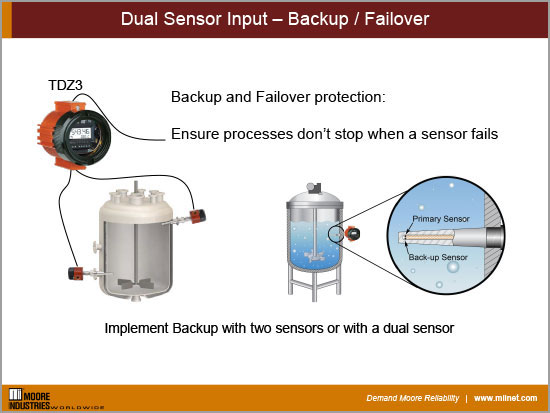
When these critical measurement needs arise and you can’t afford to have your process shut down, look to the THZ3/TDZ3 Smart HART Dual Input Temperature transmitters that allow you to configure the transmitter for a failover or backup mode. When the primary sensor fails the TDZ3 automatically switches to the backup sensor and the failure is reported via HART diagnostics and display. The THZ3/TDZ3 transmitter family can be HART or DTM programmed and carries worldwide approvals.
Key Attributes:
- Backup or Failover mode on primary sensor failure
- HART or DTM programmable
- Worldwide hazardous area approvals
Nuclear plants are sometimes required to monitor their spent nuclear fuel onsite before sending it off for permanent disposal handing. Casks are used to store this fuel and the temperature of this spent fuel is monitored very closely looking for any rapid temperature change, which is an early alert to potential problems.
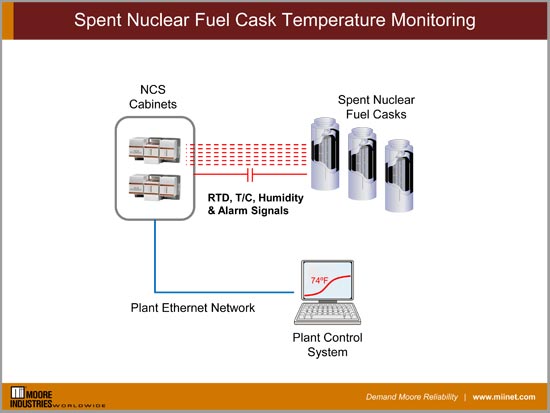
The NCS Net Concentrator System Ethernet Remote I/O System is an ideal choice for cask temperature monitoring. The NCS accepts any TC or RTD and transmits that data over the plant’s Ethernet backbone to their control system and historian. Since the NCS is field expandable, as they add more fuel and casks the additional points are easy to add and immediately accessible to the historian and control system.
Key Attributes:
- RTD and TC to Ethernet conversion
- -40 to 85C ambient operating specifications
- Embedded webserver for temperature viewing and programming via any web browser
Some plants have processes that create explosive atmospheres. When alarming is required on points that are in these locations consider using an Associated IS alarm trip, especially when the method of protection is Intrinsic Safety (IS). When IS is chosen as the facility’s protection method, intrinsically safe barriers for all of the 4-20mA, RTD and TC signals can be quite expensive, engineering intensive and space consuming.
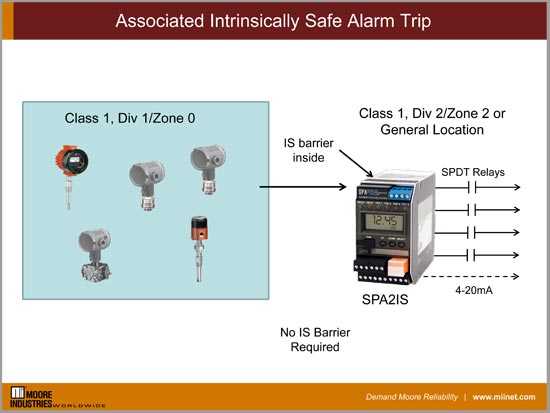
The SPA2IS Site Programmable Alarm Trip is considered an associated IS device because it has the IS barrier embedded in the device so it can connect to temperature elements and transmitters that are located in Class I Div 1 or Zone 0/1 hazardous areas. This saves time and money since traditional IS barriers and the associated marshaling cabinet is no longer needed. The SPA2IS is approved for installation in Class I Div 2/Zone 2 areas and has four programmable SPDT relays and an optional auxiliary analog output.
Key Attributes:
- IS barrier built into SPA2IS, reducing needs for external IS barriers
- Easy programming with free PC software or push buttons
- Four programmable SPDT relays with auxiliary analog output

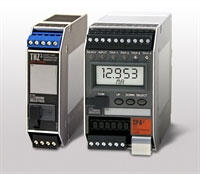 Challenge: Measure inlet and outlet temperature of a process heater using existing three-wire RTDs and provide a 4-20mA process variable signal, representing the differential temperature across the heater, to a local alarm trip for heater protection and share that differential temperature signal with the Basic Process Control System (BPCS). The measurements are in a hazardous area and plant standards require the use of a certified IS system.
Solution: The THZ3-DIN Dual Input Temperature Transmitter with the Associated IS (AIS) option and SPA2 Alarm Trip with self diagnostics capability, and local display/alarm status indicators.
Result: Successful measurements to the BPCS of inlet and outlet temperature, temperature differential, sensor diagnostics, transmitter diagnostics using HART to the BPCS.
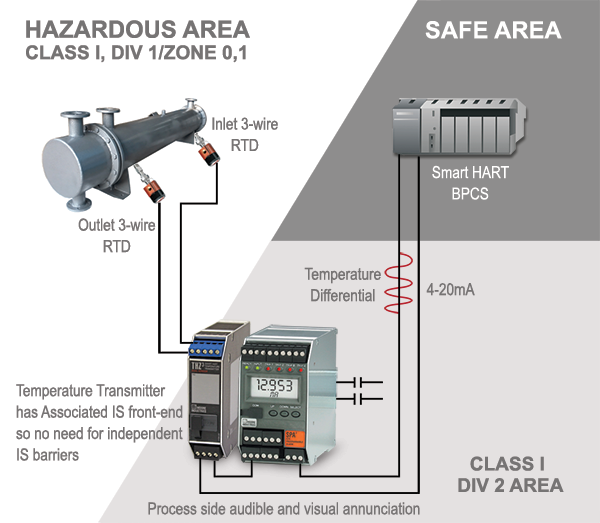
Summary: The customer needed to measure inlet and outlet temperature of a process heater using existing three-wire RTDs and provide a 4-20mA process variable signal, representing the differential temperature across the heater, to the BPCS controller. The measurements are in a hazardous area and plant standards require a certified IS system. Utilizing the associated IS and dual RTD input capability of the THZ3 temperature transmitter, the heater’s differential temperature 4-20mA signal was wired in series to a local alarm trip and host BPCS.
The process side alarm trip provided visual and audible heater failure warning and indication while the host BPCS maintained primary control and master alarming capability. Additionally, the HART diagnostics from the THZ3 allowed the BPCS to constantly monitor key parameters such as RTD drift, broken sensors and critical transmitter diagnostics.
Providing a local process side alarm trip substantially saved wiring and operation costs since new signal wires (RTD and alarm) didn’t have to be pulled to support the newly desired local alarms, two IS barriers were not needed for the RTD wires back at the BPCS location, sensor diagnostics continuously monitored by the BPCS and local differential temperature calculation and indication can now be done in the field.
Many facilities typically use a lot of thermocouple extension wire. Thermocouple extension wires are not only expensive but are a primary culprit of measurement error over time. Corrosion and susceptibility to plant noise are common sources of measurement error due to long TC extension wire runs.
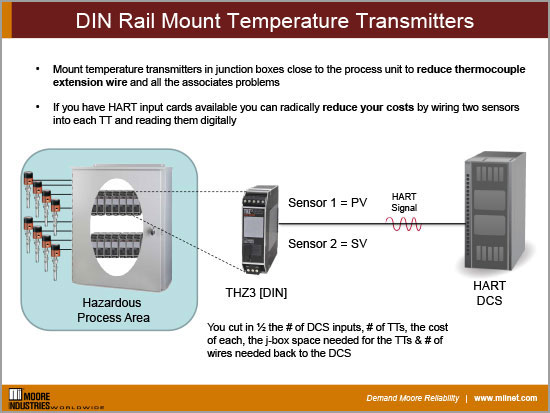
You can reduce these expenses and measurement errors by taking a different approach to installing DIN rail temperature transmitters in the field, close to the process, and running shielded twisted pair back to the DCS. The Class I Div 2/Zone 2 approved THZ3 Smart HART Dual Input Temperature Transmitter is a highly accurate and repeatable DIN rail temperature transmitter with advanced diagnostics. If your control system’s input cards can read HART, you can further reduce your measurement cost per point by bringing two sensors to each THZ3 and reading the PV and SV dynamic HART variables, which represent Sensor 1 and Sensor 2 respectively.
Key Attributes:
- Class I Div 2/Zone 2 approved DIN version of THZ3
- Dual input capability may reduce cost per point
- High ambient operating temperature range of -40 to 85C (-40 to 185F)
Temperature is one of the highest volume measurements in most plants. Reducing the cost of these measurements, that are often in hazardous areas, is always a top priority.

When you have several temperature points that are located in safe or hazardous areas, look to the TCS Temperature Concentrator System. The TCS consists of one or two TCMs and an HMC. The TCM is a 16 channel universal temperature multiplexer that communicates to the HMC via HART. The HMC in turn converts the HART temperature data into MODBUS RTU protocol for the BPCS to read. The TCM can be installed in Class I Div 1/Zone 0 areas and can multiplex up to 32 channels of temperature per HMC. This drastically reduces the temperature cost per point as opposed to running sensor extension wire all the way back to the DCS or control room.
Key attributes:
- 32 channels of multiplexed temperature reduces cost per point
- PC programmable TCM and HMC with free programming software
- Worldwide hazardous area approvals

Facilities have several signals that need to get back to a centralized control room. Often it is not cost effective or even possible to run many hundreds of twisted pair cables back to a central location.
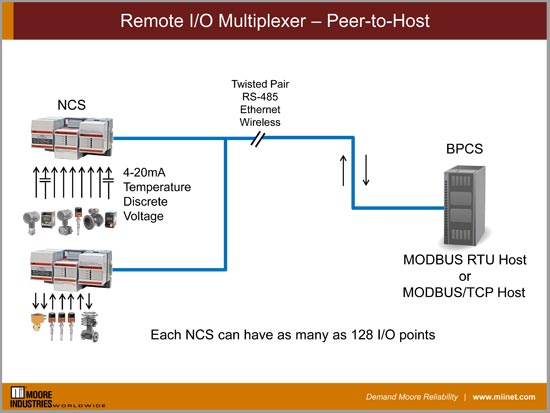
When such a requirement exists, consider the NCS Net Concentrator System Remote I/O system. Each NCS can have inputs and outputs tied to it and communicates over Ethernet, twisted pair, RS-485, fiber, or even wirelessly with the addition of a radio system. The NCS includes an embedded web server that can be used for viewing real-time process data and can be used for programming. Unlike many other remote I/O systems, the NCS was designed with field installation in mind and therefore has an ambient operating temperature specification of -40 to 85C and has full channel-to-channel isolation. The NCS is rated for Class I Div 2/Zone 2 installations and includes input and output modules that handle current, voltage, temperature sensors, discretes and relays.
Key Attributes:
- Wide range of I/O types and number of points
- Class I Div 2/Zone 2 approval and -40 to 85C ambient operating temperature specification
- Expandable to handle thousands of I/O points
Many facilities have several signals that need to get back to a centralized control room or need to be shared with another part of the plant. Ideally, there is always enough extra shielded twisted pair that can be used when signals or transmitters need to be added. Unfortunately, there never seems to be enough spare wire for these situations.
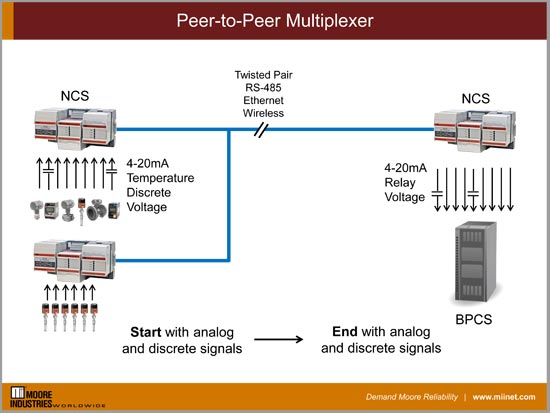
When such a requirement exists consider the NCS Net Concentrator System as it allows you to utilize just one pair, or any other medium that is available, to multiplex and digitally transmit analog and discrete signals to any other part of the plant. The NCS was designed for these exact peer-to-peer applications and has a programming interface that is extremely easy to setup with no complex programming involved. Multiple NCS stations can be set up over the network to create a very flexible peer-to-peer communication network. The NCS is designed for Class I Div 2/Zone 2 environments and includes input and output modules thathandle current, voltage, temperature sensors, discretes and relays.
Key Attributes:
- Wide range of I/O types and number of points
- Suitable for installation in Class I Div 2/Zone 2 areas and -40 to 85C ambient operating
- Peer-to-peer addressing allows network flexibility
The fermentation process in the manufacturing of beer requires tight and accurate temperature monitoring and control.
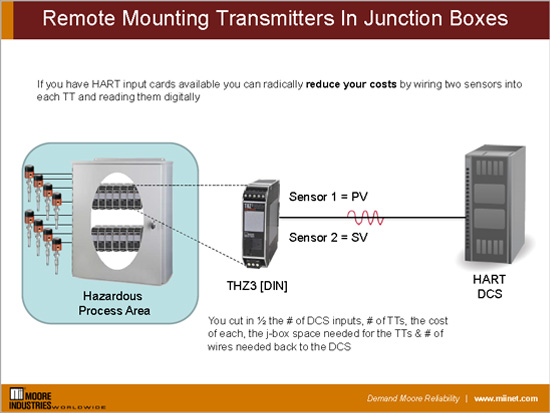
Rather than installing expensive field mounted temperature transmitters per point, consider direct wiring the RTD lead wire to a centralized cabinet. This allows for less expensive, and easier to maintain, DIN rail temperature transmitters to monitor fermentation temperatures.
The two-wire loop-powered THZ3 Smart HART Dual Input Temperature Transmitter is a highly accurate and repeatable DIN rail temperature transmitter with advanced diagnostics. If your control system’s input cards can read HART, you can further reduce your measurement cost per point by bringing two sensors to each THZ3 and reading the PV and SV dynamic HART variables, which represent Sensor 1 and Sensor 2 respectively.
Key Attributes:
- Cost-effective and compact DIN unit with highly accurate and repeatable measurement capability
- Dual input capability may reduce cost per point
- High ambient operating temperature range of -40 to 85C (-40 to 185F)
Accurate and repeatable temperature control batch processes for many industries is paramount. Several batch processes cannot be validated for sale or distributed unless accurate temperature control is maintained and documented.
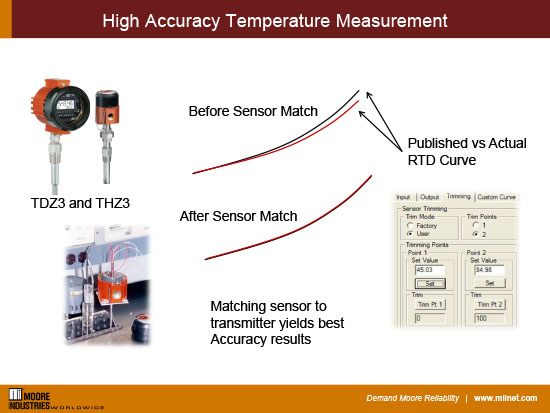
When the best accuracy is required, look to using the TDZ3 or THZ3 Smart HART Temperature Transmitters with sensor matching for optimum performance. The RTD and transmitter will be match and calibrated together in our NIST traceable calibration lab and are supplied with a full traceability calibration report. The TDZ3 and THZ3 have a 20-bit front end A/D to allow the most precise trimming capabilities to ensure that the as found RTD curve is adjusted to the published RTD curve for most accurate measurements.
Key Attributes:
- 20-bit front end A/D allows industry-best calibration and measurement
- NIST traceable calibration and report
- Worldwide hazardous area approvals
Process units in food and pharma facilities require a lot of high-profile temperature measurements. Due to the batch process nature of this industry, temperature ranges and settings change often.
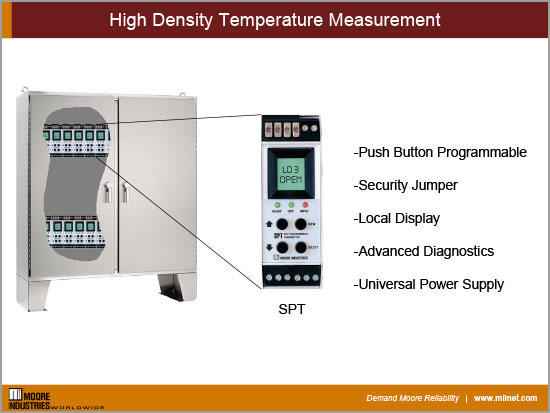
The SPT Site Programmable Temperature Transmitter is an ideal choice when measurement ranges change and high density is required. A local indicator allows operators to view current process temperature and allows easy re-configuration for different batches, as opposed to having to find and use a hand-held programmer. A security jumper is available on the unit that allows read/write access or read-only. The SPT includes advanced sensor diagnostics with an optional alarm relay.
Key Attributes:
- Local display
- Allows local pushbutton programming with security
- Enhanced sensor diagnostics

 Part of the Moore Industries FS FUNCTIONAL SAFETY SERIES, the exida® SIL 2 and SIL 3 certified STA Safety Trip Alarm performs as a logic solver and acts on potentially hazardous process conditions; warns of unwanted process conditions; provides emergency shutdown; or provides on/off control in Safety Instrumented Systems (SIS) and traditional alarm trip applications.
The 4-wire (line/mains-powered) STA models accept a signal input from transmitters, temperature sensors and a wide array of other monitoring and control instruments including:
- Current and Voltage Signals
- Temperature (RTD and T/C) Sensor Inputs
- Resistance and Potentiometer Devices
- Direct Millivolt Sources
Do you want more information? Download the data sheet. Or visit the catalog.
Check out the STA Safety Trip Alarm
Need to get price or availability or have a technical question?
Send us a message using E-Help.